What you will learn: How to apply the provider reliability stack, a three-layer fault-attribution model, in real time. After reading this, you can assign any payment failure to its correct layer within minutes and take the right remediation action before a post-mortem is even scheduled.
The thesis is direct: most payment teams blame the provider when the failure was in their own routing configuration, and blame their configuration when the failure was in the rail. The reason is not carelessness. It is the absence of a model for distinguishing the two under pressure. This piece gives you that model.
Key takeaways
- Three distinct layers produce three distinct failure signatures. Treating them as one delays recovery and misdirects engineering effort.
- Rail failures are visible across all providers simultaneously. A single-provider degradation is always a Layer 2 event, not a rail event.
- Configuration failures are the most common and the most fixable. They are also the most likely to be misdiagnosed as provider problems.
- Automated fallback routing limits Layer 2 blast radius, but only if the fallback chain is configured and active before the incident.
- The model works in minutes. You do not need a post-mortem to assign a layer. You need three triage questions.
Why misattribution is the real failure mode
When an approval rate drops, the first instinct is to call the provider. That instinct is wrong often enough to cost real revenue.
Consider what actually happens during a production incident. The monitoring alert fires. Someone opens a ticket with the provider. The provider's support team asks for transaction IDs. Twenty minutes pass. Meanwhile, volume is draining.
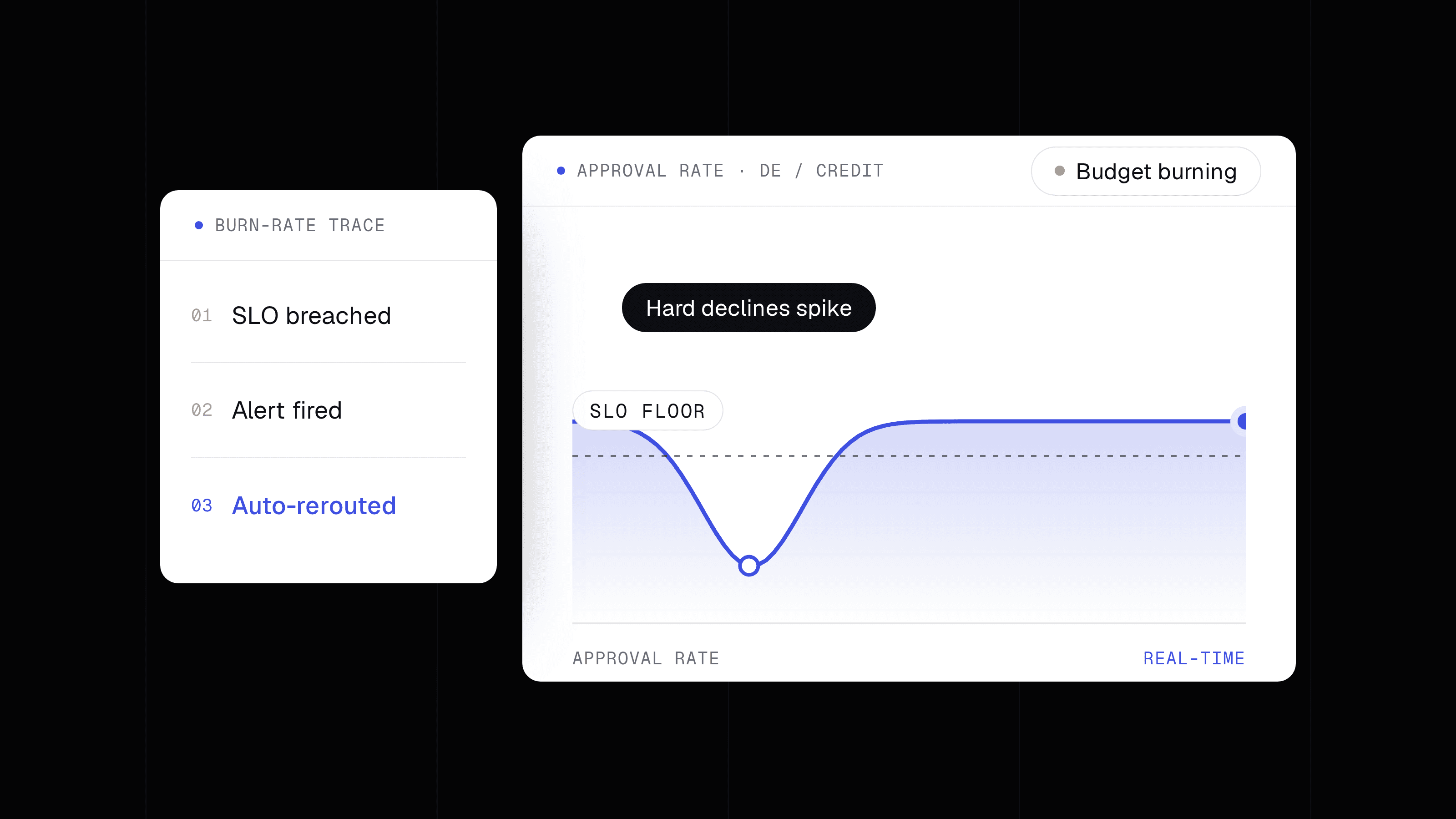
If the root cause was a misconfigured fallback chain, the provider ticket accomplishes nothing. The fix was always one routing-rules change away. According to the Yuno Monitors Documentation, upon detecting low approval rates, the system automatically redirects payments to fallback providers, keeping a small portion on the original provider to watch for recovery. That automation only works if the fallback chain was configured correctly in the first place. When it was not, the alert fires and nothing catches the volume.
The inverse error is equally damaging. A team rewrites its routing configuration during a scheme-level outage. The outage ends. The rewritten config introduces a new bug. Now the team has two problems where it had one.
The three-layer model defined
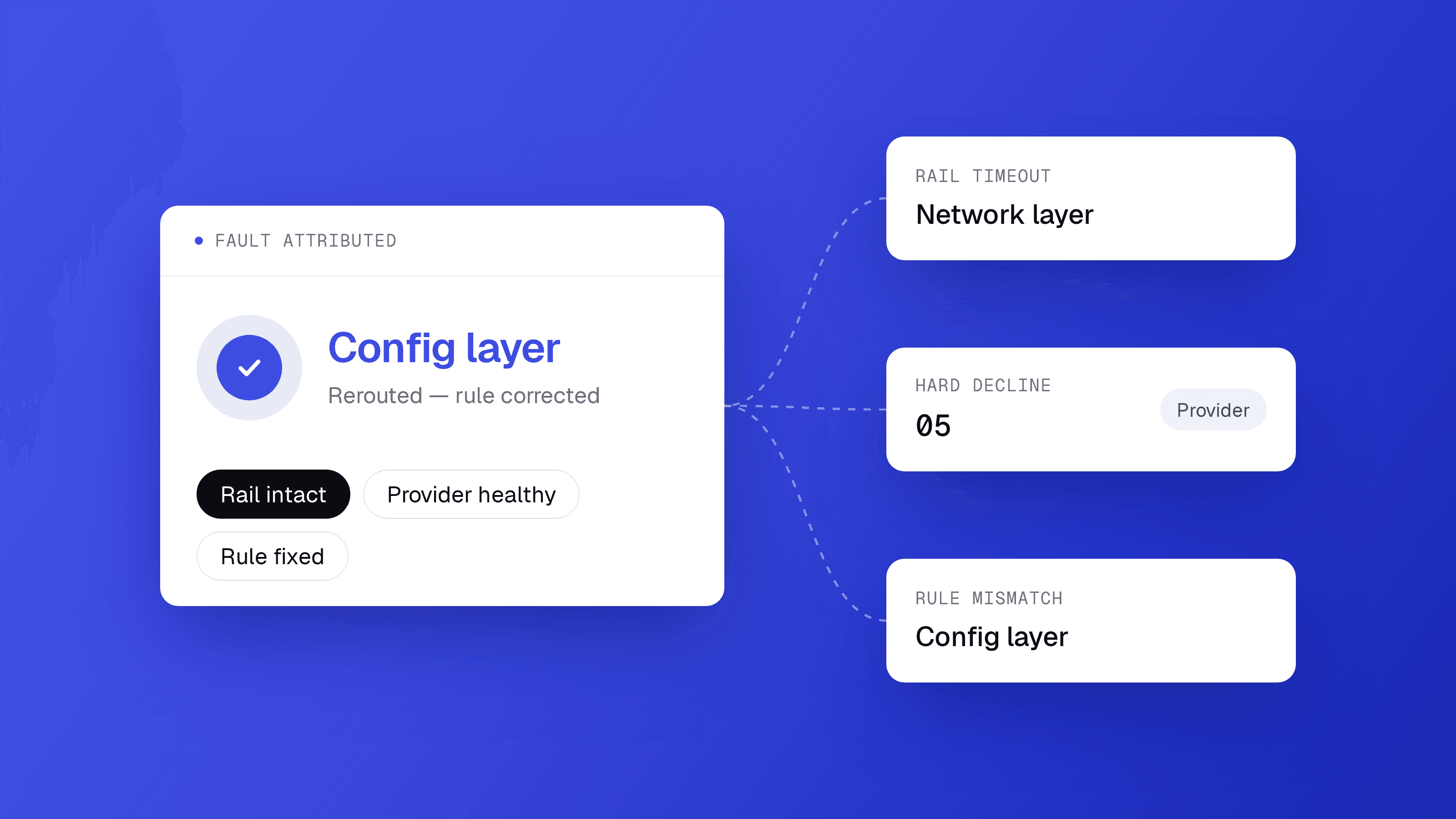
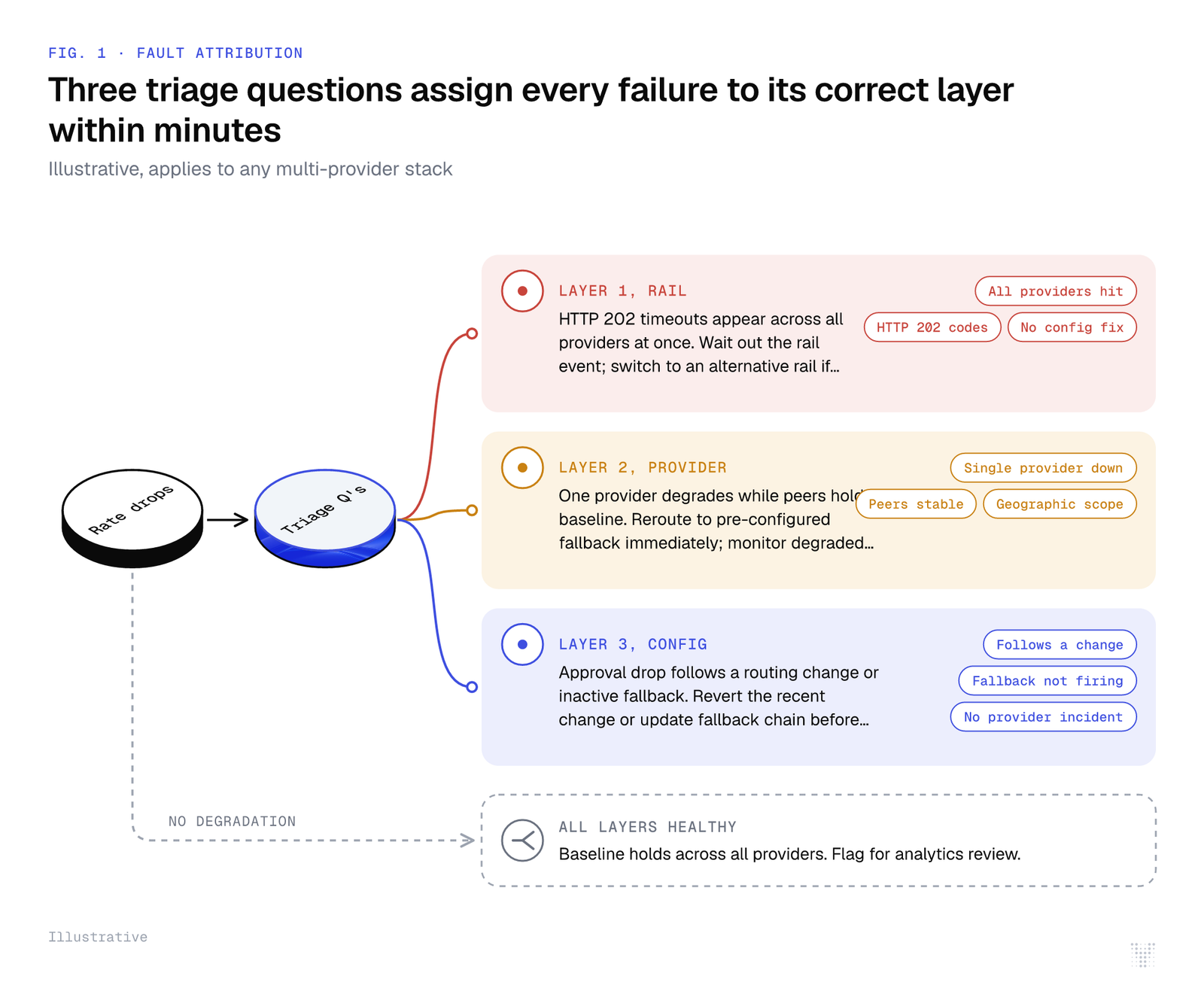
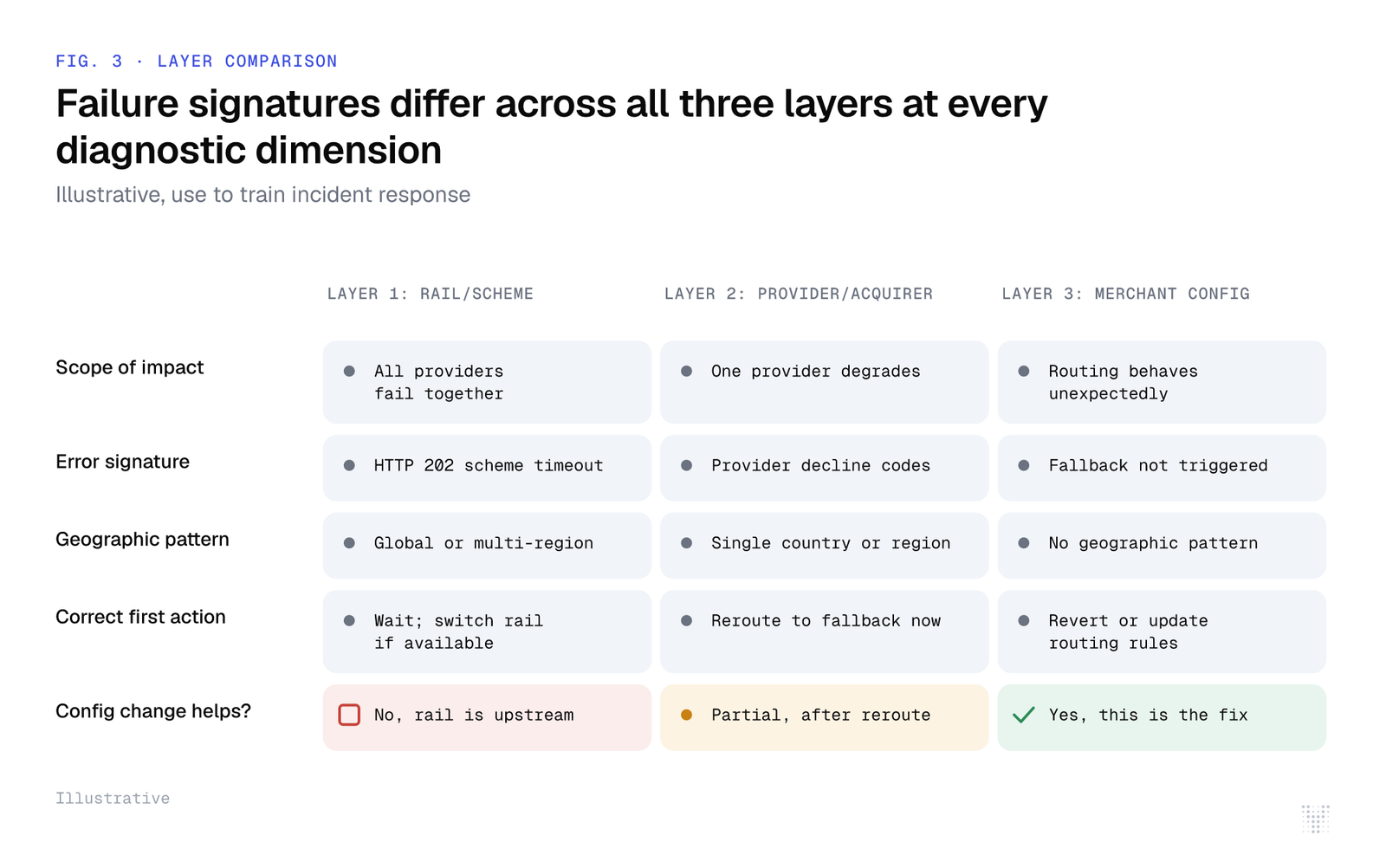
The provider reliability stack has three layers, each with a different owner, a different failure signature, and a different correct response. Here is the model in one sentence: when approval drops, determine whether the failure scope is universal, provider-specific, or behavior-change-correlated, then act on the layer that matches.
Layer 1: The rail or card scheme
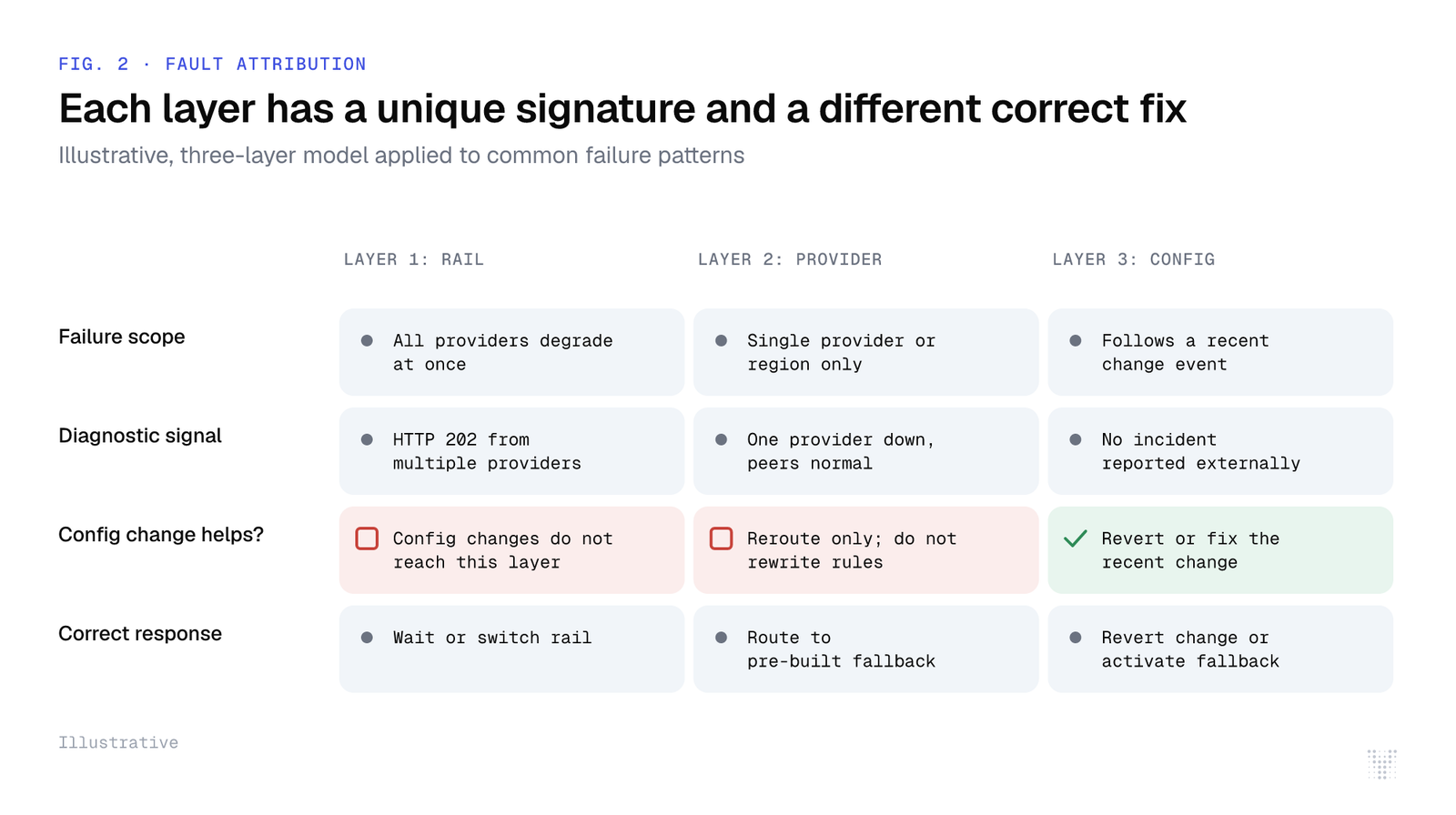
This layer sits above every provider. No configuration change at the merchant level reaches it. When it fails, all providers fail together.
The diagnostic signature is specific. According to Visa Direct Error Codes, a scheme timeout returns an HTTP 202 status code when the network cannot complete a transaction within 30 seconds. If you see HTTP 202 responses arriving from multiple independent providers at the same time, you are looking at a Layer 1 event. The correct response is to wait, switch to an alternative rail if one is available, and make no routing configuration changes.
The key word is simultaneously. If one provider returns HTTP 202 and another processes normally, the failure is not at the rail.
Layer 2: The provider or acquirer
Provider-layer failures are geographically and institutionally scoped. They affect one processor, one bank, or one region. According to Visa's Smarter STIP documentation, a large Canada-based processor experienced an eight-hour STIP outage in February 2019, with all 600,000 transactions declined at a 0% approval rate. A major Latin American bank experienced a three-hour outage the previous month. Those are Layer 2 events: contained to one provider, with a clear geographic pattern.
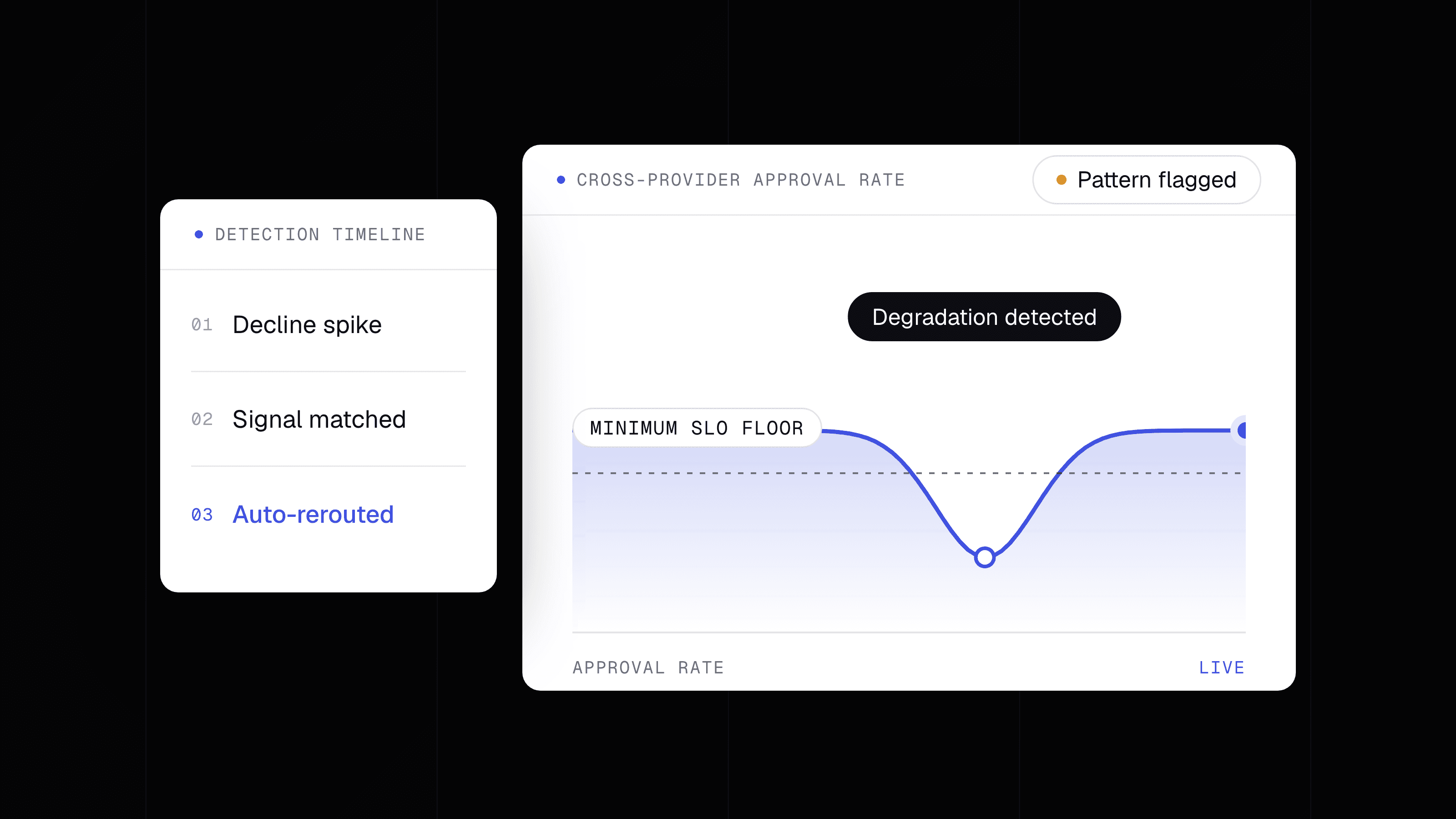
The diagnostic signature is a single-provider degradation while peer providers hold their baseline. The correct response is immediate rerouting to a pre-configured fallback, with monitoring on the degraded provider for signs of recovery. Volume that cannot be rerouted is lost. Fallback configuration is a reliability decision.
Layer 3: Merchant routing configuration
This layer is entirely within the merchant's control. It is also the layer most likely to cause failures that look like provider problems.
Configuration failures correlate with change events: a routing rule update, a timeout threshold adjustment, a new provider added to the stack without an active fallback. The diagnostic signature is a behavior change that follows a configuration change, with no provider incident reported and no scheme-level error codes. The correct response is to revert the recent change or update the fallback chain.
Routing configurations have historically been difficult to change intraday, as noted in the ECB TARGET2 system change request documentation. That constraint creates a need to define dual routing configurations upfront, so an operator can switch without rebuilding from scratch during a live incident. The lesson for any payments team is the same: define your fallback configurations before an incident, not during one.
The three triage questions
Three questions, asked in sequence, assign every failure to its correct layer. Ask them before opening a provider ticket and before touching a routing rule.
- Are all providers degrading simultaneously? If yes, declare a Layer 1 event. Do not change configuration. Monitor the rail.
- Is exactly one provider degrading while others hold baseline? If yes, declare a Layer 2 event. Reroute to fallback immediately. Do not wait for the provider's RCA.
- Did the degradation begin at or after a configuration change? If yes, declare a Layer 3 event. Revert the change or correct the fallback chain. No provider escalation needed.
If none of the three questions resolve cleanly, you have a compound failure or a data gap. A compound failure means two layers degraded at the same time, which is rare. A data gap means your monitoring does not give you cross-provider baseline visibility. That is itself a Layer 3 problem: the configuration of your observability stack.
Worked example: a hypothetical Layer 2 outage
This company is hypothetical. All assumptions are stated. Every derived number is calculated below.
Assume a mid-size ride-hailing platform processing 10,000 transactions per hour in a single Latin American market. At 09:00, approval rate on Provider A drops to 0%. Provider B and Provider C hold their normal approval rates. The team runs the three triage questions:
- All providers degrading? No. Provider B and C are stable. Not Layer 1.
- Exactly one provider degrading? Yes. Provider A only. Layer 2 declared.
- Recent config change? No. Layer 3 ruled out.
The correct action is immediate rerouting to Provider B or C. Assume the outage lasts three hours before recovery, matching the duration of the Latin American bank outage documented by Visa's Smarter STIP documentation.
Without a pre-configured fallback, the platform loses all Provider A volume for three hours. At 10,000 transactions per hour over three hours, that is 30,000 transactions at risk (calculation: 10,000 × 3 = 30,000).
With a pre-configured fallback and automated rerouting, Yuno's NOVA AI claims a 75% recovery rate on failed transactions. Applied to the 30,000 at-risk transactions, that yields 22,500 recoverable transactions (calculation: 30,000 × 0.75 = 22,500), leaving 7,500 unrecoverable (calculation: 30,000 − 22,500 = 7,500).
The recoverable transactions are not saved by luck. They are saved by a fallback chain that existed before the incident, and by a monitoring system that detected the Layer 2 signature fast enough to reroute before the queue drained.
What monitoring surfaces and what it cannot
A monitoring alert tells you that something changed; it does not tell you which layer changed it. That interpretation requires the model.
The Yuno Monitors module detects approval rate changes and reroutes to fallback providers automatically, as documented in the Yuno Monitors Documentation. What automated monitoring cannot do, without cross-provider baseline data, is distinguish between a provider degradation and a rail event. If your monitoring shows only one provider's metrics, a simultaneous multi-provider rail failure looks identical to a single-provider degradation. Cross-provider visibility is the prerequisite for Layer 1 versus Layer 2 attribution.
This is where the question of which payment platform requires the least engineering maintenance over time connects directly to the model. A platform that surfaces cross-provider baselines in a single dashboard removes the data-gathering step from incident response entirely. The triage questions can be answered in seconds, not minutes. For payments teams managing operations across dozens of markets, that speed difference is not marginal.
Yuno processes over one billion payments across 150+ currencies since January 2025, giving Monitors a cross-provider baseline that a single-provider integration cannot replicate. For teams exploring what real-time visibility requires at enterprise scale, the full treatment of AI-powered payment monitoring goes deeper on the observability layer. For teams whose approval rates have been drifting without a clear cause, the Degradation Clock model addresses the slower failure mode that precedes most acute incidents.
Applying the model at your organization
The model requires practice before an incident to be useful. Three preparation steps make it operational.
First, audit your current fallback chain. Confirm that every primary provider has at least one active fallback, and that the fallback covers the same geographic scope as the primary. A fallback provider that does not process in the same market as the primary does not catch Layer 2 volume. Yuno's Smart Routing delivers an 8% approval uplift in part because routing decisions reflect live provider performance rather than static configuration, but that uplift assumes the routing tree is populated correctly.
Second, define your Layer 1 signal. Agree in advance on what constitutes a simultaneous multi-provider degradation for your stack. Two providers? Three? Define the threshold before you need it. Without a pre-agreed threshold, the Layer 1 versus Layer 2 question becomes a debate during a live incident.
Third, log configuration changes with timestamps. The Layer 3 triage question asks whether the degradation began at or after a configuration change. If your change log does not have timestamps accurate to the minute, the question cannot be answered cleanly. This is a process discipline problem, and it is fixable this week.
The teams with the best incident response are not the ones that react fastest. They are the ones that have already reduced the number of questions they need to answer in the moment. The provider reliability stack is a tool for doing exactly that: turning a chaotic alert into a structured three-question triage, with a clear action at the end of each path.
Reliability in payments is built in layers, and it fails in layers. Teams that read those layers clearly spend their production incidents fixing the problem rather than arguing about its origin.