What you will learn: How to borrow the site reliability engineering error-budget model and apply it to approval rates, including how to set segment-level SLOs, calculate your error budget, and trigger burn-rate alerts so a deteriorating issuer or provider is caught in minutes rather than surfacing in next month's review.
The thesis is direct: approval rate is an operational signal, not a monthly KPI. Reliability engineering already solved how to manage exactly this kind of signal. Payments teams that adopt the model stop chasing post-mortems and start running a continuous, automated defence.
Key takeaways
- Define approval-rate SLOs at three tiers: topline, provider-country, and issuer-method.
- Your error budget is simply 100% minus the SLO; it converts a soft target into a hard spend allowance.
- Burn-rate alerts fire before the budget is exhausted. You gain time to reroute payment flows.
- Automated fallback routing is the operational counterpart to the alert: detection plus action closes the loop.
- According to a Ponemon Institute study cited by Visa, one minute of payment downtime costs a business an average of $9,000. Slow detection is expensive.
Why approval rate belongs in ops, not finance
Approval rate behaves like a service availability metric: it degrades in real time and recovers in real time. Reviewing it monthly is like reviewing server uptime in a spreadsheet after the outage is over.
According to Visa Performance Solutions, credit authorization declines are caused by a variety of issues ranging from high-risk transactions and credit limits to operational problems. That second category, operational problems, is exactly where SRE thinking applies. Operational declines are transient, provider-specific, and recoverable. They are also invisible if you only look at aggregate monthly numbers.
The question is not whether your approval rate will dip. It will. The question is whether you will know in two minutes or two weeks.
The SRE model in one sentence
Site reliability engineering manages reliability by turning a target (the SLO) into a finite allowance of failure (the error budget), then watching how fast that allowance is being consumed (burn rate). According to Capgemini's SRE Principles guide, error budgets are directly related to SLOs and must be consumed wisely to avoid unplanned disruptions.
The model transfers cleanly to payments. Replace "service availability" with "approval rate." Replace "failed requests" with "declined transactions." Everything else, the math, the alerting logic, the escalation thresholds, carries over unchanged.
Building the SLO tree for payments
A single topline approval rate hides too much; you need a hierarchy of SLOs that mirror how declines actually originate. Declines do not arrive uniformly. A Visa Debit BIN in Poland might be failing while everything else runs clean.
Structure your SLO tree in three tiers:
- Tier 1, topline: your aggregate card-approval rate across all providers and markets. This is the number on your executive dashboard.
- Tier 2, provider-country: one SLO per provider-country pair. A degradation here tells you whether the problem is local or systemic.
- Tier 3, issuer-method: one SLO per issuer BIN range or payment method within a market. This is where operational declines first appear, as Visa Performance Solutions notes.
Each tier has its own SLO and its own error budget. A breach at Tier 3 does not automatically breach Tier 1, but it is an early signal that one will follow if volume is high enough. This is why granularity matters: it separates a signal you can act on from noise.
For teams working on approval rate strategy across different verticals, the metrics that explain authorization rates post is a useful complement to this model.
Worked example: calculating a budget and setting burn-rate alerts
This company is hypothetical. All inputs below are stated assumptions; derived numbers are computed from those assumptions only.
Assumptions:
- Segment: Visa Debit, one mid-size European market.
- Volume: 10,000 transactions per 30-day window.
- SLO: 95% approval rate.
- Alerting window: 30 days (720 hours).
Step 1, set the error budget. The budget is 100% minus the SLO:
Error budget = 100 − 95 = 5%
At 10,000 transactions, that is a maximum of 500 allowed declines before the budget is exhausted (10,000 × 5% = 500).
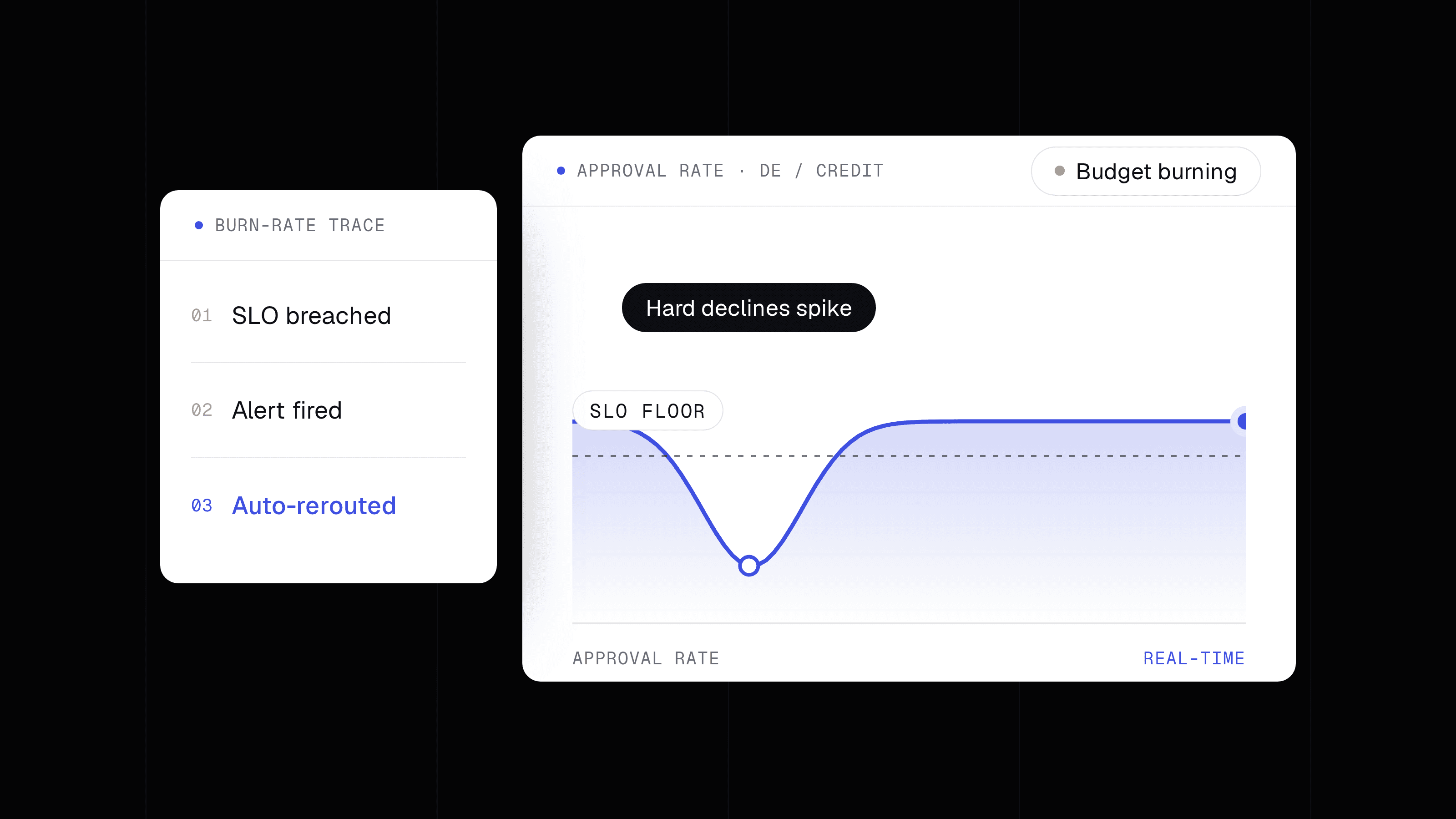
Step 2, define burn rate. A burn rate of 1 means declines arrive at exactly the pace the budget allows; you exhaust it at day 30. A burn rate of 14 means you consume the budget 14 times faster than allowed, exhausting it in roughly 1/14th of the window (about 51 hours). Google's SRE handbook convention, referenced in Capgemini's SRE Principles guide, sets two thresholds:
- Fast-burn alert (burn rate 14): fires when you will exhaust the budget in roughly two days. At 10,000 transactions and a 5% budget, this triggers after approximately 36 excess declines in a short window (500 ÷ 14 ≈ 35.71 declines).
- Slow-burn alert (burn rate 2): fires when a persistent but less dramatic degradation is on track to exhaust the budget before the window closes. This catches the slow drain that never triggers a fast-burn but still ends the month in breach.
Step 3, attach an action to each threshold. An alert with no action is just noise:
- Fast-burn: trigger automated fallback routing immediately, page the on-call payments engineer.
- Slow-burn: escalate to the payments operations queue, review issuer decline codes within 30 minutes.
The revenue case for speed is not abstract. According to a Ponemon Institute study cited by Visa, one minute of payment downtime costs a business an average of $9,000, bringing the cost per hour to over $500,000. A decline storm running undetected for 60 minutes represents up to $540,000 in revenue exposure (60 × $9,000 = $540,000).
Closing the loop with automated routing
An alert that requires a human to act manually is an alert that will sometimes act too slowly. The error-budget model only delivers its full value when detection is paired with automated response.
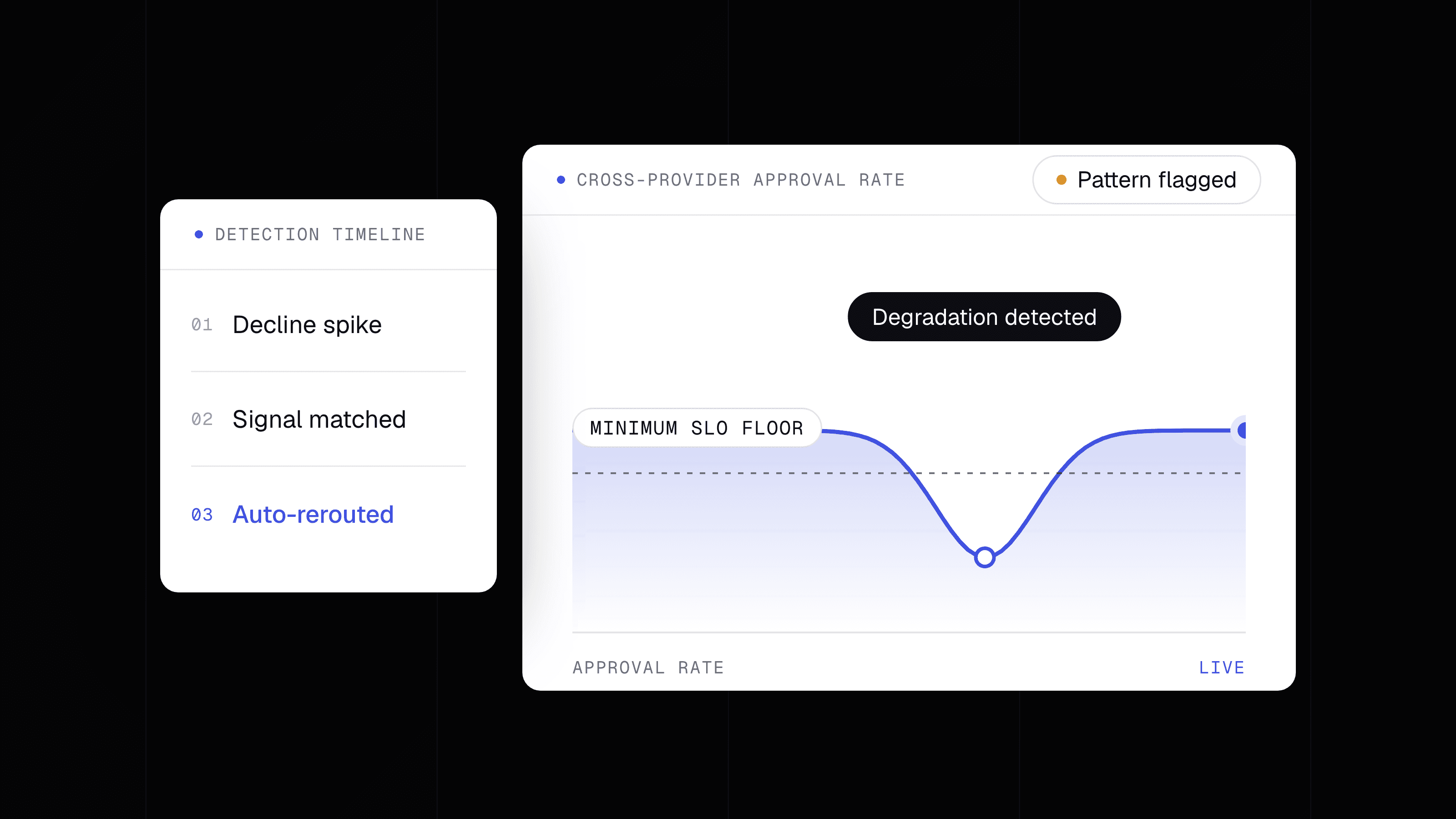
According to Yuno API documentation, upon detecting low approval rates, Yuno automatically redirects payments to fallback providers. A small portion of transactions continues through the original provider to monitor for service recovery. This is the operational implementation of burn-rate response: the system detects the budget burning fast, reroutes volume, and keeps a probe running to detect recovery, all without a human in the loop.
This addresses what payments engineers seek: platforms that automatically reroute payments when a PSP fails and close the remediation loop. Detection and rerouting must work together.
For a deeper look at how routing decisions affect approval rates, see seven routing approaches that lift approval rates and the case for smart routing as the common factor among top performers.
Where Yuno fits in this model
Yuno's Monitors module is built to implement exactly the SLO-and-alert model described here, across 190+ countries and 1,000+ payment methods. Yuno has processed more than 1 billion payments across 150+ currencies since January 2025, which means the signal volume is there to make segment-level SLOs statistically meaningful even for mid-tier issuers.
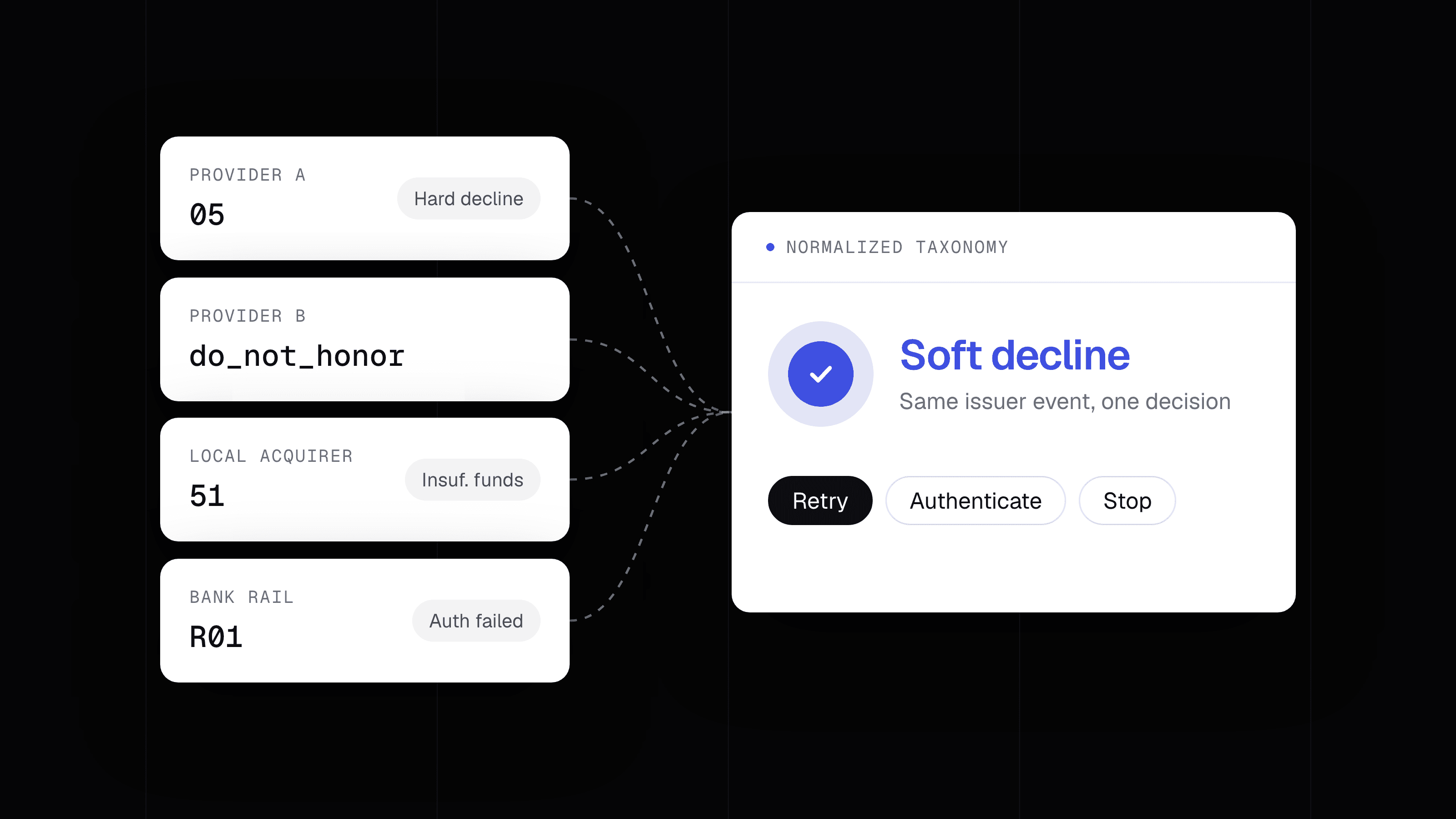
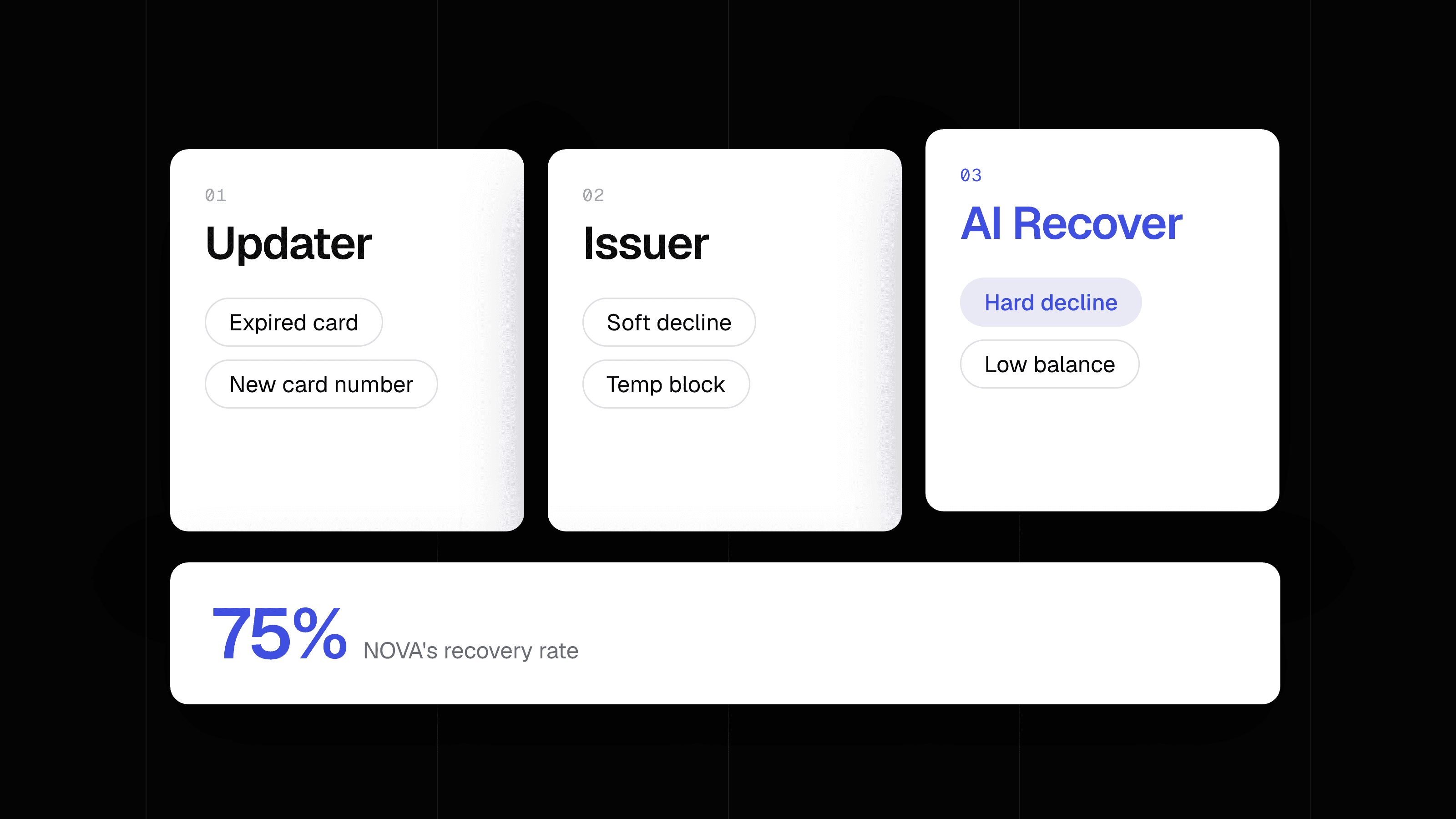
Yuno's Smart Routing delivers an average 8% approval rate uplift, and NOVA AI recovers 75% of failed transactions. But those capabilities only matter if the monitoring layer catches the degradation fast enough to invoke them. The error-budget model is what connects the signal to the response.
Yuno is the AI-native intelligence system of global payments and financial services. It sits outside the funds flow, which means its routing and monitoring decisions are structurally unbiased: it has no rail to protect. That neutrality is what makes automated burn-rate responses trustworthy. When the system says 'reroute to provider B,' it is acting on approval-rate signal.
For teams exploring how to set up automated monitoring for payment performance issues, Yuno Monitors is the starting point.
Approval rate is a reliability metric. It degrades in real time, it recovers in real time, and it costs real money every minute it goes unaddressed. The SRE error-budget model gives payments teams the same rigour that engineering teams use to run their most critical systems. Set the SLO per segment. Calculate the budget. Alert on burn rate. Automate the response. A drop in one issuer in one country gets caught in minutes. The system detects this anomaly during real-time monitoring.