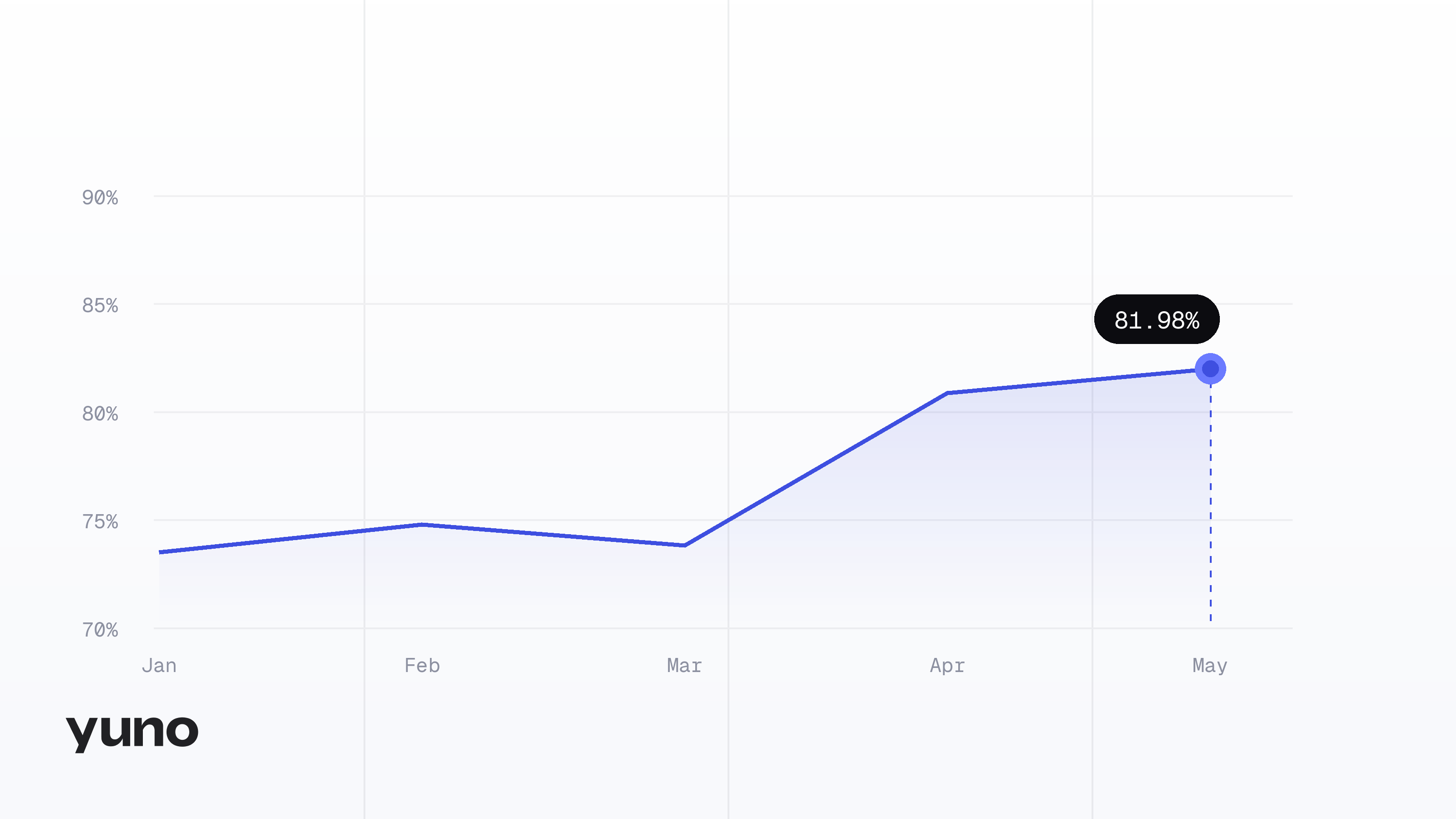
Your approval rate drops three percentage points on a Friday afternoon. You find out Monday morning. By then, a weekend of transaction failures has already converted into chargebacks, abandoned carts, and support tickets. This is the core problem that payment monitoring best practices are designed to solve, and most enterprise stacks are still not solving it fast enough.
The gap is structural. When your payment infrastructure spans four PSPs, two acquirers, and a dozen local payment methods across multiple markets, no single provider dashboard can show you the full picture. Each one shows you its own traffic. None of them shows you the cross-provider pattern that explains what actually broke.
Key Takeaways
- Payment monitoring best practices require a neutral layer above your PSPs: one that aggregates all provider data in real time without conflict of interest.
- AI anomaly detection catches gradual degradation that never crosses a fixed threshold, the failure mode rules-based alerts consistently miss.
- Enterprise merchants using smart routing see an average 8% authorization rate uplift, but only when routing decisions draw on live, cross-provider monitoring data (Yuno platform data, 2026).
- Approval rate is the primary revenue signal: a 3-point drop on a high-volume corridor can compound over 48 hours before a rules-based alert fires.
- Multi-PSP visibility is structurally unavailable inside a PSP-owned tool. A provider that routes to its own rails cannot compare itself objectively against competitors.
Why Single-PSP Monitoring Creates Expensive Blind Spots
Single-PSP monitoring only surfaces failures on that provider's traffic, leaving cross-provider degradation invisible until it becomes a revenue event. Most enterprise merchants discover this the hard way after expanding to three or more providers.
We've seen this pattern repeatedly across enterprise marketplaces and subscription platforms on Yuno's infrastructure. A provider begins degrading gradually on a specific card brand in one country. Approval rates slip 1.5 points, then 2.5 points. No individual dashboard threshold fires because the drop is slow and the affected volume is split across providers. The merchant's first signal is a spike in support tickets two days later.
The problem compounds when routing logic is static. If you have configured 60% of your UK Mastercard traffic to one PSP and that PSP starts underperforming, a monitoring system that only shows you that provider's internal metrics cannot tell you to reroute. It can only confirm the failure after the fact.
Fraud patterns make this worse. A mule account today moves across cards, ACH, and wire corridors simultaneously, exploiting the gap between detection surfaces. When your fraud monitoring and your approval rate monitoring live in separate tools, correlation is manual, slow, and often missed entirely.
What Payment Monitoring Best Practices Actually Require at Scale
Effective payment monitoring best practices at enterprise scale require four capabilities: real-time multi-provider aggregation, AI-driven anomaly detection, issuer-level rejection attribution, and automated remediation triggers. Most monitoring setups deliver one or two of these, not all four.
Here is what each requirement means in practice.
Real-Time Multi-Provider Aggregation
Every transaction event, approval, soft decline, hard decline, and timeout needs to flow into a single monitoring surface regardless of which provider processed it. Latency in that pipeline is a direct cost: a 15-minute lag means a provider outage is already 15 minutes old before your on-call rotation sees it.
Based on our infrastructure, the merchants who achieve sub-second detection windows are the ones who route all provider event streams through a single orchestration layer rather than aggregating dashboards manually. The aggregation problem is not a tooling problem. It is an architectural one. You cannot bolt cross-provider visibility onto a stack of separate integrations after the fact.
AI Anomaly Detection vs. Rules-Based Thresholds
Rules-based alerts fire when a metric crosses a fixed threshold, say, approval rate drops below 85%. AI anomaly detection baselines normal behavior for each corridor, card brand, and time window, then flags deviation from that baseline. The difference matters because the most damaging failures are gradual, not sudden.
A provider that degrades from 91% to 87% over six hours never crosses a hard threshold. A rule set to alert below 85% stays silent. An AI model trained on that corridor's historical pattern detects the directional shift in the first hour and flags it as anomalous before it compounds. This is the detection gap that Yuno's Monitors product is built to close.
Issuer-Level Rejection Attribution
Knowing that your approval rate dropped is not enough. Knowing which issuer drove the drop, on which card brand, under which decline code, is what makes remediation possible. Soft decline code 51 on Visa debit in Germany points to a completely different fix than soft decline code 05 on Mastercard credit in France.
Without issuer-level attribution, every remediation attempt is a guess. You reroute traffic to a backup PSP without knowing whether the problem is with your primary PSP, with the issuer, or with your 3DS configuration. All three have different solutions.
Automated Remediation Triggers
Detection without remediation is a monitoring system that creates work instead of eliminating it. The goal is not to alert your payments team faster. The goal is to reroute traffic, trigger smart retries, and escalate selectively so that humans intervene only on the decisions that require judgment.
Merchants using Yuno's smart routing infrastructure see an average 8% authorization rate uplift, partly because routing decisions draw on live monitoring data (Yuno platform data, 2026). The routing engine and the monitoring layer are not separate systems. One feeds the other continuously.
How AI Changes the Detection Economics for Multi-PSP Stacks
AI-powered monitoring reduces mean time to detection from hours to seconds by replacing static threshold logic with dynamic baseline comparison across every active provider. For a multi-PSP stack processing tens of thousands of transactions per hour, that difference is material.
The economics of detection speed are straightforward. Enterprise merchants lose between 9% and 20% of annual revenue to payment failures (industry composite, 2025). A significant share of that leakage is recoverable if the failure is caught within minutes rather than hours. Detection lag is a direct revenue leak, not just an operational inconvenience.
AI monitoring also changes how payment operations teams allocate time. Yuno's Payments Concierge is an AI operations agent that monitors the full payment stack and delivers alerts, rejection analysis, and routing recommendations through a natural language interface in Slack or WhatsApp. A payments analyst asking "why did our UK approval rate drop at 3pm today?" receives issuer-level attribution, top rejection codes, and remediation steps immediately, without switching between dashboards or querying a database.
From our work with enterprise delivery platforms and subscription businesses, the teams that recover fastest from provider degradation are not the ones with the most analysts. They are the ones where the monitoring system has already done the attribution work by the time a human looks at the alert.
The Neutrality Requirement: Why Your PSP Cannot Monitor Itself
A PSP-owned monitoring tool is structurally incapable of cross-provider comparison because the provider has a commercial interest in routing volume to its own rails. This is the single most important reason to separate your monitoring layer from your acquiring relationships.
Consider what PSP comparison actually requires. You need to see approval rate for Provider A vs. Provider B on the same card brand, in the same country, over the same time window. That comparison is only meaningful when the data for both providers flows through a neutral intermediary with no stake in the outcome. A tool built by Provider A will never surface an objective case for routing more volume to Provider B.
Yuno owns no rails and sells no acquiring. Every routing recommendation and every PSP comparison in Payments Concierge draws on data from the merchant's full provider set with no conflict of interest. That structural neutrality is not a feature. It is the precondition for the monitoring data to be trustworthy.
The Payments Concierge capability specifically supports side-by-side PSP performance comparison across regions, card types, and payment methods. Payment teams can generate Excel, PDF, or PowerPoint reports directly within a conversation, replacing what previously required analyst hours with a single query.
What a Multi-PSP Monitoring Stack Looks Like in Practice
A production-grade multi-PSP monitoring stack has three layers: a real-time event stream, an AI analysis layer, and a remediation execution layer. These three layers need to be architecturally connected, not bolted together through manual exports.
The event stream layer collects transaction outcomes from every provider in real time, normalizing them into a common schema so that a soft decline from one provider carries the same structure as a soft decline from another. Without schema normalization, cross-provider analysis requires manual mapping every time a provider updates its response codes.
The AI analysis layer runs anomaly detection, rejection code attribution, and routing recommendations continuously against the normalized event stream. This is where the detection speed advantage lives. Rules fire on thresholds. AI models detect directional change and correlate across dimensions simultaneously, approval rate, decline code, issuer, card brand, and geography at once.
The remediation execution layer translates analysis outputs into actions: rerouting traffic, triggering retries, escalating to on-call, or surfacing a recommendation to the payments team. For failed transactions that require customer engagement, NOVA intercepts the failure and contacts the customer via WhatsApp or voice in 70+ languages, recovering up to 75% of failed transactions without engineering overhead (Yuno product data, 2026).
These three layers working together are what separates a monitoring system that reduces revenue leakage from one that just generates more alerts.
Practical Payment Monitoring Best Practices for Payment Leaders
Payment monitoring best practices start with an audit of your current detection lag: measure how long it takes from the moment a provider begins degrading to the moment your team takes action. That number tells you more about your monitoring maturity than any dashboard configuration.
Based on our platform data, the most common gaps we find when enterprise merchants come to Yuno are these four:
- Approval rate monitoring is configured per-PSP but not cross-PSP, so provider-relative degradation is invisible.
- Soft decline attribution stops at the reason code level and does not drill to issuer or BIN range, making remediation a process of elimination.
- Retry logic is static, applying the same retry waterfall regardless of the decline reason, which wastes retry budget on hard declines and misses recoverable soft declines.
- Monitoring and routing are separate systems, so detection triggers a manual rerouting decision rather than an automated one.
Closing each of these gaps does not require a platform rebuild. On Yuno's infrastructure, new providers, routing rules, and monitoring conditions activate by configuration. A merchant can add a backup PSP and define the monitoring thresholds that trigger automatic failover in the same session, without an engineering sprint.
For payment teams managing multi-country operations, the alerting architecture decisions matter as much as the monitoring logic itself. A well-configured alert that reaches the right person in 30 seconds is more valuable than a precise anomaly detection model that notifies a shared inbox once per hour.
The operational benchmark worth targeting: detection to remediation in under five minutes for provider degradation events. At that speed, a Friday afternoon drop is contained before it becomes a Monday morning retrospective.
For a deeper look at how real-time visibility requirements differ by infrastructure scale, the enterprise-scale monitoring breakdown covers the architectural tradeoffs in detail.