Enterprise merchants lose 9–20% of annual revenue to payment failures (industry composite, 2025). Most CFOs know that number. Few can split it by cause. Declined card payments sit inside that figure as three distinct problems: stale credentials, recoverable issuer declines, and situations where only the cardholder can fix what went wrong. Each problem demands a different tool. Deploying the wrong one wastes retries, burns customer trust, and still leaves revenue on the table. The goal is to reduce payment declines systematically, and that requires matching each recovery layer to the failure type it was built for.
Key Takeaways
- Account updater prevents stale-credential declines before authorization fires, removing a failure class that retries cannot fix.
- Issuer retries work only on soft declines. Retrying hard declines after network caps is a compliance risk, not a recovery strategy.
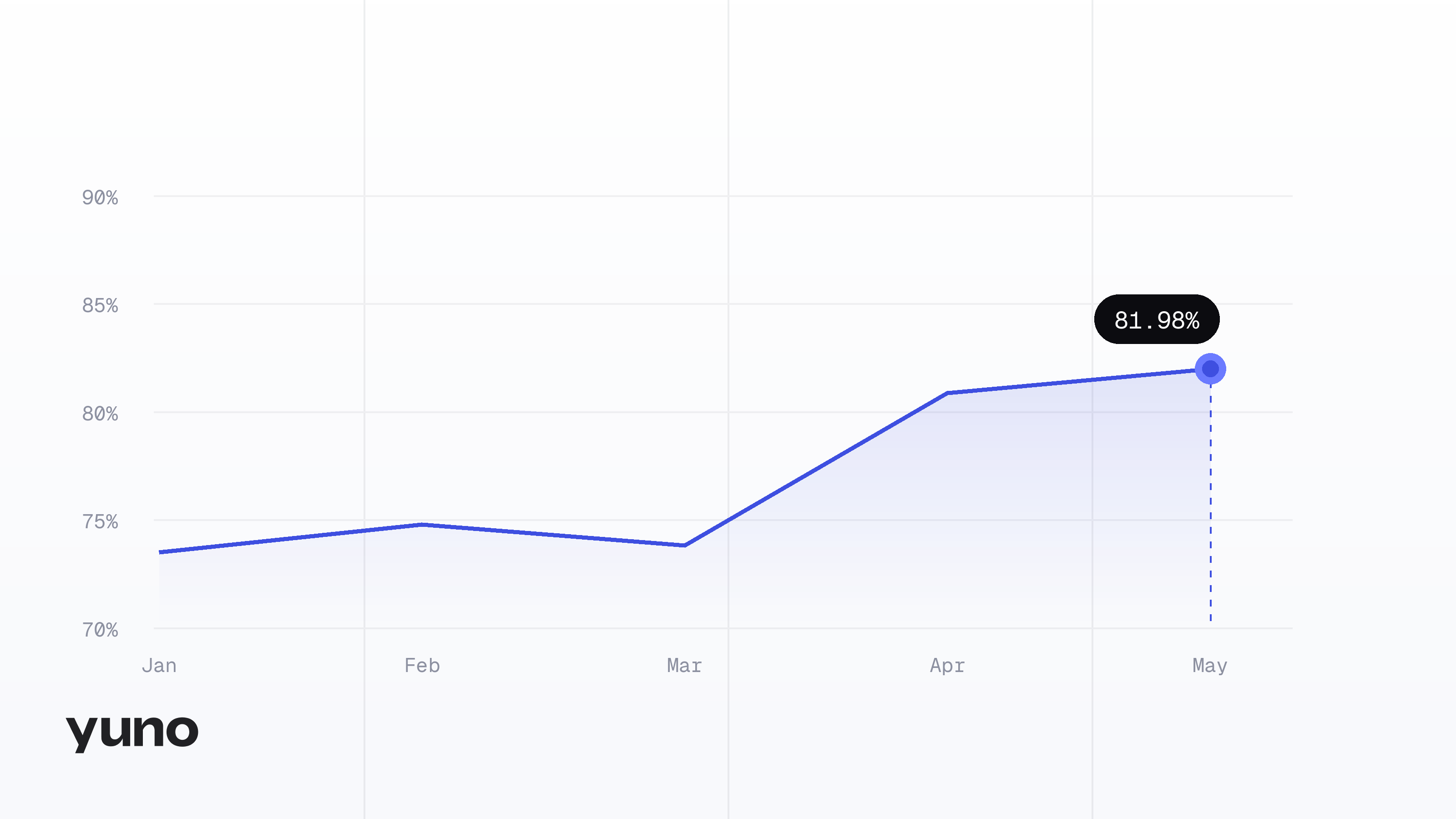
- AI-driven recovery via NOVA contacts customers directly, recovering up to 75% of failed transactions where automated layers have already been exhausted (Yuno product data, 2026).
- Each recovery layer has a distinct trigger condition. Deploying all three in sequence is the only way to address the full decline population.
- A neutral, multi-PSP layer is the prerequisite for effective retry logic: single-acquirer retry rates are structurally capped because the same issuer sees the same acquirer BIN every time.
Why Most Declined Card Recovery Strategies Under-Perform
Most decline recovery strategies treat all failures as the same problem and apply one tool across the board. They do not, and that mismatch is where recoverable revenue disappears.
We see this pattern repeatedly across enterprise merchants migrating to Yuno's platform. A merchant has retry logic configured, perhaps with a fixed schedule, and considers the recovery problem solved. What they have actually done is address one sub-segment of failures while leaving two others untouched. The result is a recovery rate that looks acceptable in aggregate but misses entire categories of revenue.
The three failure categories are structurally different. Stale card credentials fail before any real authorization decision is made. Soft declines are issuer decisions that can change if the attempt is resubmitted under better conditions. Hard declines are final issuer decisions that require a new payment instrument. Any recovery architecture that does not treat these separately will leak revenue at every stage.
What Account Updater Fixes and What It Cannot
Account updater is a pre-authorization service: it refreshes card credentials on file before a charge is attempted, eliminating the failure class caused by expired or reissued cards. Visa and Mastercard operate these services for their networks, and participation from issuing banks determines the effective coverage rate any merchant will see.
The use case is narrow but high-value. Any merchant with card-on-file storage, including subscription businesses, marketplaces with stored payment methods, and platforms with one-click checkout, will see a predictable share of cards expire or get reissued due to fraud replacement every year. Those credentials will decline at the authorization step even when the cardholder is solvent and willing. Account updater removes that class of failure before it ever hits the authorization network.
What account updater cannot fix is worth being explicit about. It does not affect issuer-side soft declines, network timeouts, or hard declines caused by account status. Merchants sometimes treat account updater as a retry tool. It is not. It is a credential hygiene tool. Applying it to soft decline recovery is category error, and we see it contribute to misattributed decline data when merchants try to reconcile their numbers. Yuno's Account Updater product handles both Visa and Mastercard credential refresh, and it sits upstream of the authorization attempt so it never contributes to retry count against network caps.
How Issuer Retries Reduce Payment Declines on Soft Codes
A soft decline is a conditional rejection from the issuing bank: the account exists, the card is valid, but something about the timing or the transaction context caused the issuer to decline. Common soft decline codes cover temporary holds, velocity limits, generic do-not-honor responses, and insufficient funds where the cardholder's balance situation may change.
Retrying these codes can work. The key word is can. Whether a retry succeeds depends on the decline code, the retry interval, the acquirer BIN presented, and whether network retry caps have been reached. Visa and Mastercard both enforce retry limits, and merchants who exceed them face scheme fines. A compliant retry strategy reads the specific code, routes the retry through a different acquirer where possible, applies an appropriate interval, and stops at the network cap.
This is where single-PSP retry logic hits a structural ceiling. When a merchant retries through the same acquirer, the issuer sees the same BIN profile. For some issuers, that is sufficient reason to continue declining regardless of timing. Routing retries across multiple acquirers changes the BIN, which can shift the issuer's decision. That requires multi-PSP infrastructure. Yuno's smart routing engine handles this automatically, and merchants using it see an average 8% authorization rate uplift (Yuno platform data, 2026). For a deeper look at how multi-PSP failover compounds this effect, see our analysis of smart routing and multi-PSP failover for global merchants.
What retries categorically cannot fix is hard declines. A hard decline is a final issuer decision: the card is lost, stolen, closed, or blocked. Retrying a hard decline code does not produce a different issuer decision. It consumes retry budget, risks scheme fines, and delays the customer contact that is the only real recovery path for that failure type.
Where AI Recovery Applies When Retries Have Been Exhausted
AI-driven payment recovery applies after automated layers have run their course: when the decline is a hard code, when retry caps have been reached on a soft code, or when the recovery requires the cardholder to supply a new payment method. This is a fundamentally different operation from retry logic.
NOVA, Yuno's AI recovery agent, intercepts failed transactions and contacts the cardholder directly via WhatsApp or voice in over 70 languages. The outreach is timed, personalized, and requires no engineering work from the merchant. Based on our platform data, NOVA recovers up to 75% of failed transactions it handles (Yuno product data, 2026). That figure covers the segment of failures where automated retry and account updater have already been applied and exhausted. It is not a retry rate; it is a customer conversion rate on a population that would otherwise be written off.
The distinction matters for how CFOs should think about recovery economics. Retry logic operates at near-zero marginal cost per attempt. AI recovery involves a contact event. The ROI calculation is different, and it applies to a different slice of the failure population. The right frame is triage: automated layers first, AI recovery on the residual hard-decline and retry-exhausted population.
A large travel marketplace we work with had strong retry logic in place but was writing off the hard-decline segment entirely. After layering NOVA on top of its existing retry infrastructure, it began recovering a material share of that previously lost segment with no additional engineering overhead on their side. That incremental recovery compounds directly into revenue because the customer relationship was already there.
How to Sequence the Three Layers
The correct sequence is upstream credential hygiene, then code-aware retry logic, then AI-driven customer recovery. Running them in the wrong order, or skipping layers, creates gaps that accumulate into the 9–20% revenue leakage figure most enterprise merchants report.
Here is how each layer triggers in practice:
- Before authorization: Account updater refreshes credentials on file. Cards that would have expired or been reissued are updated silently. The authorization attempt fires against a current card number.
- At authorization, soft decline codes: Smart routing selects the next acquirer based on BIN, region, and live performance data. The retry fires with the correct interval and stops at the network cap. Routing across acquirers improves the BIN diversity the issuer sees.
- At authorization, hard decline codes or retry cap reached: NOVA intercepts the failed transaction and initiates a customer contact flow in the cardholder's language. The customer is guided to update their payment method or complete the transaction on a new card.
This sequence reduces payment declines across all three failure classes rather than optimizing one at the expense of the others. It also produces clean attribution data. When each layer is distinct and sequenced, CFOs can see exactly which failure type their decline rate is driven by and which layer is recovering it.
What the Recovery Rate Number Actually Means
Recovery rate is only meaningful when the denominator is defined clearly: what failure population is included, and which recovery layers have already been applied before the rate is measured. We see inflated recovery claims frequently when the denominator is small or pre-filtered.
From our work across enterprise merchants on Yuno's platform, recovery rates reported by single-layer tools often exclude the hard-decline population because that population is genuinely irrecoverable by retries alone. When a vendor reports a retry recovery rate of 40–60%, that is typically measured against the soft-decline subset. The full failed transaction population, including hard declines, drops that figure significantly. NOVA's 75% recovery rate is measured against the failed transactions NOVA contacts, which includes hard-decline cases that retry logic has already been unable to address (Yuno product data, 2026). That is a materially different claim.
For CFOs building a business case, the right metric is incremental revenue recovered per dollar of recovery infrastructure cost, measured against the full failed transaction population. Measuring only the layer that is easiest to optimize overstates the system's performance and understates the total opportunity.
The full architecture behind this, including how routing logic and AI recovery interact at the infrastructure level, is covered in our guide on the enterprise revenue recovery stack.
How Yuno Deploys All Three Layers Without Additional Engineering
Yuno's platform combines account updater, multi-PSP smart routing, and NOVA on a single integration, so merchants activate all three recovery layers through configuration rather than separate engineering projects. This matters operationally because the typical alternative is three separate vendor relationships, three integrations, and a data reconciliation problem across all three.
Because Yuno owns no rail and sells no acquiring, routing recommendations carry no conflict of interest. The platform selects the optimal acquirer for each retry based on live performance data, not on which provider pays Yuno a higher rate. That neutrality is structurally important: it means retry routing decisions are genuinely optimized for approval rate rather than for internal economics.
Account updater sits upstream as a credential hygiene layer. Smart routing handles code-aware retry sequencing across the connected acquirer network. NOVA sits downstream for the residual population. The merchant sees a unified decline attribution dashboard rather than three separate reports with different denominators and different definitions of "recovered."
Merchants in the European market have additional complexity from SCA requirements on retries. Applying authentication correctly across the retry sequence, without triggering unnecessary friction on recoverable soft declines, requires the authentication layer to be integrated with the routing layer. Our coverage of how to reduce payment declines in Europe addresses that dimension specifically for merchants operating under PSD2.
The Practical Starting Point for CFOs
The first audit should be a decline code breakdown, not a top-line decline rate. Identify what share of declined transactions are soft codes, hard codes, and credential failures. Most payment operations reporting does not produce this split by default, and without it, any recovery investment is under-targeted.
Once the split is visible, the sequencing logic follows directly. A high credential failure rate points at account updater as the highest-ROI first move. A high soft decline rate with a single acquirer points at smart routing and retry diversification. A hard decline population with no recovery path points at AI-driven customer contact.
From our integrations across subscription and marketplace verticals, the merchants who recover the most revenue are not necessarily the ones with the most sophisticated retry logic. They are the ones who have mapped their decline population accurately enough to know which layer to apply to which cohort. That diagnostic step consistently surfaces recoverable revenue that was previously attributed to permanent churn.
Reducing payment declines at enterprise scale requires all three layers working in sequence. Any one of them in isolation leaves significant, attributable revenue unrecovered.
Frequently Asked Questions
What is the difference between account updater and smart retries for declined card payments?
Account updater prevents declines caused by stale card credentials by refreshing card details before the charge fires. Smart retries address soft declines during authorization by resubmitting at an optimized time. They target different failure types and deliver the most value when deployed together.
Which decline types can be recovered without contacting the customer?
Soft declines, including do-not-honor responses, insufficient funds codes, and network timeouts, can be retried without customer involvement. Stale credential failures are resolved by account updater before any authorization attempt. Hard declines require the cardholder to supply a new payment method.
How does a neutral payment layer improve retry approval rates?
A neutral layer routes retries across multiple acquirers, changing the BIN the issuer sees on each attempt. That BIN diversity can shift an issuer's decision on a soft decline. Single-acquirer retry stacks cannot produce this effect because the same BIN appears on every attempt.