AI traffic to U.S. retail sites grew 693% year-over-year during the 2025 holiday season (Adobe Digital Insights, January 2026). That volume is landing on payment stacks that were designed for humans. Most stacks reject agent-initiated transactions before a human ever notices. If your goal is to integrate payments AI assistants into your revenue infrastructure, the Agentic Commerce Protocol is the standard you need to understand now.
Key Takeaways
- ACP is a convergence of standards, covering identity, delegated authorization, shared payment tokens, and settlement, not a single vendor specification.
- Most enterprise payment stacks fail ACP readiness at the authentication layer: they have no mechanism to validate agent identity or scoped spend tokens without human confirmation.
- 53% of consumers have already made a purchase based on a GenAI recommendation (Capgemini Research Institute, 2025), making agent-initiated checkout a live revenue channel, not a future experiment.
- Orchestration is the control point for ACP. It is the layer where token validation, routing, fraud rules, and 3DS enforcement converge without a new PSP integration.
- Yuno's Agentic Commerce module activates merchant catalogs inside ChatGPT, Claude, Gemini, Perplexity, and Copilot through a single integration, without rebuilding existing checkout infrastructure.
What Is the Agentic Commerce Protocol?
The Agentic Commerce Protocol (ACP) is the collective shorthand for the stack of standards that lets AI agents authorize, transact, and settle payments autonomously on a user's behalf. It is not a single document from one organization; it is a convergence of efforts across identity frameworks, delegated authorization models, and payment token specifications.
The protocol covers four functional layers: agent identity verification, delegated payment authorization, shared payment token exchange, and settlement routing. Each layer must be handled correctly for an agent-initiated transaction to complete without a human stepping in to confirm. We've seen merchants assume ACP is only a discovery problem, something the AI platform handles upstream. In practice, the receiving payment endpoint carries as much responsibility as the agent itself.
Understanding how AI agents complete purchases autonomously clarifies which layers belong to the AI platform and which belong to the merchant's stack.
Where Do Existing Payment Stacks Break Under ACP?
The failure point is almost always authentication. Standard checkout flows assume a human is present to confirm 3DS challenges, enter OTPs, or approve biometric prompts. Agent-initiated transactions carry none of those signals.
In our integrations across enterprise retail and marketplace verticals, we find three recurring gaps when merchants try to integrate payments AI assistants without an orchestration layer in place.
- No agent identity validation. The payment endpoint receives a transaction with a machine-generated token but has no logic to verify the token's origin or the agent's registered scope. The transaction gets flagged as anomalous and declined.
- SCA triggers block completion. European merchants subject to PSD2 face SCA requirements that were written assuming human presence. Agent flows that cannot satisfy exemption criteria stall at authentication before reaching the acquirer.
- Fraud rules fire on velocity patterns. AI agents purchase at inhuman speed and consistency. Existing fraud rules built around human behavior, session timing, and device fingerprints treat these patterns as card-testing attacks and reject them.
None of these failures are visible in real time if your monitoring is PSP-level only. By the time a decline spike surfaces in a dashboard, the agent has already routed future sessions to a competitor's catalog.
How to Integrate Payments AI Assistants Using ACP
Integrating payments AI assistants via ACP requires four things: an ACP-compliant receiving endpoint, a shared payment token infrastructure, agent-aware authentication handling, and fraud controls scoped to machine-initiated behavior. These sit above the PSP layer; they do not replace it.
Layer 1: The Receiving Endpoint
Your payment stack needs a publicly addressable endpoint that accepts ACP-formatted requests. This endpoint receives the agent's intent, validates the delegated payment token, and initiates the transaction. It must return structured responses the agent can parse: confirmation, failure codes, and retry signals in machine-readable format. Most existing checkout flows return HTML or redirect URLs, neither of which an AI agent can process.
Layer 2: Shared Payment Tokens
ACP transactions use shared payment tokens that a user pre-authorizes at enrollment. The token carries spend limits, merchant scope restrictions, and an expiry. Your stack must be able to receive, validate, and charge against these tokens without requiring the cardholder to re-authenticate at transaction time. This is where network token infrastructure becomes load-bearing. Stacks with native network token support handle ACP token validation as a configuration change. Stacks without it need a new integration path.
Layer 3: Authentication Without Human Presence
ACP pre-authorization shifts SCA compliance to the enrollment moment rather than the transaction moment. For European merchants, this means your 3DS implementation must be able to identify delegated-auth transactions and apply the correct exemption or out-of-scope classification. Merchants running native 3DS through an orchestration layer can enforce this at the routing level. Merchants relying on PSP-managed 3DS often have no way to override the challenge trigger for agent sessions.
For a broader view of where PSD2 authentication requirements create gaps in agentic flows, the post on PSD2 readiness for enterprise payment stacks covers the edge cases we still see in 2026.
Layer 4: Agent-Aware Fraud Controls
Fraud models trained on human sessions will misfire on agent traffic. The fix is rule sets that recognize agent identity signals, registered token scope, and pre-authorized spend envelopes as positive signals rather than anomalies. Velocity rules need agent-specific thresholds. Device fingerprinting rules need to be bypassed or weighted differently for validated agent sessions.
Why Orchestration Is the Control Point for ACP
Orchestration is where token validation, routing decisions, authentication logic, and fraud rules converge in one place, without requiring a new PSP. This is the architectural reason a neutral orchestration layer handles ACP more cleanly than a single-PSP setup.
A single-PSP stack can add an ACP endpoint, but it cannot apply cross-provider routing logic to agent transactions. If that PSP has a degraded session, the agent gets a hard decline and routes elsewhere permanently. An orchestration layer retries across providers in milliseconds, applying the same fallback logic to agent transactions that it applies to human ones.
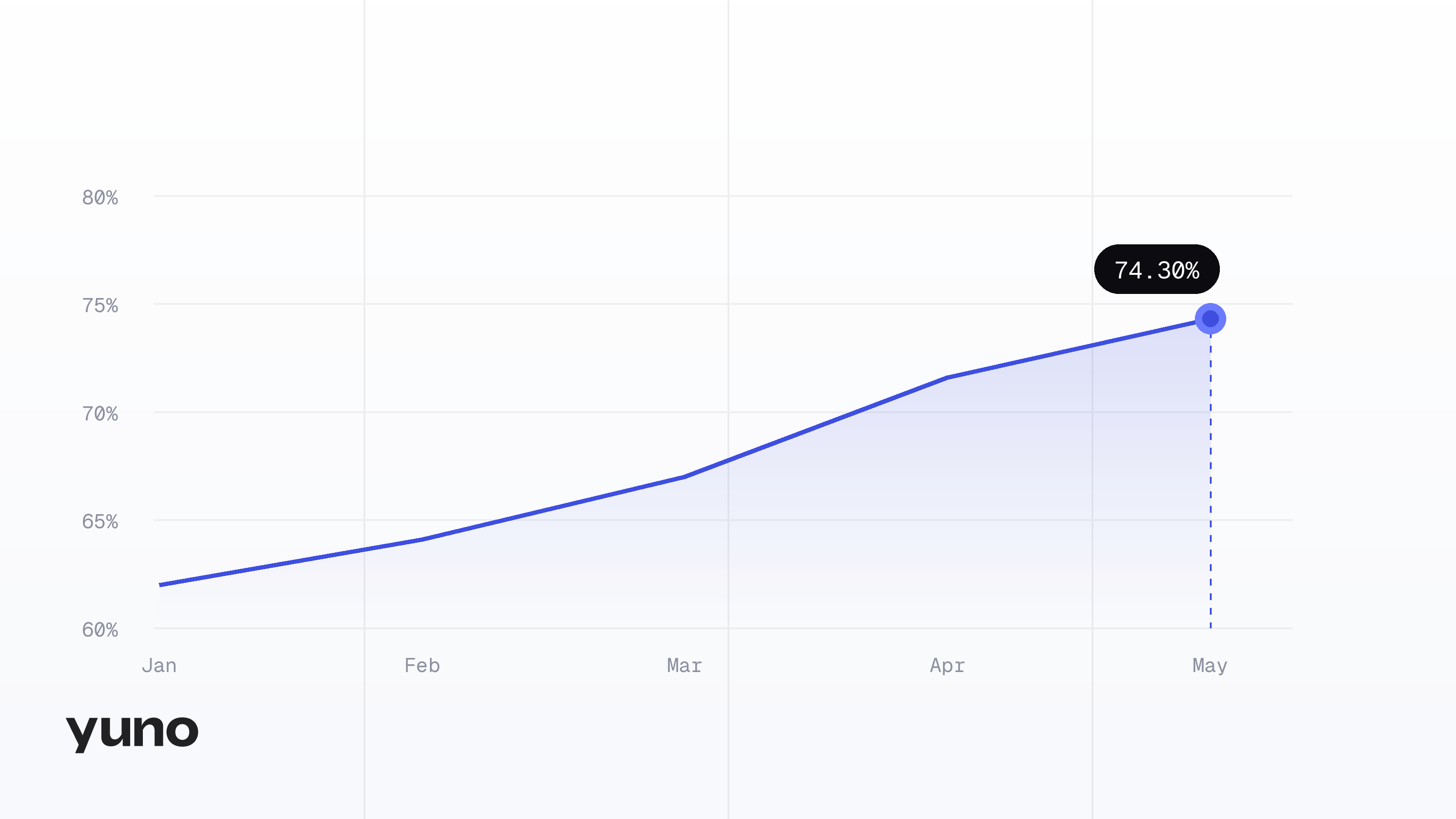
Yuno's platform data shows an 8% average authorization rate uplift from smart routing across enterprise merchants (Yuno platform data, 2026). For agent-initiated transactions, where the buyer has no fallback behavior and will not manually retry, that 8% is the difference between capturing the sale and losing the agent's future sessions entirely.
The broader question of which payment orchestrators support agentic commerce comes down to this: does the platform handle the auth, token, and routing layers natively, or does it pass them back to the PSP where they break?
What ACP Means for Merchant-of-Record and Liability
ACP does not change the fundamental merchant-of-record structure; the merchant whose catalog the agent is purchasing from remains liable for the transaction. What changes is the evidence trail required to defend chargebacks when no human session exists.
Agent-initiated transactions produce no browser session data, no biometric confirmation, and no device fingerprint in the traditional sense. Chargeback defense depends entirely on the pre-authorization record: the enrollment event, the token scope accepted by the cardholder, and the spend confirmation sent back to the agent at transaction time. Merchants need to retain this data explicitly. Most payment stacks do not log it by default.
The liability questions that most vendors are avoiding in their ACP documentation are covered in detail in the post on merchant-of-record liability in agentic commerce.
How Yuno Activates ACP Without a Rebuild
Yuno's Agentic Commerce module connects merchant catalogs to the major AI shopping surfaces through a single integration, without modifying the existing checkout stack. The module handles the ACP-compliant endpoint, token validation, routing, and fraud rule application as configuration rather than custom engineering.
From our work with enterprise merchants across retail, travel, and digital goods verticals, the integration path that works fastest is one where the orchestration layer owns the ACP interface while the underlying PSP connections remain unchanged. Merchants do not swap processors. They add a layer above the processors that speaks the protocol AI platforms require.
The five AI surfaces where Yuno activates merchant catalogs are ChatGPT, Claude, Gemini, Perplexity, and Copilot. A single Yuno integration covers all five. Each surface has its own checkout flow and token standard; the orchestration layer normalizes these into a single transaction path that routes to the merchant's existing acquirers.
Payments Concierge adds a second layer of operational visibility for payment teams managing agentic volume. The Payments Concierge monitors agent transaction patterns in real time, flags approval rate drops on agent sessions specifically, and surfaces routing recommendations without requiring manual dashboard investigation.
The Forward Projection: What ACP Adoption Looks Like by 2030
Gartner projects that 20% of digital commerce transactions will be executed via AI platforms by 2030 (Gartner, 2025). Bain forecasts U.S. agentic commerce at $300 to $500 billion by the same year, representing 15 to 25% of total eCommerce (Bain and Company).
These projections frame a decision that payment teams are making right now, not in 2028. The merchants whose stacks can receive agent-initiated transactions today are building the catalog presence and token enrollment base that compounds through agent learning. The ones waiting for the protocol to stabilize are ceding that first-mover position to competitors who integrated earlier.
35% of U.S. consumers already use AI at the product discovery stage, compared to roughly 14% for traditional search (Adobe 2026 AI and Digital Trends Report). Discovery is already shifting. Checkout is next. The payment stack that handles agent discovery but fails at agent checkout loses the sale at the last meter.
Where to Start: A Practical Readiness Audit
Based on our infrastructure assessments across enterprise merchants, the fastest path to ACP readiness follows four audits in this order.
- Endpoint audit. Confirm whether your payment stack exposes a machine-readable endpoint that can receive structured ACP requests and return structured responses. If your checkout returns HTML or redirects, this is the first gap to close.
- Token infrastructure audit. Verify whether your stack can ingest and charge against pre-authorized shared payment tokens without triggering a fresh authentication challenge. If your 3DS flow always challenges, this needs configuration before any ACP traffic arrives.
- Fraud rule audit. Pull your current velocity rules, device fingerprint rules, and session-anomaly rules. Flag every rule that would fire on a machine-initiated pattern. Separate agent-session logic from human-session logic before you open the ACP endpoint.
- Routing resilience audit. Test what happens when your primary PSP returns a soft decline on an agent transaction. If there is no automatic fallback, agent traffic that hits a degraded session is permanently lost. Smart routing with agent-aware retry logic closes this gap.
These four audits surface the gaps that block ACP readiness without requiring a full stack review. Most enterprise merchants can complete them in two weeks with an orchestration layer already in place. Without one, the same audit takes significantly longer because the gaps sit across multiple PSP integrations with no unified control point.
The Yuno Agentic Commerce product page describes the integration path and the AI surfaces covered, including what activation looks like for merchants already on Yuno's orchestration layer.