What you will learn: How to build a complete second PSP business case, including integration cost, incremental approval-rate revenue, volume-weighted MDR delta, and failover value, and how to produce a go/no-go threshold before committing engineering resources or signing a new contract.
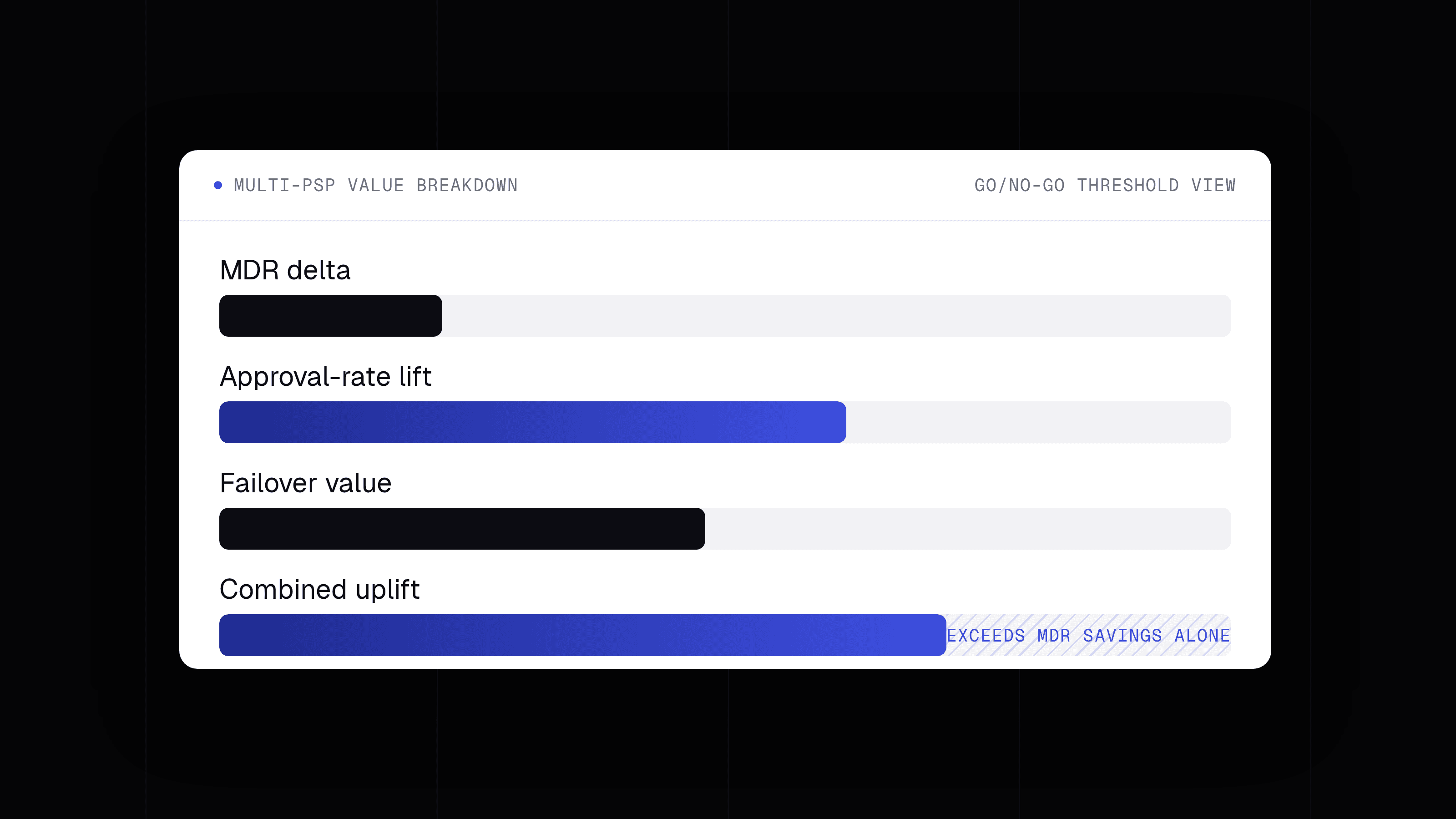
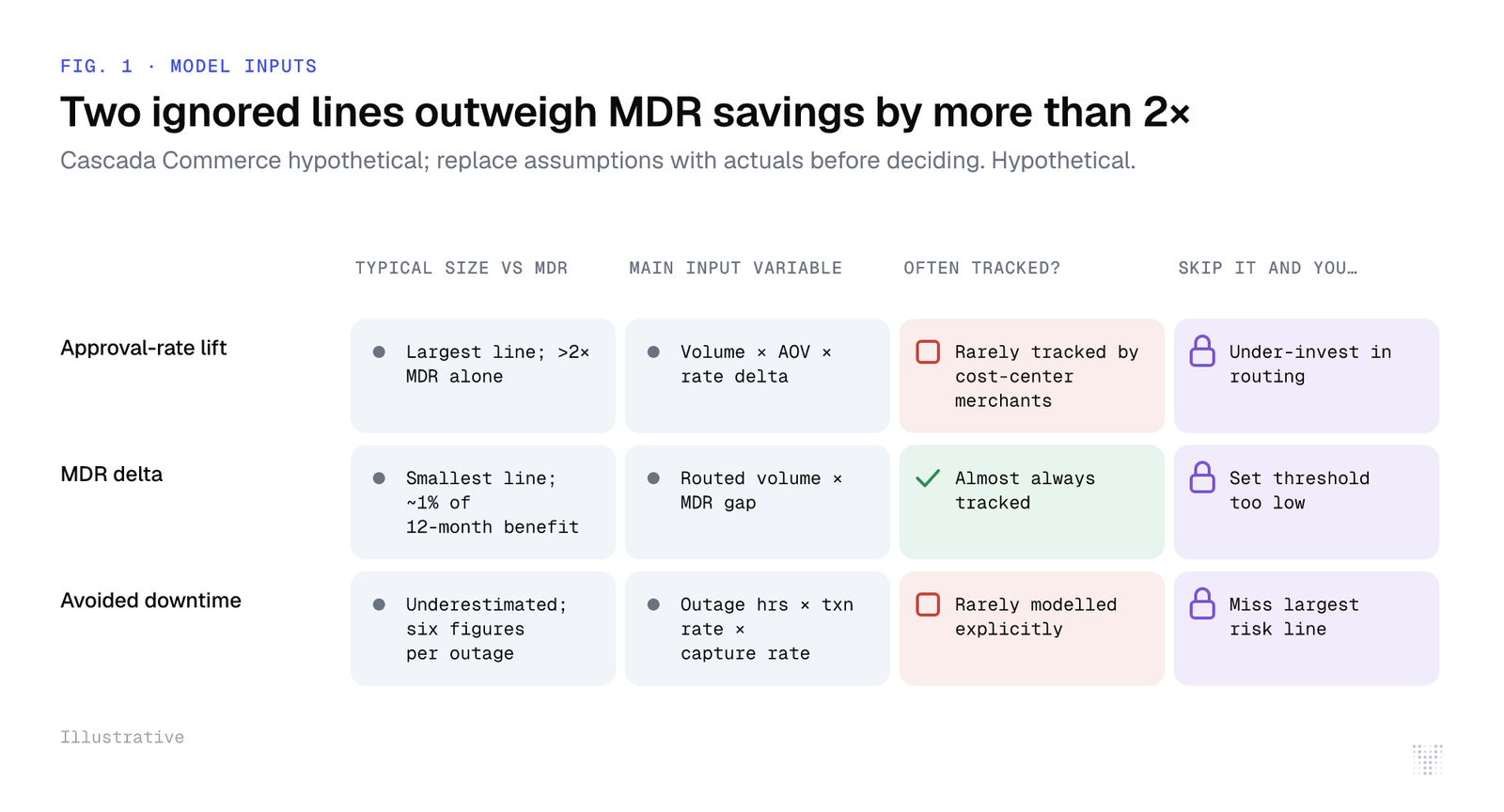
The thesis here is direct: most multi-PSP business cases are approved or rejected on MDR alone. The approval-rate delta and avoided-downtime value together typically exceed the MDR savings by a factor of more than two, and heads of payments who ignore those lines systematically under-invest in routing. This playbook shows you exactly how to run the numbers.
Key takeaways
- MDR savings are real but small. In the worked example below, they represent approximately 1% of total 12-month benefit.
- Approval-rate lift is the largest line. Yuno's Smart Routing delivers an 8-percentage-point uplift on average (c13), and at any meaningful volume that recovers far more revenue than a rate negotiation ever will.
- Downtime value is the most underestimated line. A single PSP outage lasting 8 hours can put six figures of revenue at risk.
- The go/no-go threshold is a number, not a feeling. Compute it before you brief engineering or legal.
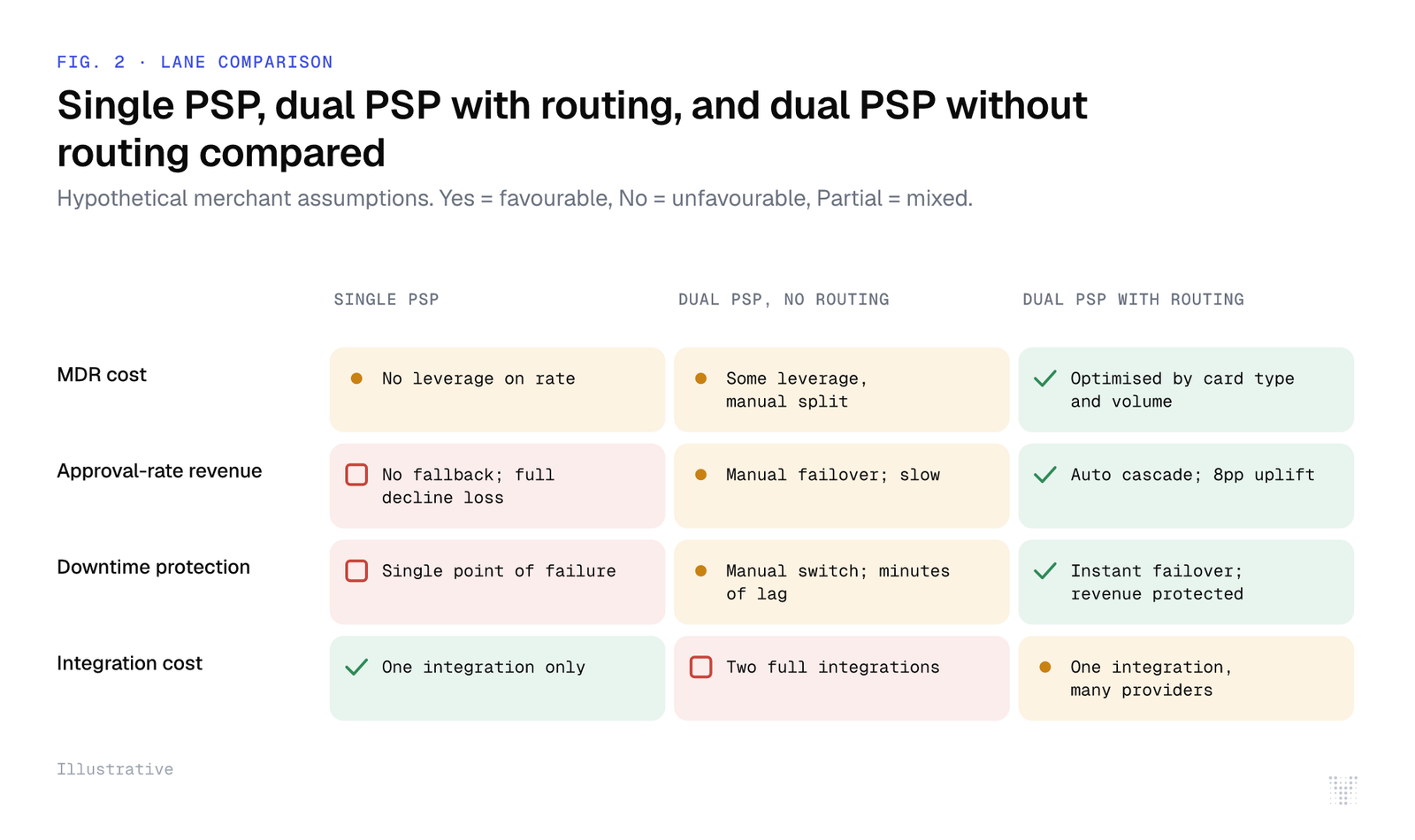
- A routing layer changes the calculus. Without one, dual-PSP delivers a fraction of the benefit at the same integration cost.
Why MDR-only analysis leads you to the wrong answer
When a head of payments evaluates a second PSP on rate alone, the wrong equation is being solved. According to the BCG 2026 Global Payments Report, cost-center merchants are 21 percentage points less likely to track authorization rates than profit-center merchants (c14), and 17 points less likely to track false-positive fraud rates.
These two quantities are not on the same scale. The MDR delta between two PSPs is typically measured in basis points. The revenue impact of a one-point approval-rate improvement at high volume is measured in hundreds of thousands of dollars. The worked example below shows all three benefit lines together so you can see the true shape of the decision.
The practical consequence: merchants who build the case on MDR alone will set a go/no-go threshold that is too low for the right reasons and too high for the wrong ones. Run all three lines before that conversation starts.
The three benefit lines you must model
Benefit line 1: Approval-rate lift
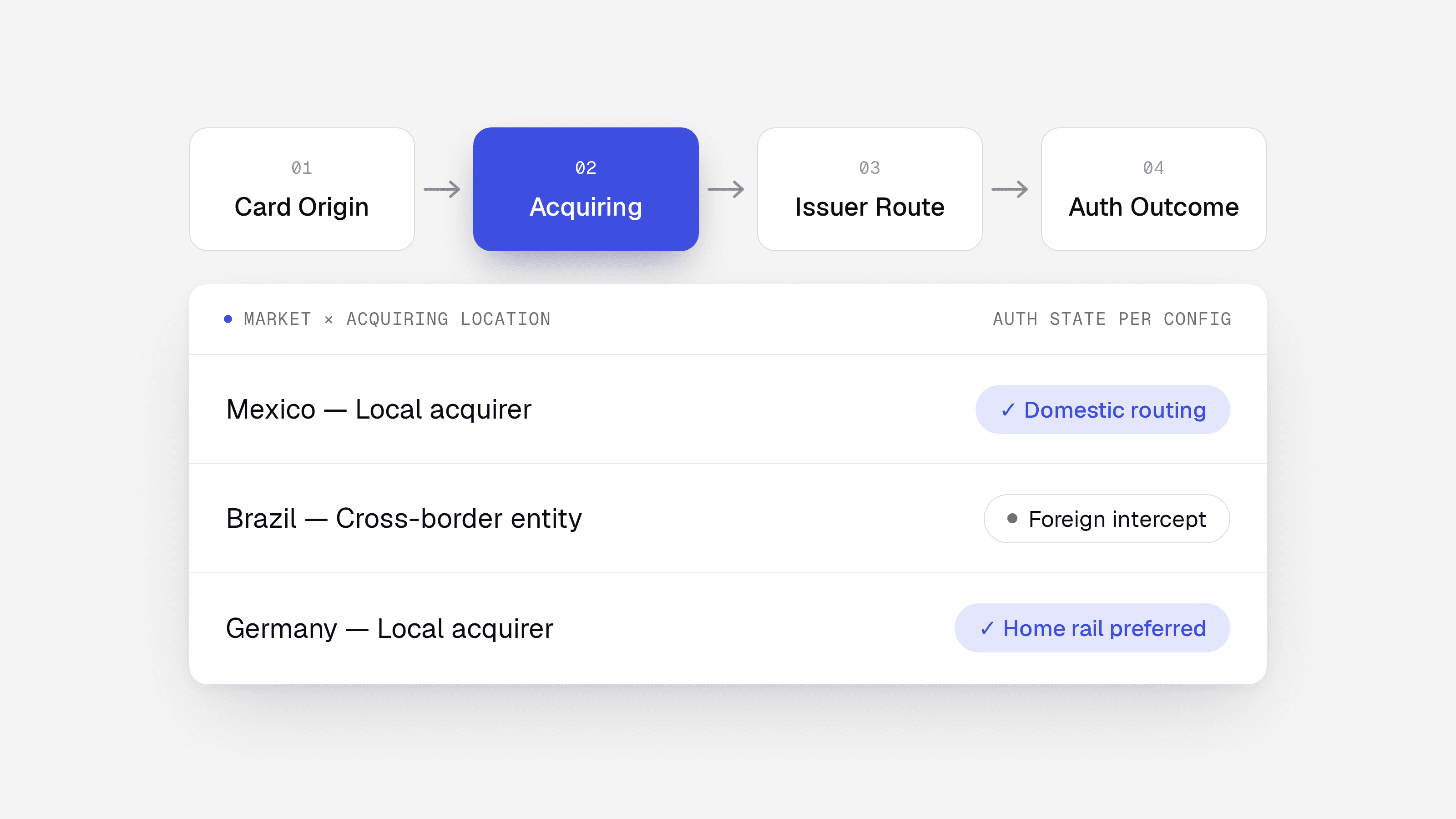
This is almost always the largest line in the model. Routing logic can direct transactions to the most suitable PSP based on card type, transaction amount, currency, and payment origin, according to Yuno's routing documentation (c11).
According to Deloitte (c2), 75% of declined transactions are false positives: legitimate transactions rejected by issuer fraud controls. That is a large pool of recoverable revenue sitting inside your current decline rate. Smart routing captures a portion of it by presenting the transaction to a different acquirer with a different issuer relationship.
Yuno's Smart Routing product delivers an 8-percentage-point approval uplift on average (c13). That figure is the input used in the model below. Use your payment provider's observed figure if one is available. Verify that any benchmark comes from actual transaction data, not a marketing range.
Benefit line 2: MDR delta
MDR savings exist, but they are smaller than most teams assume. Interchange and processing fees vary between PSPs based on merchant category and volume, according to Mastercard US (c7).
The delta is often 10 to 30 basis points on the blended rate, and it only applies to the share of volume routed to the secondary PSP. At high volume, that adds up. But it rarely approaches the revenue value of an approval-rate improvement. Model it accurately and put it in the right column.
Benefit line 3: Avoided-downtime value
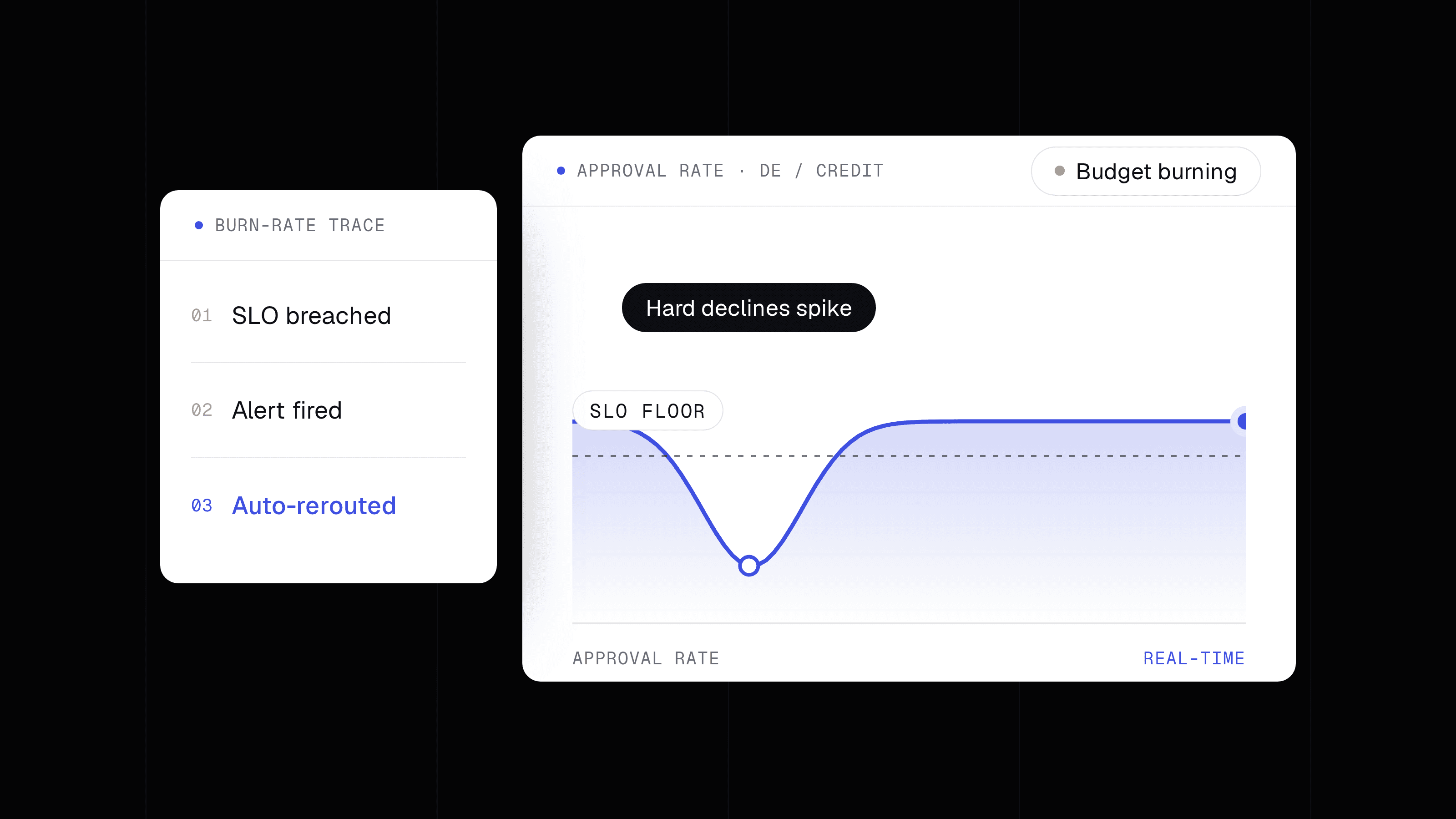
A single-PSP stack has one point of failure, and that failure has a dollar value you can calculate. When your primary PSP degrades or goes offline, every transaction attempted during that window is at risk.
With a failover route configured, those transactions cascade to PSP B. Without one, they fail. The avoided-downtime value is the product of three estimates: expected annual outage hours, transaction rate during that window, and your failover capture rate. The worked example below makes each one explicit.
Worked example: Hypothetical merchant "Cascada Commerce"
This company is hypothetical. Every assumption below is stated. Replace each with your own actuals before making a decision.
Assumptions
- Monthly transaction volume: 500,000
- Average order value (AOV): $45
- Current approval rate (single PSP baseline): 82%
- Target approval rate after smart routing: 90% (baseline plus 8 percentage-point uplift, per Yuno Smart Routing data, c13)
- Primary PSP blended MDR: 2.2%
- Secondary PSP blended MDR: 2.0%
- Share of volume routed to secondary PSP: 40%
- Assumed PSP outage: 8 hours per year
- Failover capture rate: 80% of transactions attempted during outage
- One-time integration engineering cost: $120,000 (moderate-effort integration, per American Express Integration Guide, c6)
- Annual maintenance and monitoring cost: $24,000
- Modelling horizon: 12 months
Benefit line 1: Approval-rate lift
At baseline, Cascada Commerce approves 410,000 transactions per month (500,000 × 0.82). After routing, it approves 450,000 (500,000 × 0.90). The incremental approved transactions per month: 500,000 × 0.08 = 40,000.
Incremental monthly revenue from approval-rate lift: 40,000 × $45 = $1,800,000. Annualised: $1,800,000 × 12 = $21,600,000.
Benefit line 2: MDR delta
Volume routed to secondary PSP: 500,000 × 0.40 = 200,000 transactions per month. The MDR delta is 2.2% minus 2.0% = 0.2 percentage points, which equals $0.002 per dollar of transaction value (interchange rates vary by merchant category and volume, per Mastercard US, c7). Monthly MDR saving: 200,000 × $45 × 0.002 = $18,000. Annual MDR saving: $18,000 × 12 = $216,000.
That $216,000 is real money. It is also approximately 1% of total annual benefit in this model. MDR is not the main event.
Benefit line 3: Avoided-downtime value
Transactions attempted in an 8-hour outage window: (500,000 / 720 hours per month) × 8 = approximately 5,556 transactions. Revenue at risk: 5,556 × $45 × 0.90 = $225,018. With an 80% failover capture rate, avoided-downtime value: $225,018 × 0.80 = approximately $180,014 per year.
Cost
Total first-year cost: $120,000 integration plus $24,000 maintenance equals $144,000.
The 12-month scorecard
| Line | Annual value | Share of total benefit |
|---|---|---|
| Approval-rate lift | $21,600,000 | ~98.2% ($21,600,000 / $21,996,014) |
| Avoided-downtime value | $180,014 | ~0.8% ($180,014 / $21,996,014) |
| MDR saving | $216,000 | ~1.0% ($216,000 / $21,996,014) |
| Total annual benefit | $21,996,014 | 100% |
| Total first-year cost | ($144,000) | |
| Net value at 12 months | $21,852,014 |
The combined approval-rate and downtime value exceeds MDR savings by a factor of more than 100 in this model: ($21,600,000 + $180,014) / $216,000 = 100.8. That ratio will vary with your volume and rate assumptions. The direction, however, is consistent: routing decisions made on MDR alone systematically undervalue the investment.
How to set your go/no-go threshold
The go/no-go threshold answers one question: at what monthly volume does this investment pay back within 12 months? For Cascada Commerce, total first-year cost is $144,000 and monthly benefit is $1,833,001 ($21,996,014 / 12). Payback occurs in less than one month under these assumptions.
Your own threshold calculation works differently. Fix your AOV, your expected approval-rate delta (c13), and your integration cost (c6). Then solve for the monthly volume at which 12-month benefit equals 12-month cost. That is your minimum viable volume. When your current volume sits above it, the investment is defensible. When below, revisit the integration cost assumption first, then the benefit assumptions second.
What changes when you add a routing layer
A direct dual-PSP integration and a dual-PSP integration through a routing layer produce materially different cost and benefit profiles. Without routing logic, volume splits happen manually or by rule, and failover requires engineering intervention.
With routing, the system cascades automatically based on card type, amount, currency, and origin, as described in Yuno's routing documentation (c11). According to the American Express Integration Guide (c6), the lowest-effort path is a single integration covering all payment methods, while customized integrations require moderate effort per method. A direct integration with two PSPs doubles the integration surface and the maintenance burden.
That difference matters for the model. If your integration cost assumption is based on a direct dual-PSP build, your cost figure is higher and your payback period is longer. A routing layer with one integration point activates many providers without additional code, and routing logic optimises every transaction rather than splitting volume by rule.
Heads of payments often frame this as: what is the best platform to see and cut payment costs across several providers? The answer depends on whether the platform provides a shared view of MDR, approval rate, and decline reason across all connected PSPs. Without that view, cost comparisons rely on each PSP's own reporting, which is designed to present that PSP favourably.
Where Yuno fits in this model
Yuno is the AI-native intelligence system of global payments and financial services, and its Smart Routing product is the mechanism behind the approval-rate lift in this model. The 8-percentage-point uplift figure used in the worked example is an approved product claim from Yuno's Smart Routing data (c13).
Yuno connects to 1,000-plus payment methods through a single integration, which changes the cost side of the model. One integration activates many providers, reducing the engineering cost assumption significantly compared to direct dual-PSP builds. Routing logic configures to send transactions to the most suitable PSP based on card type, transaction amount, currency, and payment origin (c11).
For a merchant like Viva Aerobus or Livelo managing volume across multiple markets, that integration efficiency compounds: each new provider or market switches on as configuration, not as a new engineering project. Yuno sits outside the funds flow entirely, so routing decisions occur at the intelligence layer without touching reconciliation logic or token infrastructure. For teams exploring how a payment orchestration layer pays back, the business-case model for finance teams covers the broader investment framework in detail.
The decision framework in four steps
Before signing a second PSP contract, run these four steps in order. Each step produces a number that feeds the next one.
- Establish your baseline approval rate. Get this from your current PSP's reporting. Verify it against your own transaction logs. Know whether it is card-only or all-methods, and hold the definition constant throughout the model.
- Estimate your approval-rate delta. Ask your prospective PSP or routing provider for an observed figure based on your card mix and geography. The 8-percentage-point figure from Yuno's Smart Routing data (c13) is a reasonable benchmark for a routing-enabled configuration. Use an observed figure, not a marketing range.
- Quantify your integration cost honestly. Distinguish between a direct PSP integration and a routing-layer integration. Direct integrations require moderate effort per payment method, according to the American Express Integration Guide (c6). Include annual maintenance in year-one cost, not just the build.
- Build the three-line benefit model. Compute approval-rate lift, MDR delta, and avoided-downtime value separately. Sum them. Subtract total first-year cost. If net value at 12 months is positive and the payback period is acceptable to your finance team, the case is made. If not, identify which single assumption needs to change before revisiting the decision.
For further reading on how payment infrastructure decisions interact with cost across multiple providers, see how to reduce payment processing costs across providers and effective payment processing costs with several PSPs. For the token portability implications of a PSP contract, which belong in your legal review before you sign, see token portability as a contract term.
The business case for a second PSP is a model. Build it with all three lines visible, set your go/no-go threshold before the conversation starts, and you will make the decision on the right basis, not on whichever number a PSP sales team chose to lead with.