What you will learn: This piece explains the three main payout rails, the specific failure modes on each one, and how to design payout redundancy and reconciliation. After reading, you can draw the architecture on a whiteboard and explain to your CFO exactly where your concentration risk sits today.
Most finance leaders have spent years diversifying how they collect money: multiple acquirers, local payment methods, regional processors. Then they look at the outbound side and find one provider handling every payment to every seller, contractor and gig worker in every market. Payouts are where concentration risk now hides, and most companies do not see it until a provider goes down.
Key takeaways
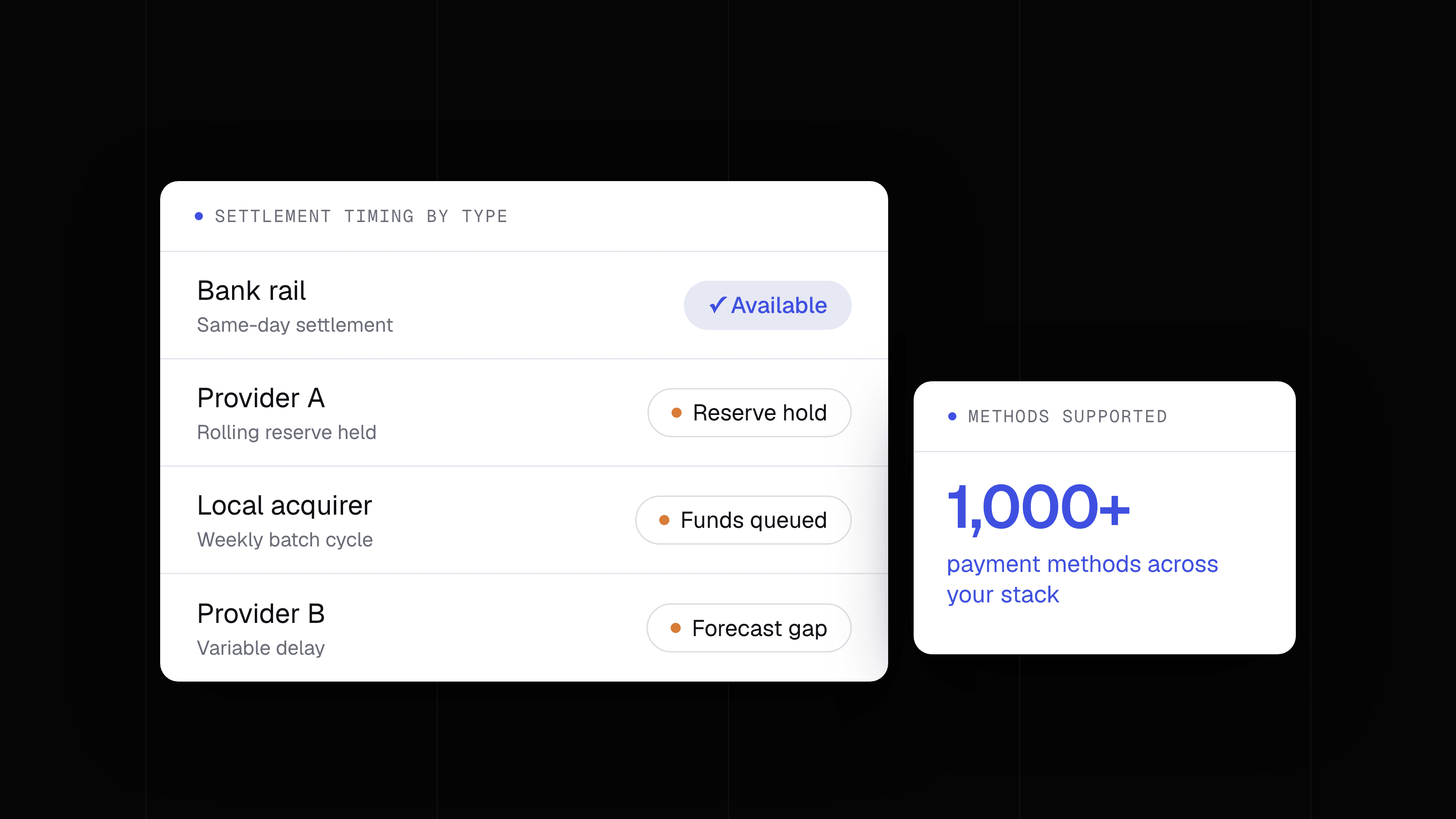
- Three rails carry almost every payout: bank transfer, card push, and digital wallet. Each has distinct settlement timing, failure modes and geographic reach.
- A single payout provider is a single point of failure. According to the Bank of England, dependence on one supplier in a payment network means aggregate risk exceeds the sum of individual participant risks.
- Payout reconciliation must be a separate discipline from payin reconciliation. Returns, holds and timing differences require their own workflow.
- Redundancy means having a second rail ready to fire, not just a second contract with the same provider type.
- Buying a multi-provider payout layer beats building one. The engineering cost of maintaining multiple direct integrations compounds every time you add a corridor.
Why payouts deserve the same attention as collections
Payouts are the moment your business relationship with a seller, driver or contractor becomes real. According to Visa, today's marketplace sellers are entrepreneurs who depend on fast access to their earnings, and delayed payouts have a measurable negative impact on them.
When a payout fails, the damage is not symmetric. A failed collection means lost revenue for you. A failed payout means a worker cannot pay rent. That asymmetry has reputational and legal consequences most finance leaders underestimate.
Yet most companies treat payouts as an operational afterthought. They connect to one payout provider, automate the batch file, and move on. The result is a stack that looks diversified on the collection side and dangerously concentrated on the disbursement side.
The three payout rails: how each one really works
Every payout travels one of three paths: a bank transfer, a card push, or a wallet credit. Understanding each path, including who controls the settlement clock and where failures occur, is the foundation of payout design.
Bank transfer
Bank transfers are the workhorse of B2B and high-value payouts. In the US, ACH is the dominant rail. According to Nacha, approximately 80% of ACH Network volume settles in one banking day or less. Same Day ACH can accelerate that for eligible transactions.
The failure mode is account-detail mismatch. A wrong routing number or account number causes the payment to return, typically within one to two business days. By then your ledger has already moved the funds. You must reverse the entry, investigate the correct details, and retry, adding cost and delay at every step.
Cross-border bank transfers add a compliance layer. According to PwC, if your company is making US-source cross-border payments, FATCA reporting requirements apply and your company is the payor responsible for them. This means contractor payments across borders may require withholding or disclosure before the wire is released.
Card push
Card push (Visa Direct, Mastercard Send) moves funds directly to a debit card, often within minutes. It is the fastest rail for payees who already have a card on file. Settlement is near-real-time for the payee, though funding your push account still follows a schedule you agree with your provider.
The failure mode is eligibility. Not every card accepts push credits. Business debit cards, some prepaid cards, and cards issued in certain markets are not enrolled in push programs. A failed push does not automatically fall back to another rail unless you have designed that fallback explicitly.
Digital wallet
Wallet payouts credit a payee's balance inside a digital wallet. When the payee wants cash, they initiate a cashout to their bank account. According to Nacha, using a Same Day ACH credit, a provider can support faster payouts or cashouts, pushing funds from the wallet to the user's bank account within hours on the same business day.
The failure mode is wallet availability by market. Dominant wallets vary sharply by region: M-Pesa in East Africa, GrabPay across Southeast Asia, UPI-linked wallets in India. A wallet payout strategy built for one market rarely extends cleanly to another without additional integrations.
Where failures actually happen: the payout flight path
Every payout follows a sequence of checkpoints, and each checkpoint is a potential failure point. Mapping this sequence is what turns a vague awareness of payout risk into something you can act on.
The sequence, for a bank-transfer payout, runs like this. Your platform instructs your payout provider. The provider validates the payee's account details. The file clears your bank's cut-off time. The receiving bank accepts or rejects the credit. The payee's account is credited. A webhook fires confirming settlement. Any break in this chain produces a different failure type, requiring a different remediation path.
Three failure categories cover most incidents:
- Pre-send failures: Bad account details, name mismatches, or compliance holds stop the payment before it leaves your provider. These are cheapest to fix because no money has moved.
- In-flight failures: The file is submitted but returned by the receiving bank. The return code tells you the reason (account closed, no such account, payment stopped). These require investigation before any retry.
- Post-credit disputes: The payee claims non-receipt even though your records show settlement. This usually means the funds arrived at the right institution but the wrong account, or were held by the receiving bank for compliance review.
Compliance holds deserve special attention at scale. As cross-border payout volumes grow, sanctions screening and FATCA reporting (according to PwC) add processing time that can push payouts past your SLA with sellers and workers. Building that buffer into your payout schedule is not optional.
The concentration risk hiding in your payout stack
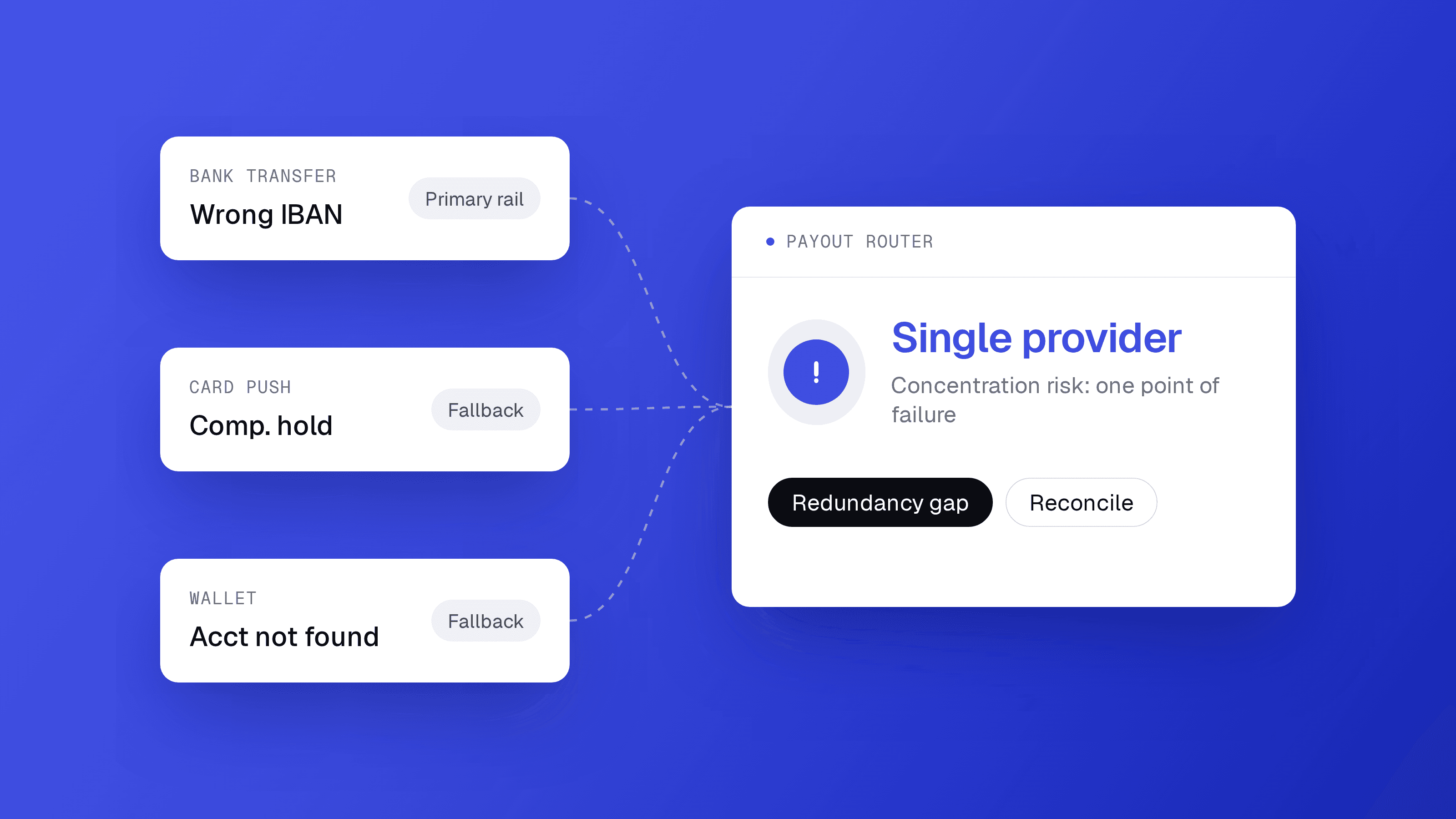
Concentration risk in payouts is the exposure that results when all outbound payments flow through one provider. The Bank of England described this structure precisely: when all network participants depend on a single supplier for infrastructure, the aggregate risk to the network exceeds the sum of individual participant risks.
This is not theoretical. A provider maintenance window, a compliance hold on your merchant account, a commercial dispute, or a regional outage can freeze every payout simultaneously. Your pay-in stack keeps working. Money flows in. Nothing flows out. Sellers notice within hours.
The irony is that the same finance leaders who insist on two or three acquirers for collections have one payout provider because "payouts are simpler." Payouts are not simpler. They are less visible until they break.
According to Visa, delayed payouts negatively impact marketplace sellers who depend on fast access to their earnings. A single-provider outage converts that negative impact from an occasional risk into a certain outcome whenever your provider has a problem.
How to design payout redundancy
Payout redundancy means having a second rail ready to execute, not just a second contract with the same provider type. True redundancy has three components: provider diversity, rail diversity, and routing logic.
Provider diversity
Connect to at least two payout providers in each corridor where you have material volume. Defining "material" is a finance decision: set a threshold in daily payment count or dollar volume above which a single-provider dependency is unacceptable. Then fund that second provider's settlement account so it can fire without a prefunding delay.
Rail diversity
Provider diversity alone is not enough if both providers use the same underlying rail. If Provider A and Provider B both send ACH, an ACH network incident affects both. Pair rails: bank transfer plus card push in markets where payees hold eligible debit cards, or bank transfer plus wallet where card push has low eligibility.
Routing logic
Routing logic decides which rail fires first and what triggers a failover. A simple decision tree works for most platforms:
- Attempt primary rail via primary provider.
- If pre-send failure (bad details), route to your data-quality workflow before retry.
- If provider returns a system error or timeout, switch to secondary provider on the same rail.
- If the rail itself is unavailable, switch to the alternate rail.
- If all automated options exhaust, escalate to a human review queue.
That logic requires a system that knows the status of each provider and each rail in real time. Building that monitoring in-house is possible. Maintaining it as providers change their APIs and status pages is where the build-versus-buy calculus shifts sharply toward buying.
Reconciliation for payouts: a separate discipline
Payout reconciliation is not the same as payin reconciliation, and treating them identically creates blind spots. The timing, the failure types, and the ledger entries are all different.
Three principles make payout reconciliation work:
- Match on settlement, not on instruction. Your ledger entry should reflect when the receiving bank confirmed credit, not when you submitted the file. The gap between instruction and settlement is where returns happen.
- Track every return code. ACH return codes (R02 for account closed, R03 for no account, R10 for stop payment) tell you whether to update the payee's details, escalate to compliance, or simply retry. Lumping all returns into one queue loses that signal.
- Reconcile the payout account balance daily. Your payout provider holds a prefunded float. If your batch files and your settlement reports do not reconcile to the cent, you have an exposure you have not yet found.
For more on building reconciliation across multiple providers, the piece on how enterprise SaaS platforms should think about payment reconciliation when operating across multiple PSPs covers the operational detail.
Worked example: what concentration risk costs a mid-size marketplace
The company below is hypothetical. All inputs are stated assumptions. Derived numbers are shown with their formulas.
Assume a marketplace with 5,000 active sellers paid daily at an average payout of $120 each. Daily payout volume equals 5,000 sellers multiplied by $120, which is $600,000 per day. Assume seller churn from a delayed payout is 3% of daily volume in lost future GMV (a conservative estimate based on stated seller sensitivity to payout timing, per the Visa evidence above). Revenue at risk per disruption day is $600,000 multiplied by 0.03, or $18,000. At five disruption days per year, the annual exposure is $18,000 multiplied by five, which is $90,000. That figure does not include remediation cost, support volume, or the reputational cost of sellers who leave permanently.
Five disruption days per year sounds like a lot. It is not. A single maintenance window, one compliance hold, and three days of a return-file backlog can consume that budget in a quarter.
Where Yuno fits in a payout architecture
Yuno's Payins and Payouts product connects one integration to many providers, covering bank transfers, cards and wallets across 190+ countries. This is the structure that solves the concentration risk described in this piece: a single API above multiple payout providers, with routing logic and reconciliation in one place.
Yuno is out of the funds flow. It does not hold your money or your payees' money. It routes the instruction to the provider you choose, based on the logic you configure. That neutrality matters: Yuno has no incentive to push volume to any single rail or provider, which is the same independence that makes its smart routing advice on the collection side unbiased.
Platforms like Rappi and inDrive operate at significant scale across markets where payout rail availability varies sharply by country. The architecture that handles that complexity, one integration above many local providers, is what Yuno's Payins and Payouts product delivers. You can explore how that product is structured at y.uno/en/product/payouts.
For finance leaders who want to understand the full operational impact of running multiple providers behind one layer, the piece on what changes for operations, finance and engineering when you consolidate several PSPs behind one layer covers the transition in detail.
The action your stack needs today
Map your top five payout corridors by daily volume. For each one, write down the provider, the rail, and what happens if that provider is unavailable for 24 hours. If the answer to the last question is "payouts stop," you have found your concentration risk. The fix is not a new contract with a similar provider. It is a routing layer that can switch rails and providers without a new engineering sprint every time one of them has a problem. Optionality, in payouts as in collections, is the only architecture that holds under pressure.