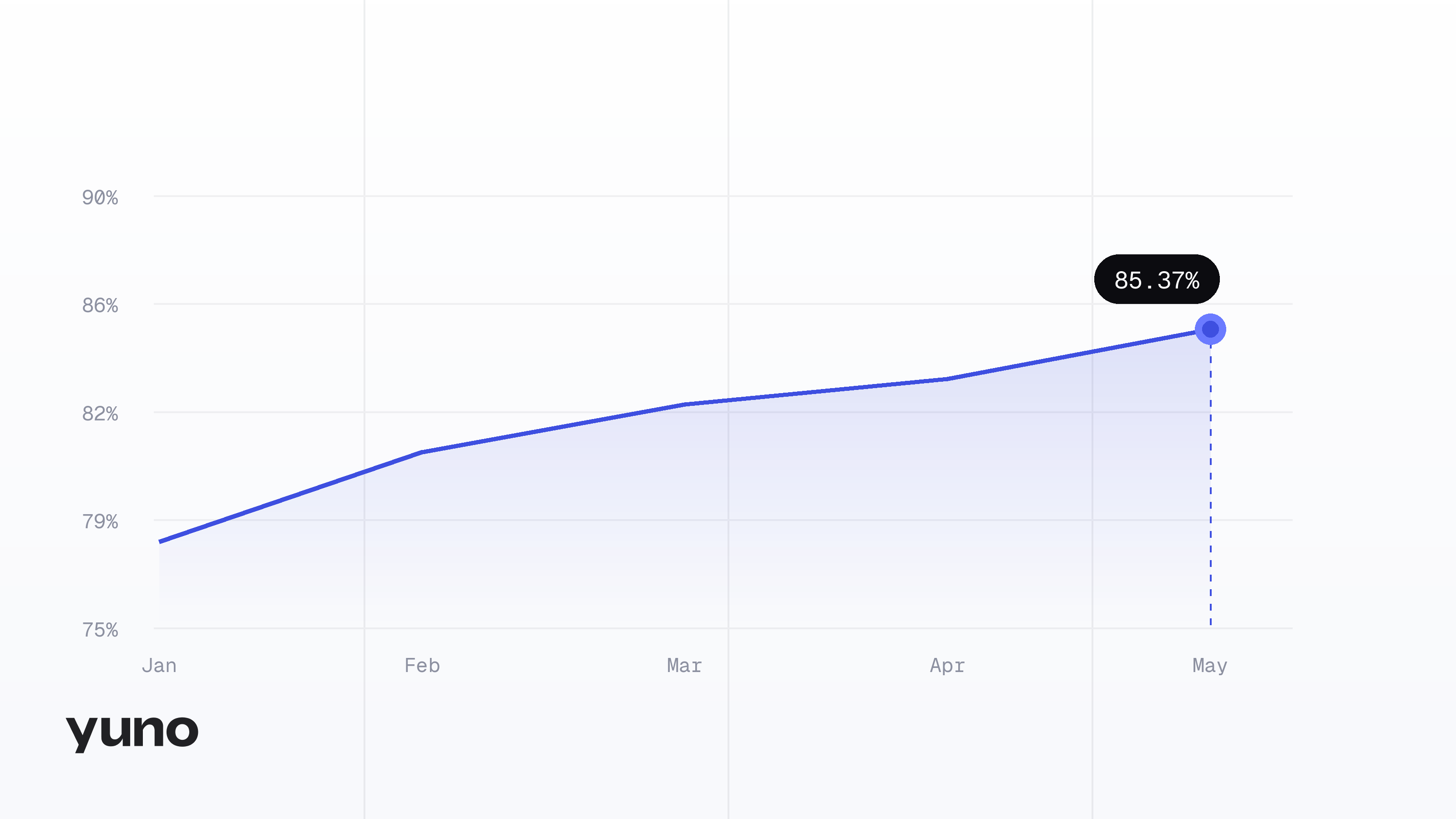
Cross-border payment failures and FX drag cost enterprise merchants between 9% and 20% of annual revenue (industry composite, 2025). Most of that loss is invisible in dashboards because it hides in exchange-rate spreads across correspondent hops, not in the headline fee line. If your goal is to reduce cross-border payment costs, the headline fee is the wrong place to start.
We've built stablecoin orchestration into Yuno's routing layer and watched where the savings actually materialize. The answer is almost never "switch everything to stablecoins." It is "route each corridor to the rail that wins on cost and speed today." That requires a live comparison engine, not a treasury policy.
Key Takeaways
- Most FX cost on cross-border payments accumulates in correspondent banking spread, not the wire fee itself. Each additional hop adds margin and opacity.
- Stablecoin cross-border payments priced below interbank rates throughout every month of Q2 2026 across tracked global payment corridors (Bain & Company, December 2025; Borderless.xyz Q2 2026 benchmark).
- Single-provider routing cost businesses an extra $2,330 per $1 million moved during Q2 2026, compared to optimized multi-rail routing.
- Yuno's smart routing delivers an 8% average authorization rate uplift across enterprise merchants, with stablecoin rails active as a competing option alongside bank and card rails (Yuno platform data, 2026).
- Stablecoins work best as a selective rail on high-value or volatile-currency corridors. They do not replace card rails or local payment methods for consumer transactions.
Where FX Cost Actually Hides in Cross-Border Payments
The true cost of a currency conversion is almost never the advertised fee; it is the spread applied to the exchange rate, which correspondent banks rarely disclose upfront. Each additional banking hop introduces another conversion point, another margin, and another layer of opacity before funds reach the destination.
A wire routed through three correspondent banks can accumulate 1-3% in hidden spread before the headline transfer fee appears. Merchants see the fee. They almost never see the spread.
Traditional correspondent banking costs 2-5% in combined fees and takes one to five business days to settle, with Nostro and Vostro account float earning 0.5-1% at best. That math made sense when SWIFT was the only option. Today, multiple rails compete on the same corridors, and every day spent on a slower, more expensive rail is a margin decision made by default.
In our integrations across enterprise merchants processing significant cross-border volume, the spread problem compounds in three specific situations: payments touching volatile-currency markets, high-value B2B transfers where basis points matter, and any transaction that crosses a weekend or public holiday and sits in a correspondent queue.
How Multi-Rail Routing Reduces Cross-Border Payment Costs
Multi-rail routing dynamically selects between bank rails, card networks, real-time payment networks, and stablecoin settlement based on corridor cost, speed, and regulatory availability for each transaction. It treats every rail as a competing option rather than a fixed default, so the cheapest compliant route wins on each payment.
The logic sounds straightforward. The hard part is execution: you need live cost data across rails, real-time availability checks, fallback sequencing, and a reconciliation layer that handles settlements arriving from different infrastructure. Most merchant payment stacks were not built to compare rails in parallel. They were built to route to one provider per corridor.
For a deeper look at how cross-border routing has evolved from an access problem into an optimization problem, see how cross-border routing became an optimization problem.
The gap between single-rail and optimized multi-rail routing is now quantifiable. Single-provider routing cost businesses an extra $2,330 for every $1 million moved during Q2 2026, compared to corridors where multi-rail routing was active. That figure reflects spread, fees, and settlement float combined, not just the wire cost.
When Stablecoins Win on Cross-Border Corridors
Stablecoins perform best as a rail on corridors where correspondent banking spread is high, settlement time is slow, or banking hours create liquidity gaps. Bain & Company identified near-instant, lower-cost settlement as the primary structural advantage of stablecoins over traditional wires for cross-border B2B payments (Bain & Company, December 2025).
That advantage is not uniform. A payment from a UK merchant to a US supplier on a Tuesday morning may clear cheaply and quickly on SWIFT. The same corridor on a Friday afternoon, or into a market with a weaker banking infrastructure, changes the math entirely.
Stablecoin cross-border payments priced below interbank rates throughout every month of Q2 2026 across the global payment corridors tracked in the Borderless.xyz Q2 2026 benchmark. The spread advantage held across high-value corridors. It was most pronounced on routes with multiple correspondent hops and in markets where local currency volatility drives FX premiums.
From our work with enterprise marketplaces processing cross-border payouts, stablecoins consistently deliver on three corridor types:
- High-value B2B transfers where the spread on a 2% FX margin is material in absolute dollar terms
- Volatile-currency corridors where holding a dollar-pegged settlement asset protects against depreciation between payment initiation and receipt
- Corridors where banking hours create multi-day settlement windows and the business needs liquidity faster
They are not the answer for consumer-facing checkout. Card rails and local payment methods still dominate conversion at the point of purchase. The stablecoin rail is a treasury and settlement tool, not a checkout experience.
Why Stablecoins Alone Do Not Solve the FX Problem
A stablecoin denominated in USD does not eliminate FX exposure for a merchant paying a supplier in euros or a platform settling to creators in emerging markets; it moves the conversion point, not the conversion cost. The FX event still happens, either at on-ramp or off-ramp, and if only one provider handles that conversion, the spread problem reappears in a different form.
This is the structural limitation that single-stablecoin strategies miss. The on-ramp spread, the off-ramp spread, and the liquidity provider's margin still exist. They are just less visible than a SWIFT fee, which makes them harder to audit.
We've seen merchants move from traditional rails to a single stablecoin provider expecting cost savings, then discover their effective FX cost was similar because the provider was the sole price-setter on the conversion. The reduction in correspondent banking hops was real. The savings were not.
The answer is to apply the same multi-provider logic to stablecoin routing that already governs card routing. Multiple liquidity providers, real-time spread comparison, and corridor-specific routing rules mean no single provider sets the price. Yuno's stablecoin orchestration layer manages liquidity across currencies and providers, and routes each cross-border transaction to the cheapest compliant option at the moment of payment.
How Yuno Routes Between Bank Rails and Stablecoins in Practice
Yuno's stablecoin module sits inside the orchestration layer as a competing rail option, not a separate integration. Smart Routing evaluates bank rails, card networks, real-time payment networks, and stablecoin settlement in parallel for each transaction, then selects the route that optimizes for cost, speed, and availability given the corridor and payment type.
The operational implications are significant. Merchants do not run parallel treasury setups with separate teams managing each rail. The routing decision is automatic, the reconciliation is unified, and fallback sequencing is configured once. If a stablecoin liquidity provider is unavailable or spreads widen above a threshold, traffic routes back to the traditional rail without manual intervention.
For payment operations teams tracking performance across providers, Payments Concierge surfaces real-time cost and approval comparisons across all active rails, including stablecoin. That visibility is only possible from a neutral layer. Any provider that owns a rail has a structural incentive to show its own performance favorably; Yuno owns no rail and sells no acquiring.
Yuno's smart routing delivers an 8% average authorization rate uplift across enterprise merchants (Yuno platform data, 2026). On cross-border corridors where stablecoin settlement is active, the cost reduction compounds that approval benefit with lower FX drag. Both levers work from the same configuration, with no additional integration.
For merchants who want to understand the full cost picture across their provider mix, the guide to managing merchant account payment costs covers how to surface and benchmark fees across your stack before adding a new rail.
What a Practical Cross-Border Cost Reduction Looks Like
Reducing FX costs on cross-border payments requires three changes in sequence: audit corridor cost, activate multi-rail comparison, and set routing rules by corridor type. Skipping the audit means adding a new rail without knowing whether it is actually cheaper for your specific payment mix.
Based on our infrastructure and the routing decisions we see across enterprise payment stacks, here is the sequence that produces measurable cost reduction:
- Map your top 10 cross-border corridors by volume and identify the effective FX cost per corridor, including hidden spread, not just the headline fee.
- Benchmark those corridors against stablecoin settlement cost at current spreads for the same currency pairs.
- Set routing rules to prefer stablecoins on corridors where the spread advantage exceeds your on-ramp and off-ramp conversion cost.
- Configure fallback to bank rails when stablecoin liquidity providers widen spreads above threshold, or when regulatory constraints apply.
- Monitor effective FX cost per corridor continuously, because spread advantages shift with liquidity conditions and market volatility.
This is a dynamic routing problem, not a one-time treasury decision. The corridors where stablecoins win in Q3 may not be the same ones that win in Q1, depending on liquidity conditions and FX volatility in each market.
For merchants operating across multiple markets, the cross-border payments orchestration architecture that supports this routing is covered in detail in how payment orchestration optimizes cross-border transactions.
The Operational Case for a Neutral Routing Layer
The only entity that can compare stablecoin rails against bank rails without a conflict of interest is one that owns neither. Every provider that sells stablecoin settlement and also holds your FX conversion business has an incentive to show its rail favorably in any cost comparison.
Yuno owns no rail, processes no acquiring, and holds no FX position. When our routing engine compares a stablecoin settlement option against a SEPA transfer or a Faster Payments credit, the comparison uses live cost and availability data with no thumb on the scale.
That neutrality matters more as stablecoin liquidity markets mature and spread variance between providers grows. In thin markets, the difference between the best and worst stablecoin conversion rate on a single corridor can exceed the cost advantage over correspondent banking. The only way to capture the rail's structural advantage consistently is to compare multiple providers in real time, which requires a routing layer that has no stake in which provider wins.
We've seen enterprise payment teams build this comparison manually, running periodic corridor audits and updating routing tables quarterly. The savings are real but lag the market by weeks. Automated routing that checks spread in real time captures the corridor advantage on every transaction, not just the ones that happen to fall after a manual review.
For heads of payments evaluating how stablecoins fit into a broader treasury and settlement strategy, the Yuno Stablecoins product page covers the full capability, including how liquidity management across currencies works alongside traditional rails.
Practical Takeaway for Heads of Payments
Start with a corridor audit before activating any new rail. Map the top 10 cross-border corridors by volume, calculate effective FX cost including hidden spread on each, and compare that against current stablecoin settlement cost for the same pairs. The corridors where stablecoins clear cheaply and quickly are the ones to activate first.
Do not build a separate stablecoin stack. The operational overhead of managing a parallel treasury setup, separate reconciliation, and separate compliance monitoring erodes the savings the rail was supposed to generate. Route stablecoins through the same orchestration layer that governs your card and bank rail decisions, so routing rules, fallback sequencing, and cost monitoring are unified.
The businesses that reduce cross-border payment costs most durably are the ones that treat rail selection as a continuous optimization problem, with real-time data driving every decision, rather than a quarterly treasury review that always arrives slightly too late.