
Agentic Commerce: The Next Revenue Channel for Merchants

Agentic commerce is moving from idea to behavior. In this model, AI agents don’t just suggest products. They complete tasks across the full journey: product discovery, checkout, and post purchase support. Generative AI and modern AI tools power this shift and connect models to real systems.
The market signal is already clear. AI-driven traffic to U.S. retail sites grew 4,700% year over year (July 2025), and those visits show stronger engagement signals over time. in their analysis of generative AI-powered shopping. For U.S. merchants, that means new demand is forming through AI surfaces right now.
For enterprise teams, the next question is not “Should we build agents?” It is: Will your payment systems convert agent-led demand into revenue?"
Agent-led shopping moves fast. When an agent hits checkout, there is no patience for payment declines, confusing payment options, or a fragile payment gateway setup. Payment failures become immediate revenue loss.
This is the moment where agentic commerce and payment orchestration meet.
The funnel is changing; payments are now in the spotlight
Traditional ecommerce funnels were built for humans. A shopper can retry after a card decline, switch payment methods, enter a new billing address, or overcome friction. But they're often hesitant to go through all these hurdles to complete a simple purchase.
Agentic commerce compresses the funnel – agents act in seconds. Google describes this shift toward agent-driven retail journeys as part of its view of agentic commerce for retailers.
Traditional funnel
- Browse
- Cart
- Checkout
- Support
Agentic funnel
- Intent
- Agent decides
- Agent checks rules
- Agent checks out
- Agent handles support
That shift changes the cost of friction. In an agent-led flow, one failed transaction is often the end of the sale.
What is agentic commerce?
Agentic commerce is ecommerce where agentic AI acts on behalf of users and brands.
Agents can:
- Compare products across sites and commerce platforms
- Select a payment method based on user preference and probability of success
- Execute checkout steps without the shopper doing the work
- Manage customer service tasks like order updates, returns, and reorders
- Support recurring payments (subscriptions, replenishment, memberships)
What agents will require from merchants
Agents will choose merchants that are easy to transact with. That means merchants need two things.
1) Agent-ready data
Agents need clean and current information:
- Product attributes
- Taxes and shipping
- Inventory and delivery promises
- Return rules
They also need checkout inputs that reduce mistakes:
- Correct billing addresses
- Accurate expiration dates
- Secure handling of card numbers
- Validated payment data
If this data is messy, it can increase the likelihood of a decline. The decline may appear as an “issuer decision,” but the root cause can be basic: incorrect formatting, missing fields, or mismatched address data.
2) Agent-ready checkout
Agents need predictable checkout flows with:
- Multiple payment methods per market (local + global)
- Modern payment options, including digital wallets
- Fast confirmation and order events
- Support for regional compliance steps
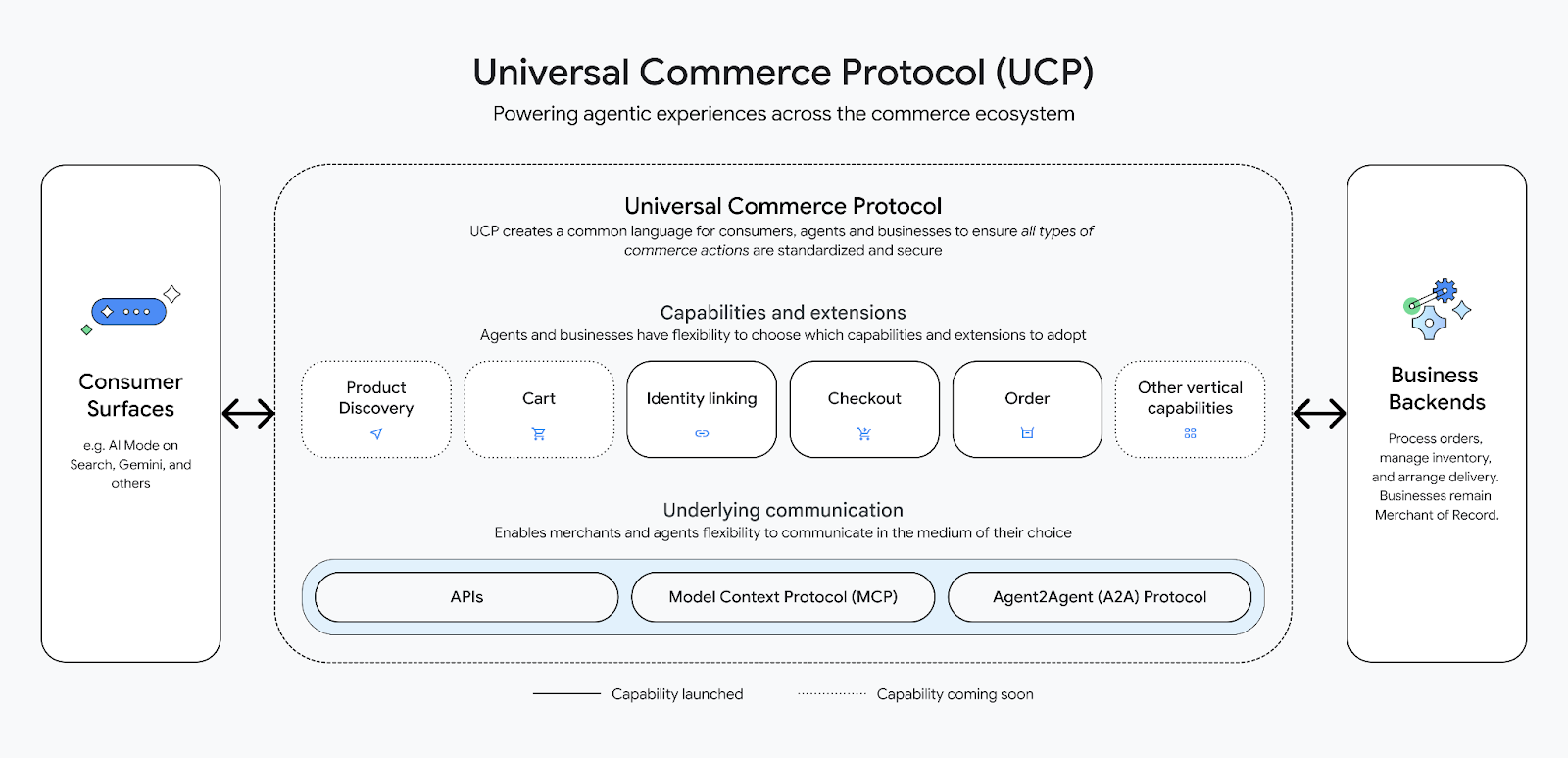
Google has also announced the Universal Commerce Protocol (UCP) to help platforms, agents, and businesses connect across discovery, buying, and post-purchase flows in its post on agentic commerce and UCP. The direction is clear: cleaner handoffs, fewer fragile workarounds.
Trust is the new conversion lever
Agentic commerce adds a new risk: merchants must know who is on the other side of the transaction.
That means verifying:
- The agent is legitimate
- The shopper has given consent
- Spending limits are enforced
- Bots and abuse are blocked
Visa introduced the Trusted Agent Protocol to support secure communication, trust, and controls for agent-based commerce.
Trust checks affect authorizations. If fraud rules are weak, you can lose money. If they are too strict, you will see payment declines and lower customer satisfaction.
Better outcomes come from layered security: strong authentication, smart fraud detection, and low-friction identity.
Why payments become the bottleneck in agentic commerce
Agentic commerce can generate demand. But revenue is only real when payments clear.
In ecommerce, payment failures come from a few recurring sources:
- Issuing bank or card issuer declines (risk rules, velocity checks, limits)
- Card network routing constraints or regional rules
- Bad payment data (wrong expiration dates, mismatched billing addresses)
- Technical issues at the payment gateway, processor, or provider
- Strict fraud tooling creates false positives
- Weak retry logic for recurring payments
- Missing local payment method coverage for the market
In agent-led flows, these problems are sharper. A human might retry; an agent will often pick another merchant.
This is why payment orchestration and transaction routing are now strategic. They help merchants reduce failed transactions, lift approval rates, and protect conversion at scale.
What “agentic payments” should mean in practice
In the agent era, “good payments” is not “one provider and hope.” Agentic payments should include:
- Smart transaction routing to improve approval rates by market and method
- Automatic fallbacks when a provider is down
- Support for multiple payment options, including digital wallets
- Tokenization so you are not handling raw card numbers
- Routing rules that consider issuer behavior and cost, not just uptime
- Consistent reconciliation so finance teams can trust outcomes
This is not just a stack choice. It is a revenue lever.
Where Yuno fits: global reach + performance, built for execution
Yuno is built for this moment. When AI-powered commerce creates intent, Yuno helps you convert it through reliable payment orchestration.
Global Reach
Agents act globally. They do not care how hard it is to launch a market. They care whether you accept the correct payment method.
Yuno helps merchants:
- Offer local payment options by default
- Expand into new regions with one integration
- Support multiple payment methods without rebuilding checkout each time
Performance Optimization
Agentic commerce rewards reliability. Payment declines punish it.
Yuno allows merchants to:
- Improve approval rates with intelligent transaction routing
- Recover failed transactions with automatic fallbacks
- Reduce payment failures tied to provider downtime and technical issues
- Analyze performance by market, method, and provider in real time
Don’t lose the customer relationship
There is a real risk in agentic commerce. If shopping starts and ends on external AI surfaces, merchants can lose direct customer context and data.
To protect your value:
- Keep catalog and policy data clean
- Make post-purchase support fast and consistent
- Treat payment success as part of the brand experience
- Measure agent-driven traffic as a distinct channel
Customer satisfaction will increasingly depend on reliability across the whole lifecycle, not just the product.
What to measure in agentic commerce
Track these metrics by region, provider, and payment method:
- Agent-driven traffic share
- Conversion rate from agent-led flows
- Approval rates and decline reasons (issuer vs gateway vs fraud)
- Recovery rate for failed transactions (fallbacks, retries)
- Cost per approved order
- Recurring payments performance (churn and retries)
- Post-purchase resolution time and customer satisfaction
AI shopping behavior is maturing over time, so start planning for it now.
A practical 60–90 day plan
Days 1–30: Stabilize one journey
- Pick one high-volume flow and one market
- Reduce data-driven declines (billing address checks, expiration dates validation)
- Add digital wallets and local payment options
- Baseline payment declines and approval rates
Days 31–60: Add routing and recovery
- Enable transaction routing rules by market and method
- Add fallbacks to reduce failed transactions during outages
- Tune fraud detection to reduce false positives
Days 61–90: Scale and operationalize
- Expand into 1–2 more markets
- Separate reporting for agent-led flows
- Improve finance visibility and reconciliation
Conclusion
Agentic commerce is becoming a real revenue channel. AI-driven shopping traffic is rising. Standards like commerce protocol work are forming. Trust frameworks are being built. And agent-to-merchant connections will continue to get easier.
When an AI agent is ready to buy, can you avoid payment failures, reduce payment declines, and protect approval rates (across markets and payment methods)?
Yuno helps you do that with payment orchestration built for agentic payments.
Turn agentic commerce into approved revenue. Let’s map your markets, payment options, and routing strategy, and lift approval rates where it matters.
More from the Blog
More from the Blog



%20(1)%20(1).png)


Talk with one of our payment experts
Explore how Yuno's innovative payment orchestration solutions can help you increase approval rates, reduce costs, seamlessly integrate over 1,000 global and local payment methods, and simplify payment management.
Yuno is proudly certified to the highest industry standards, ensuring that data is handled with the utmost security and compliance. Its certifications include ISO 27001 and ISO 27701 for information security and privacy management, GDPR compliance for data protection, PCI DSS for secure payment processing, SOC 2 Type 2 for service organization controls, and recognition as a Visa Service provider. These certifications demonstrate Yuno's commitment to delivering trusted and secure services for businesses worldwide.


%20(1)%20(1).png)