What you will learn: Every hop in a stablecoin settlement, who holds the funds at each stage, where FX is priced, what the GENIUS Act and MiCA require of each party, and a decision framework for when the stablecoin rail beats a bank wire and when it does not.
The thesis here is direct: stablecoin settlement is a rail, not a strategy. It wins on specific corridors, at specific ticket sizes, and at specific times. It loses elsewhere. That means it belongs in a routing decision alongside cards, wires, and local real-time rails, not in a treasury headline about crypto adoption.
Key takeaways
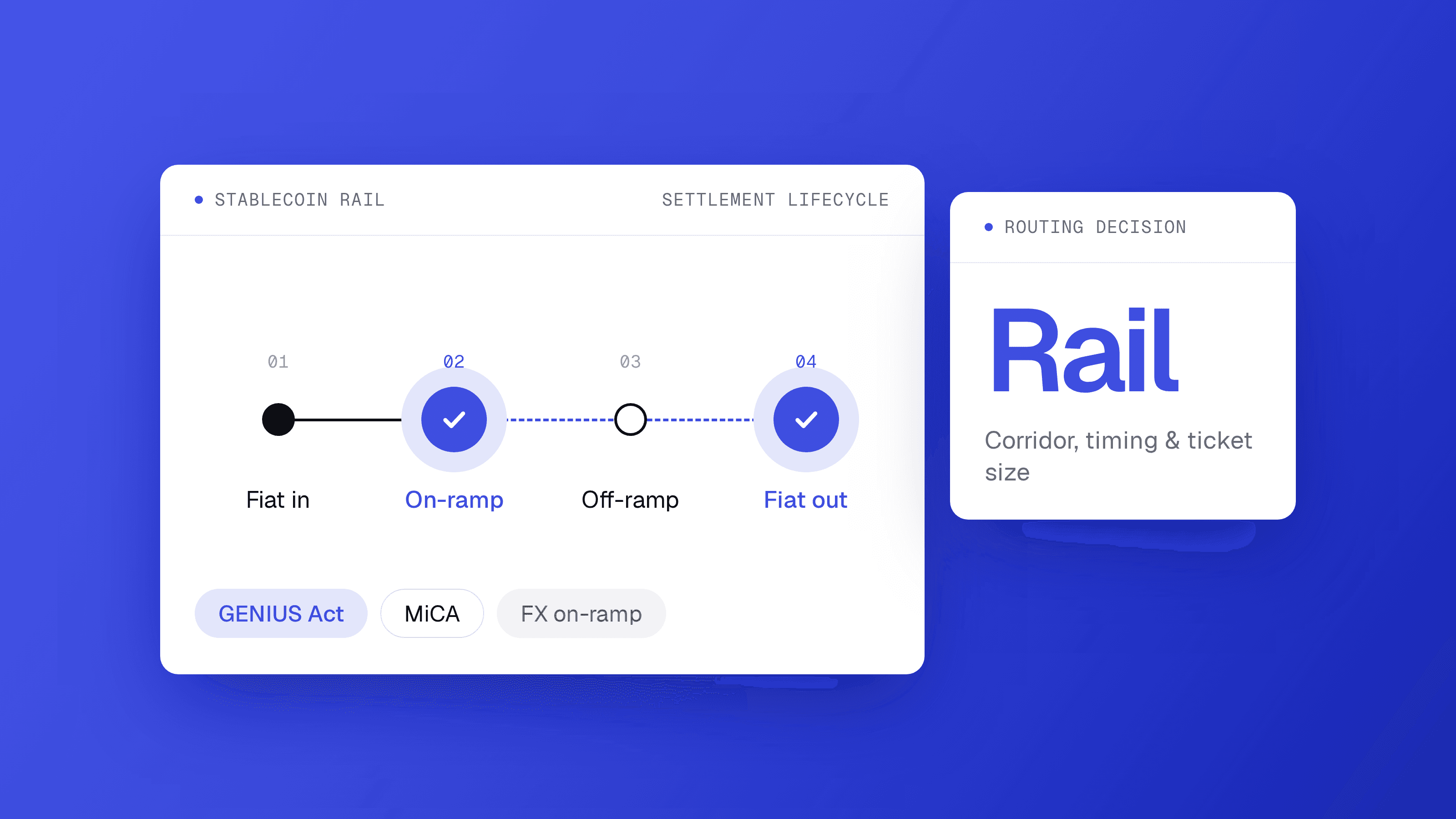
- Stablecoin settlement has five distinct hops: fiat deposit, on-ramp, chain transfer, off-ramp, fiat out. Custody changes at every hand-off.
- FX is priced twice: once at the on-ramp, once at the off-ramp. The bigger exposure is usually at the off-ramp when converting to a local currency.
- Three regulatory frameworks govern different actors in the same payment. FinCEN rules cover exchanges, the GENIUS Act covers token issuers, and MiCA covers EU reserve custody.
- The rail wins on large-ticket, emerging-market corridors and outside banking hours. It loses on small tickets and domestic payments where real-time rails already run cheaply.
- Routing stablecoins as one option among many, not as the default, is what turns the rail into a performance tool.
The five hops: a whiteboard anatomy
A stablecoin payment is a relay race with five legs, and a different party holds the baton at each one. Walk through them in order and the whole system becomes clear.
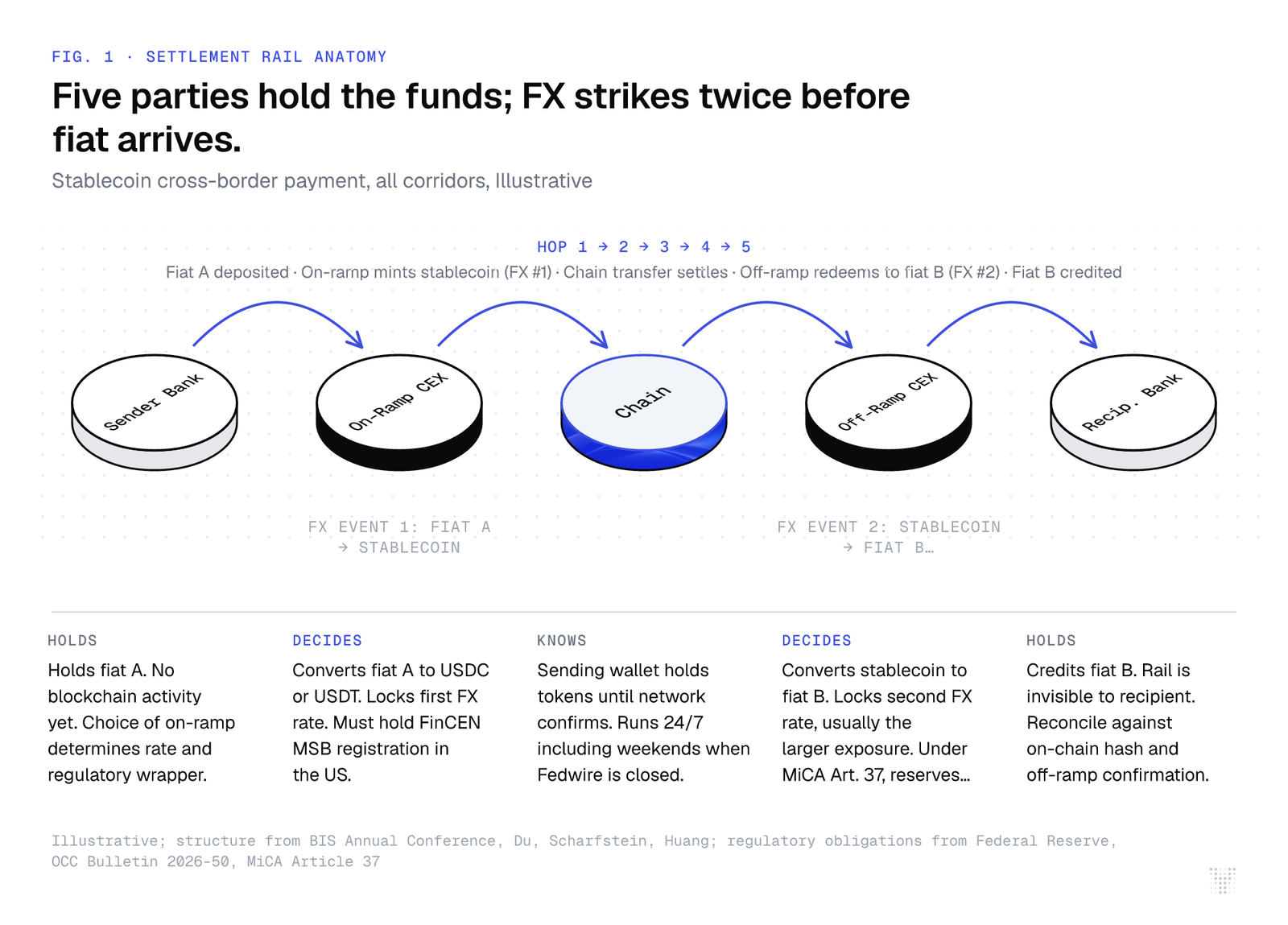
Hop 1: Fiat deposit
The sender's bank holds the funds. Nothing has moved on a blockchain yet. This leg looks identical to any bank-initiated wire. The merchant or treasury's choice of on-ramp determines the exchange rate and regulatory wrapper for every subsequent hop.
Hop 2: On-ramp via CEX
The on-ramp exchange converts fiat A into a stablecoin, typically USDC or USDT. According to BIS Annual Conference research by Du, Scharfstein, and Huang, the structure runs: fiat A, on-ramp via CEX, then USDC or USDT on-chain. This is where the first FX rate is locked and where the first regulatory obligation lands.
In the United States, the on-ramp operator is a money services business. According to the Federal Reserve, each money services business must register with FinCEN whether or not it is licensed as an MSB by any state. That registration sets a federal floor independent of state licensing. Your treasury team may not carry this obligation directly. Confirm that every on-ramp counterparty holds it before transacting.
Hop 3: Chain transfer
Once released from the exchange's custody, the token moves on-chain. The sending wallet holds the tokens until the network confirms the transaction. Settlement finality depends on the chain: some chains confirm in seconds, others in minutes. The chain runs continuously, which is the core timing advantage over rails like Fedwire.
According to the Federal Reserve Fedwire Funds Service Product Sheet, Fedwire settles same-day with finality. Credit to the receiving participant's master account in central bank money is final and irrevocable. That is a high bar. The stablecoin chain matches finality but adds 24/7 availability, including weekends and holidays when Fedwire is closed.
Hop 4: Off-ramp via CEX
The off-ramp exchange converts the stablecoin back to fiat B. This is the second FX moment, and usually the larger one. If the recipient operates in a local currency, the off-ramp rate determines what they actually receive. According to BIS Annual Conference research by Du, Scharfstein, and Huang, stablecoins can offer favourable FX pricing for transfers from developed markets to some emerging market economies, though this advantage is corridor-specific and not universal.
In the European Union, the off-ramp operator is subject to MiCA. Under MiCA Article 37, reserve assets must be held in custody by a designated custodian: a crypto-asset service provider, a credit institution, or an investment firm. That custodian must be designated within five working days of token issuance. The reserve custodian is separate from the issuer and separate from the payment processor. This segregation is a structural requirement.
Hop 5: Fiat out to recipient bank
The recipient's bank credits fiat B. From the recipient's perspective, this looks like any incoming wire. The stablecoin rail is invisible to them. Settlement is complete, and the finance team can reconcile against the on-chain transaction hash and the off-ramp confirmation.
Where FX lives and what it costs
FX in stablecoin settlement is two events that compound, and both must be priced before choosing the rail. Treating them as one blended cost leads to routing errors.
At the on-ramp, the exchange converts fiat A to the stablecoin. If fiat A is USD and the stablecoin is USD-pegged, the spread is usually a small fee plus a fixed charge. At the off-ramp, the exchange converts the stablecoin to fiat B. If fiat B is a local currency in an emerging market, this is a true FX trade with a bid-ask spread. The combined cost of both conversions must be compared against the correspondent banking spread on the same corridor before concluding the rail is cheaper.
The regulatory layer: three frameworks, three actors
Three different rule sets govern three different parties in the same payment, and none of them falls directly on the merchant. Understanding which applies to whom prevents both over-compliance and gaps in counterparty due diligence.
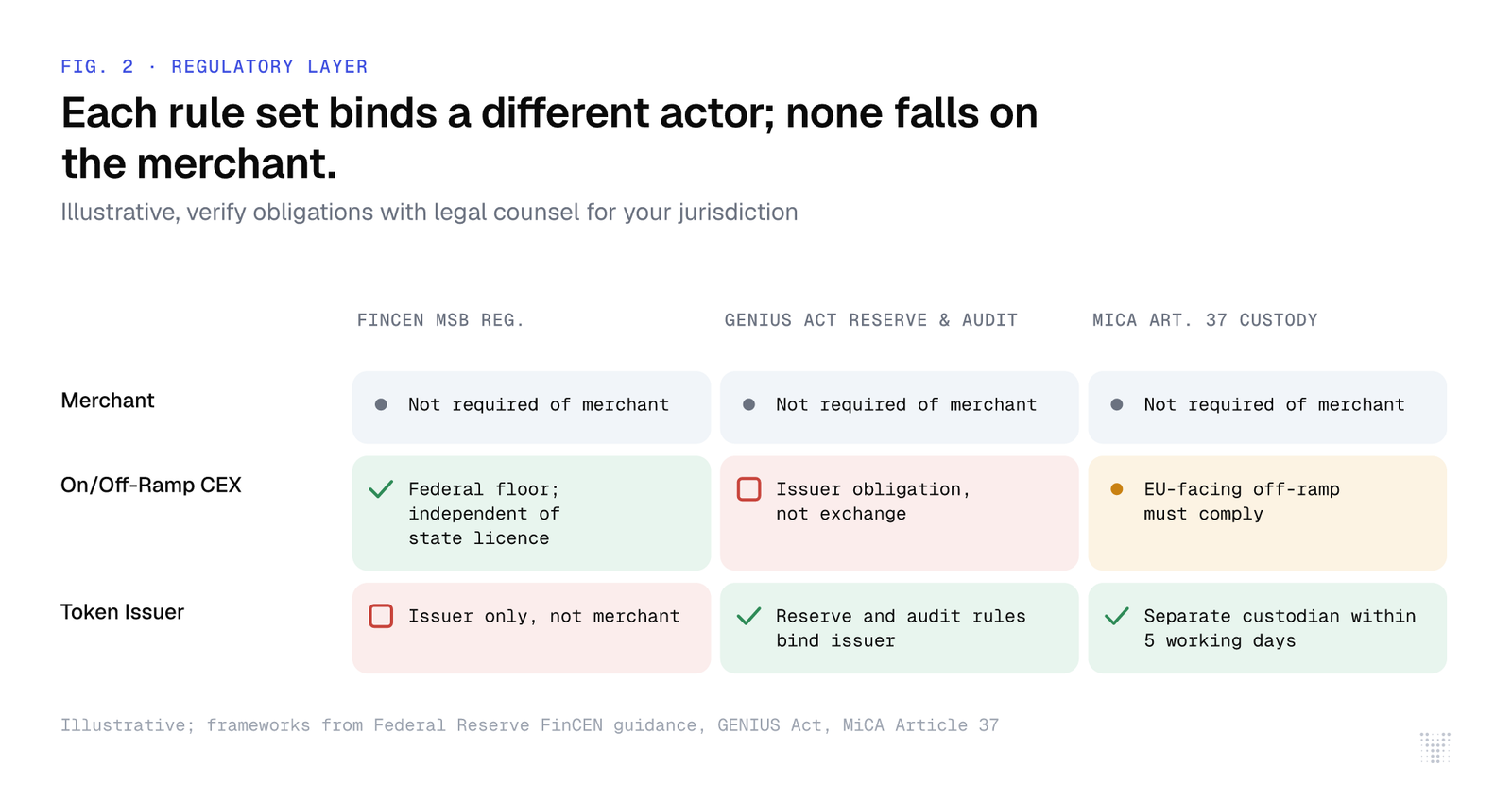
The on-ramp and off-ramp operators face FinCEN MSB registration requirements in the US, according to the Federal Reserve. The token issuer faces the GENIUS Act. According to OCC Bulletin 2026-50, the majority of the GENIUS Act OCC rules sit in a new 12 CFR 15, covering reserve assets, redemption standards, risk management, and audit and supervision requirements. The reserve custodian in the EU faces MiCA Article 37's segregation rules, as cited by the European Securities and Markets Authority.
The merchant's obligation is due diligence: confirm that every counterparty in the chain holds the registrations and licences their role requires. Build that confirmation into onboarding and review it annually. The stablecoins your treasury policy approves should reflect whether the issuer meets GENIUS Act standards and whether the EU off-ramp custodian meets MiCA Article 37's custody requirements.
When the stablecoin rail wins: a decision framework
The rail beats alternatives when corridor, ticket size, and timing all align. Optimize for one dimension and ignore the others and you will misroute payments.
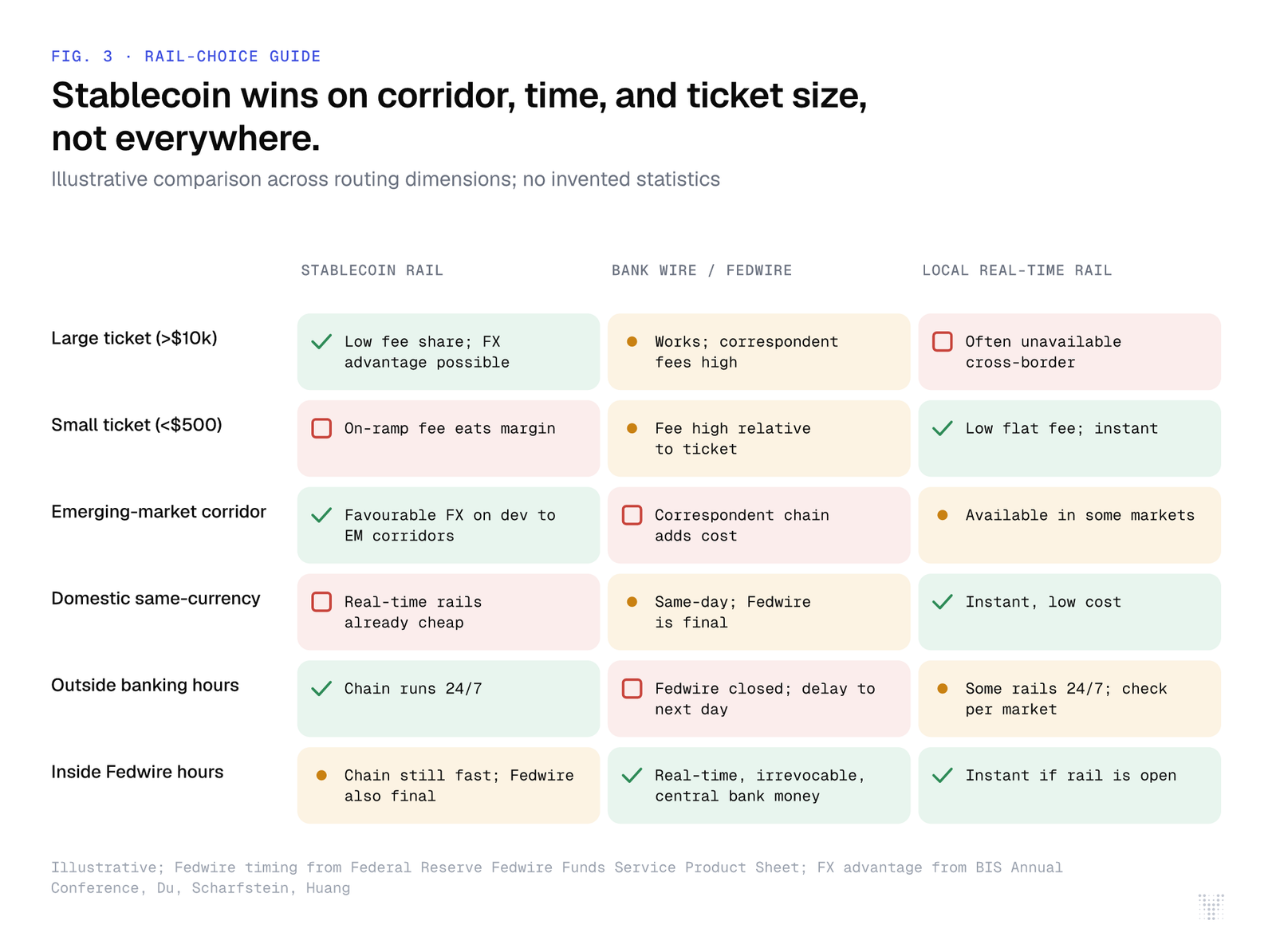
On corridor, BIS Annual Conference research by Du, Scharfstein, and Huang points to developed-market to emerging-market transfers as the clearest advantage. Correspondent banking on those corridors adds intermediary fees and unpredictable timing. A fixed $15 on-ramp fee represents 0.15% of a $10,000 transfer but 3.0% of a $500 transfer. The math favours larger tickets. On time, the rail's 24/7 availability matters most when Fedwire is closed: evenings, weekends, and public holidays, per the Federal Reserve Fedwire Funds Service Product Sheet.
The rail tends to lose on domestic payments with existing low-cost local real-time rails. It loses on small tickets where fixed on-ramp fees dominate, and on corridors with thin off-ramp liquidity.
Worked example: routing a $10,000 supplier payment (hypothetical company)
This section uses a hypothetical company with all assumptions stated. No real company data is used. The purpose is to show the routing logic in arithmetic form.
Assume a hypothetical US-based marketplace, "GlobalParts Co.", pays a supplier in a Southeast Asian market. Ticket: $10,000 USD equivalent. The payment falls on a Saturday afternoon US Eastern time, when Fedwire is closed. Two routes are available:
- Route A: Bank wire via correspondent, settled Monday morning.
- Route B: Stablecoin rail, assumed on-ramp fee of $15 flat, assumed off-ramp FX spread of 0.4%, chain transfer confirmed in under two minutes.
On Route B, the on-ramp fee as a share of the $10,000 ticket is 0.15% (calculated as $15 divided by $10,000, multiplied by 100). The off-ramp FX cost on the assumed 0.4% spread is $40 (calculated as $10,000 multiplied by 0.004). Total stablecoin route cost: $55 (calculated as $15 plus $40). The assumed correspondent wire cost on this corridor is a $25 sender fee plus an assumed intermediary deduction of $30, totalling $55 (calculated as $25 plus $30), plus two business days of float. On Saturday, Route B delivers on the same day under these assumptions instead of Monday, releasing float and meeting the supplier's payment terms. The routing decision favours the stablecoin rail for this ticket, corridor, and time combination.
Change the ticket to $500 and the on-ramp fee rises to 3.0% of the ticket (calculated as $15 divided by $500, multiplied by 100). At that level, the stablecoin rail is unlikely to win on cost. The timing advantage on a weekend may still apply for time-sensitive smaller payments, but the routing decision must weigh cost and timing together at transaction level.
How Yuno routes stablecoins alongside other rails
Stablecoins become a performance tool when they are one routable option among many, evaluated at transaction level. That requires a neutral layer with no stake in which rail wins.
Yuno is the AI-native intelligence system of global payments and financial services. Its Stablecoins module adds the rail as a routable option within the same orchestration layer that handles cards, bank transfers, and local payment methods. Yuno is out of the funds flow: it does not hold, convert, or custody money at any hop. The routing intelligence sits above the rails without owning them. Structural neutrality allows the system to recommend stablecoins when corridor, ticket, and timing favour it. It recommends Fedwire or local real-time rails when they do not.
Merchants seek stablecoin payment platforms for high-volume businesses that settle stablecoins alongside cards and bank transfers. This is stablecoins as one rail in a multi-rail stack, chosen by logic. Yuno connects to 1,000+ payment methods across 190+ countries through one integration, with stablecoins switchable as a configuration, not a rebuild. Rappi and inDrive are among the global platforms running payments across multiple rails and markets through the same layer.
Practitioners should ask: does the platform route stablecoins based on corridor, ticket, and timing data like every other rail? If the stablecoin channel requires a separate integration and separate reporting, operational maintenance costs will erode its corridor advantage. Set-and-forget kills performance on any rail. The stablecoin route that wins today on a given corridor may lose next quarter if a local real-time rail launches or if off-ramp liquidity tightens. Continuous routing review, applied to stablecoins the same way it applies to card acquirers, is what turns the rail into durable performance.
Draw five hops on a whiteboard and mark the custody owner at each. Locate the two FX moments and map each regulatory obligation to the right actor. Then apply the corridor-ticket-time matrix. That sequence is the analytical work that makes stablecoin settlement a finance decision rather than a technology bet.