
Payment Declines in the U.S.: 9 Causes and How to Fix Them

Payment declines are a major source of lost revenue for U.S. ecommerce merchants. Studies suggest that 10-15% of online card payments fail, especially in card-not-present scenarios where fraud pressure is high and issuer rules vary. The fastest ways to reduce declines are:
- Intelligent multi-acquirer routing
- Real-time fallback
- Issuer-friendly data such as network tokens, clean AVS/CVV, and address enrichment
Yuno helps merchants improve authorization rate and reduce failed transactions without checkout changes by using smart routing, enrichment, and fraud-aware optimization.
What Are Payment Declines?
Payment declines happen when an issuer, processor, or payment gateway rejects a card payment, so the customer cannot complete checkout. Declines occur more often in the U.S. because fraud detection systems are stricter in card-not-present flows. Visa outlines many of these decline reasons in its acceptance support documentation.
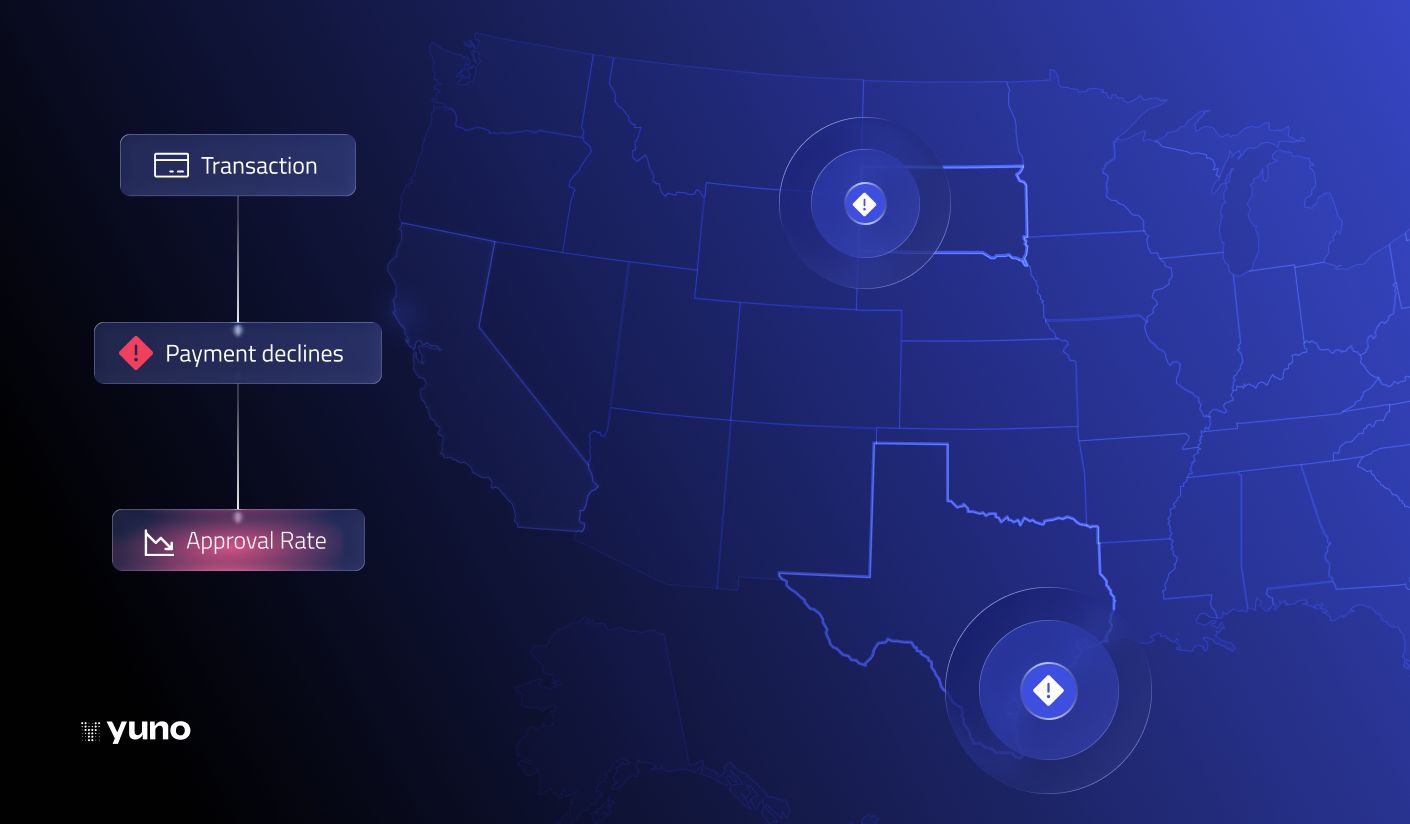
There are two main types of declines:
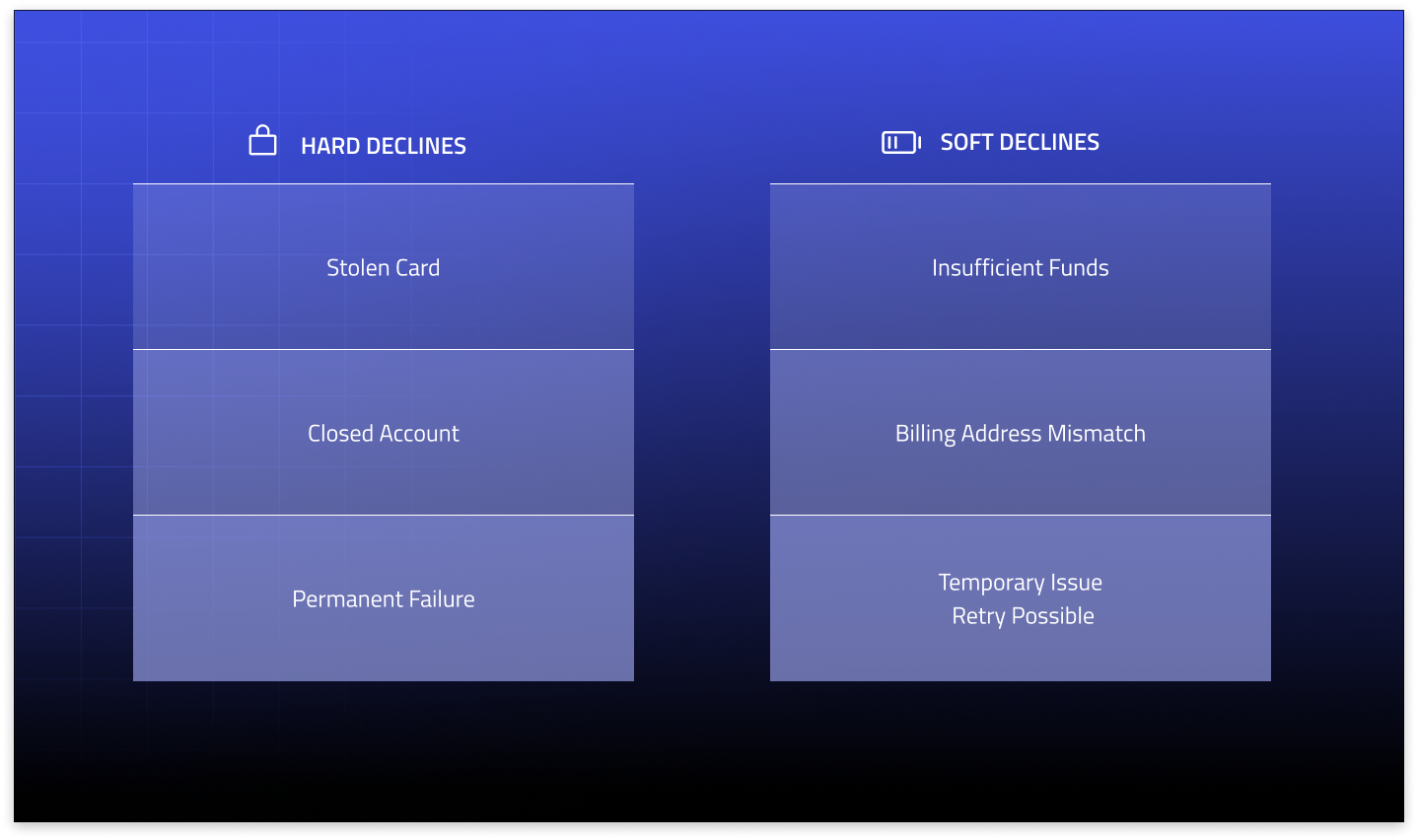
- Hard declines – permanent failures such as stolen cards or closed accounts
- Soft declines – temporary failures due to issues like insufficient funds, timeout, AVS mismatch, or a brief issuer outage
Soft declines offer the biggest recovery opportunity because you can often resolve the issue with retries, better data, or a different routing path. Churnkey explains this well in its primer on soft vs. hard declines.
Approval rates also vary because each financial institution uses different rules, risk models, and technical setups. The U.S. has thousands of issuers, which makes inconsistency common.
Hard vs. Soft Declines
Hard declines are final. If the card is stolen, closed, or invalid, retrying won’t work and may raise risk flags.
Soft declines are temporary. They happen when there’s not enough money that day, the billing address doesn’t match, the network is down, or a false positive triggers. Soft declines often convert into approvals with dynamic retries, updated credentials, or a smarter route to the issuer.
Why U.S. Merchants See More Payment Declines
Fragmented issuer landscape
Thousands of U.S. banks and credit unions apply different scoring rules. This leads to inconsistent success rates and more issuer declines. Checkout.com details this complexity in its guide to U.S. payment performance.
High fraud pressure
The U.S. experiences high levels of card-not-present fraud. Issuers tune models aggressively, which means more good transactions get falsely declined.
Complex processing chain
Gateways, acquirers, card networks, and issuers all introduce points where technical issues and payment failures can occur.
Domestic vs. cross-border routing differences
U.S. issuers often prefer domestic routing. EBANX explains these patterns in its Latin America and U.S. payments report. When cross-border paths are used incorrectly, declines occur more often.
Subscription and recurring payment challenges
Expired cards, insufficient funds, and day-of-month patterns increase failures. FastSpring highlights these trends in its subscription commerce research.
Growing variety of payment options
Cards, ACH, real-time payments, BNPL, and digital wallet flows each send different data elements. More complexity means more room for error.

The 9 Most Common Causes of Payment Declines (and How to Fix Them)
1. Insufficient Funds
A top cause of soft declines. It’s common in recurring payment cycles, where balances vary across paydays.
Fixes:
- Use dynamic retry timing (e.g., payday logic)
- Use partial authorization where supported
- Use clear descriptors so legitimate customers recognize the charge
2. Incorrect or Expired Card Details
Typos and expired cards lead to many failed transactions. Network tokens reduce the problem by keeping credentials current.
Stripe explains this in its guide to network tokenization.
Fixes:
- Tokenization
- Account updater services
3. Issuer Fraud Rules Triggering False Declines
Fraud models often reject good customers when they suspect fraud. These false positive outcomes are costly.
Fixes:
- Intelligent payment routing
- Enriched issuer data
Selective 3DS for high-risk cases
Wenalyze explains how data quality improves approvals in its overview of risk and scoring.
4. Processor or Gateway Outages
Many declines stem from processor downtime or latency spikes, not customer issues.
Fixes:
- Multi-acquirer routing
- Automated fallback based on real-time health signals
Mastercard offers guidance on routing resilience within its developer tools.
5. AVS & CVV Failures
Stricter in the U.S. Incorrect billing address or CVV mismatches often cause soft declines.
Fixes:
- Normalize address fields
- Adjust AVS rules
- Improve fraud-model calibration
Visa outlines AVS patterns here.
.png)
6. Cross-Border Declines
U.S. cardholders are often routed incorrectly across borders, which issuers may distrust.
Fixes:
- Local acquiring
- Domestic routing paths
- Richer transaction context
EBANX describes this issue in its cross-border performance analysis.
7. High-Risk Merchant Category Codes (MCCs)
Travel, gaming, ticketing, and some subscription businesses face stricter issuer checks.
Fixes:
- MCC-specific routing
- Issuer-preference rules
- Clear descriptor formatting
Checkout.com covers MCC behavior in its acceptance guide.
8. Card Network or Issuer Downtime
Network maintenance windows and issuer outages are often invisible to merchants.
Fixes:
- Real-time monitoring
- Instant fallback routing
Mastercard displays system health in its status tools.
9. Poor Payment Data Quality
Missing or inconsistent fields reduce issuer trust and lead to avoidable declines.
Fixes:
- Data enrichment
- Normalized address formats
Clean mappings across all providers
How to Reduce Payment Declines Fast (Top 5 Fixes)
1. Intelligent Payment Routing
Smart routing selects the best acquirer and path for each payment using real-time performance and issuer preferences. It raises approval rate without changing checkout.
2. Multi-Acquirer Setup
Reduces dependency on one provider, improves routing flexibility, and unlocks domestic paths that issuers prefer.
3. Fallback Routing
Instant retries through healthier processors turn many soft declines into approvals.
.png)
4. Network Tokens and Updaters
Tokens keep credentials current even when physical cards change, reducing payment failures.
5. Better Fraud Strategy + Data Enrichment
Cleaner data reduces reduce false declines and stabilizes authorization rate. It also helps issuers avoid mistakenly blocking legitimate customers.
What a Healthy Approval Rate Looks Like in the U.S.
Many merchants target 80%+ approval rate in CNP environments. Best-in-class setups often reach 90%+ using routing, enrichment, and multi-acquirer strategies. Even a 1% uplift can improve the bottom line for merchants processing 100k+ transactions per month.
How Yuno Helps Reduce Payment Declines
Routing engine
Chooses the best acquirer and route based on issuer behavior and real-time metrics.
Multi-acquirer orchestration
Add and manage acquirers through one platform. Reduce dependency risk and improve success rates.
Data enrichment
Clean, complete fields help issuers score transactions correctly.
Fraud-aware routing
Route based on risk context. Apply 3DS only when needed.
Real-time monitoring
Detects outages and triggers fallback paths automatically.
Checkout-agnostic improvements
Optimizations work behind the scenes with no front-end changes.
FAQs
What causes most payment declines?
Insufficient funds, incorrect card data, and issuer fraud checks.
How do I reduce declines?
Use smarter routing, fallback logic, network tokens, and enriched data.
Why are approvals inconsistent?
Issuer rules, processor health, and data quality vary daily.
What’s the difference between soft and hard declines?
Soft declines are temporary. Hard declines are permanent.
Do I need a new provider?
Not always. Many solutions sit above your existing stack.
Conclusion – Reducing Payment Declines Starts With Better Routing
Payment declines cost merchants revenue, customer satisfaction, and growth. The fastest wins come from intelligent routing, multi-acquirer strategies, and issuer-friendly data. Yuno helps enterprise merchants improve approval rate, reduce false declines, and recover failed transactions with a unified, high-performance platform.
More from the Blog
More from the Blog


.png)
Talk with one of our payment experts
Explore how Yuno's innovative payment orchestration solutions can help you increase approval rates, reduce costs, seamlessly integrate over 1,000 global and local payment methods, and simplify payment management.
Yuno is proudly certified to the highest industry standards, ensuring that data is handled with the utmost security and compliance. Its certifications include ISO 27001 and ISO 27701 for information security and privacy management, GDPR compliance for data protection, PCI DSS for secure payment processing, SOC 2 Type 2 for service organization controls, and recognition as a Visa Service provider. These certifications demonstrate Yuno's commitment to delivering trusted and secure services for businesses worldwide.


%20(1)%20(1).png)