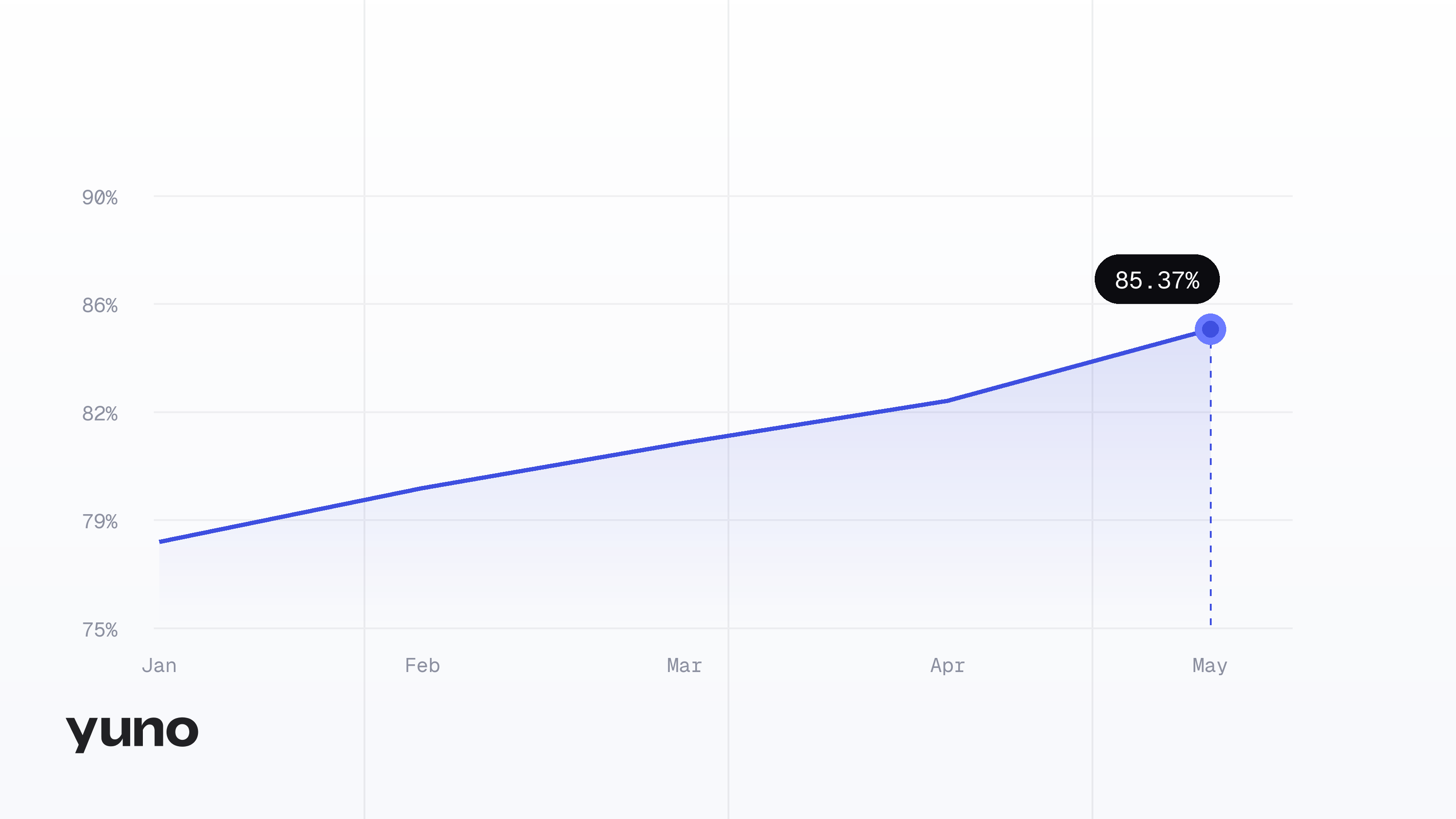
Why your payment approval rate doesn't travel
Payment teams speak about approval rate in the singular, as if the company has one. It doesn't. It has hundreds — one per corridor of issuer, acquirer, method, and market — and the number on the dashboard is just their weighted average.
That average behaves like an anesthetic. It moves slowly, it smooths shocks, and it hides the fact that the newest market — the one the growth plan depends on — is usually running the worst number in the portfolio, invisibly subsidized by mature markets that no longer need the attention.
What happens to a transaction at the border
Issuing banks approve what they recognize. A transaction acquired by a local entity, carrying familiar descriptors, arriving through a domestic BIN, looks like the thousands the issuer approved yesterday. The same card and the same amount, acquired by a foreign entity through an unfamiliar path, scores as risk — and risk gets declined. Nothing about the customer changed. The corridor did.
This is the default physics of cross-border processing. Issuer models are trained on local patterns, and every element that reads as foreign — the acquiring entity, the descriptor, the routing history — pushes the authorization score down. The merchants most exposed are precisely the ones expanding fastest.
The conversion you lose before authorization
A second loss never shows up in approval statistics at all. Every market has payment methods customers treat as the default way to pay. Where those are absent, a share of customers abandons checkout before any issuer gets to decide — a loss that lives in conversion data, not payment data, which is why payment teams systematically underestimate it. Approval rate measures the customers who made it to authorization. It says nothing about the ones who left when they didn't see their method.
Static routing exports your weakest path
The third mechanic is self-inflicted. A stack wired to send all traffic through the acquirer that performs at home sends new-market traffic down the road with the least issuer trust — automatically, on every transaction, until someone rewrites the rule by hand. Adding a local acquirer changes nothing by itself: without a layer deciding per transaction when to use it, the contract is an option nobody exercises.
Read it by corridor, not blended
The diagnostic is simple and rarely run. Break approval out by market, method, and issuer, and look at the spread between your best and worst corridor. That spread — often reaching double digits — is the size of the recoverable opportunity, and it is invisible in the blended number that reports up to the board.
What the fix actually is
The fix is architectural, not contractual. Route each transaction to the path most likely to approve it: domestic acquiring where it exists, the method the market expects, retries that switch provider rather than hammer the same one. And let the routing learn from more than your own history — patterns across an entire network of merchants surface issuer behavior no single company can observe: which paths approve for this BIN, this method, this hour, this market. Platforms routing this way lift in-market approvals by 5 to 11%, with authorization uplift around 8% across portfolios — recovered by making better decisions across the providers already connected, rather than by adding more.
The proof case is public: inDrive, operating across dozens of markets, reached approval rates around 90% and launched new countries in months on exactly this model.
The trade-off
Corridor-level performance means corridor-level moving parts: local entities, more provider relationships, more configuration than a single-acquirer contract. That complexity is real, and the question is who absorbs it — your engineering team, or an orchestration layer built to hold it. What should not be accepted is the silent alternative: paying for the complexity anyway, in declined transactions, spread across every market you enter.
Where Yuno sits in this
Yuno routes every transaction through the path most likely to approve — across 1,000+ payment methods and 460+ integrations in 190+ countries — with automatic fallback when a provider degrades, and decisions made by AI agents learning from every transaction on the network. One integration, local performance everywhere.
Book a demo to see your corridors mapped on real traffic.