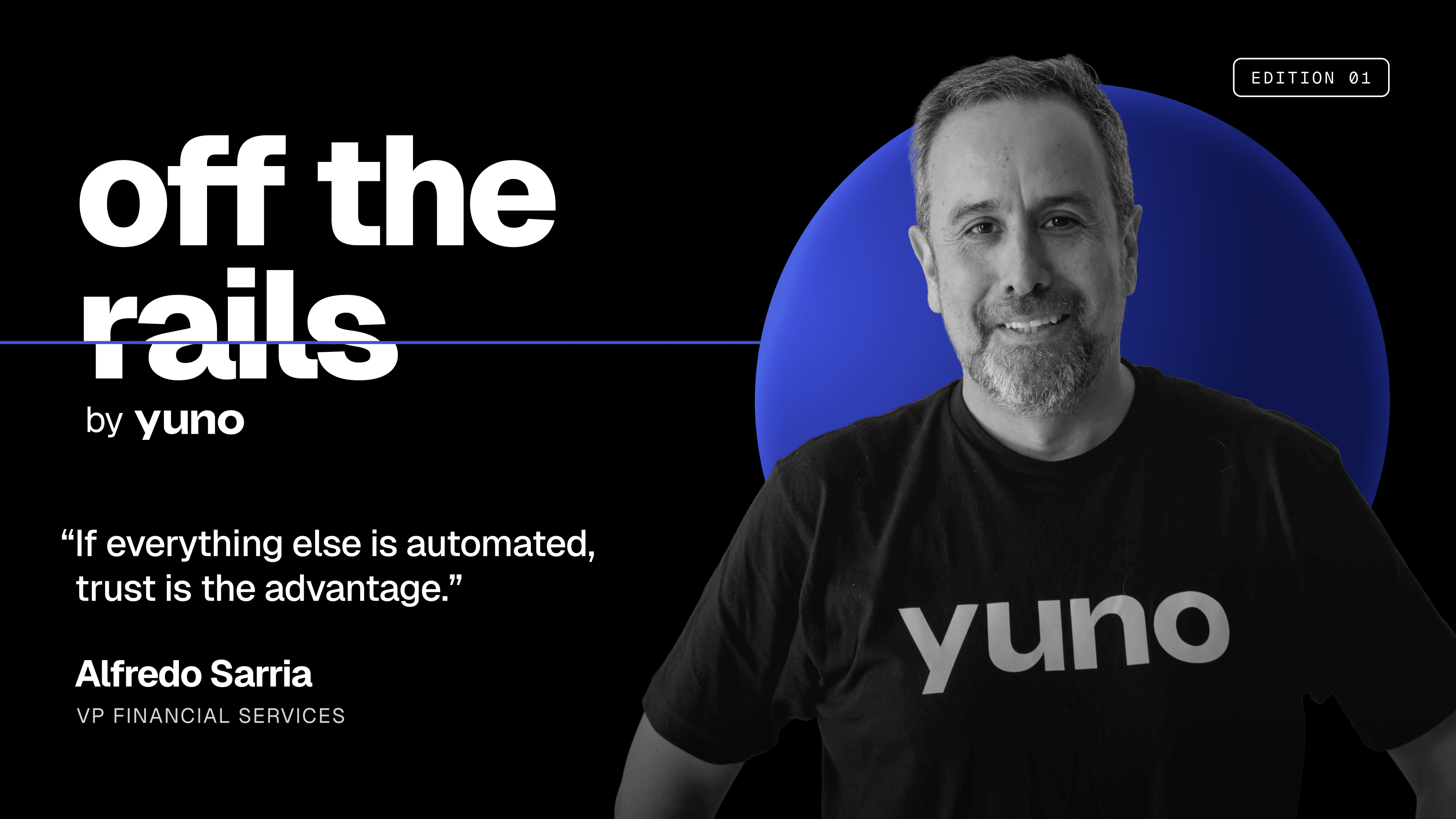
This fall, we're launching Off the Rails, a series that asks the operators, builders and dealmakers behind the world's payment systems to tell us honestly what's working, what's broken and what comes next. First up is Alfredo Sarria, Yuno's VP, Financial Services Sales & BD LATAM.
Alfredo has spent more than two decades on nearly every side of the payments table: building card products at Citi, launching card-issuing and merchant-acquiring businesses at Santander (including a stint in São Paulo), and leading growth strategy across more than ten markets at Mastercard. Along the way, he co-founded a bilingual generative-AI platform years before ChatGPT made the category obvious, and he has taught financial services and marketing to the next generation of operators.
Naturally, we were curious about what twenty years across the table from banks has taught him. But we also wanted to hear how he sees the industry's next turn. In August, Yuno announced a new Banking and Financial Services division for Latin America and the Caribbean, with Alfredo leading the work across the region. It comes at a moment when banks are being pulled in every direction at once: fintechs winning merchants on speed, AI agents starting to shop on customers' behalf, and the world's biggest banks lining up behind digital dollars of their own.
We asked him how AI is changing the way banks buy and sell, what still hasn't changed, and what he expects to see next in Latin America.
Here's Alfredo Sarria on banks, trust and the future of global payments...
Your career has gone from Citi to Santander in São Paulo to Mastercard and now Yuno. How would you explain your job to someone who has never thought about payments?
I build the invisible layer between a financial institution and the payment methods its customers use. When it works, nobody notices and nobody cares. When it doesn't, the bank's client loses a customer.
So what we do at Yuno is this: when someone taps, swipes or clicks to pay, the money finds the best route, the right method and the optimal rail for that transaction. The person never sees it. You don't think about which rail you're paying on. That's the point.
Why it matters: it opens up optionality on payment rails for the clients we serve. For years, many customers learned to pay on cards. Now other methods are taking precedence and becoming more useful, and that helps the end user pay. My clients provide that technology without having to reveal the whole stack.
But I'd say I'm a connector. I listen to understand what pain is holding my clients back. Then I go to my commercial team and my product team, and we build a solution that solves that pain point effectively. That's what I like.
I've learned over time that listening actively is often more important than coming straight to the point with a recommendation. The problems may be similar, but the solutions have nuances, and getting that information is very important.
You were building on OpenAI's models in 2021, before most people had heard of ChatGPT. Has your relationship to AI changed since it became something everyone uses?
It's evolved, and it's going to keep evolving. I was building on AI models before most people knew what an LLM was. Early access to the OpenAI API taught me early on what AI can do.
I was early, and early was humbling. I still keep my coffee mug from that company. We built a generative AI platform that created bilingual content, in English and Spanish, for industries where my co-founder and I had expertise. We assumed enterprise adoption would take a few years. ChatGPT proved us wrong about 18 months later, and it was given away for free.
That wasn't expected. But what it taught me was to build. Can this work? Can I listen to the pain? Can I solve for it? Can I understand what an API is, what a webhook is, how to get GitHub access? In a startup I don't necessarily need to code. But knowing what it takes to get something built is very important when I explain it to my clients, my partners and my team.
The key lesson is about execution: how you deploy it, how you trace it, and how you capture value beyond the hype. There's a lot of hype, as you can imagine. Separating the two matters even more now, because I serve enterprise, highly regulated organizations.
How does Alfredo Sarria use AI day to day?
It's an assistant. A great tool. I see most of the value in two places: a research accelerator and a sparring partner.
Research first. Before a meeting, a conference or a go-to-market push, instead of spending hours reading reports on local payment data and market share, I can get a lot of information condensed and digested. A TL;DR and a path forward on where to focus. Then I spend more time thinking carefully about it. What can I tell? What can I share? What can I build? What can I learn? That has helped me tremendously in preparation. The information has to come from very valid sources.
Second, a sparring partner. I ask it to play devil's advocate. Challenge me. Put yourself in the other person's shoes. Where are they going to push back the most: trust, integrity, economics, build versus buy? That stress-test thinking is of tremendous value.
I don't outsource judgment. I think through scenarios and alternatives and pressure-test them.
Without naming names, have you seen a bank use AI in a way that genuinely surprised you? And is there an experiment you wish more banks would try?
Without naming names, everybody and their mother is talking about optimization, doing more with fewer people. But let me take a step back. AI has been in banks and payments for almost two decades. It used to be called machine learning, and the fraud side of the equation has run on those models for a long time. The layer we talk about now, generative AI, has become mainstream, and it's helping institutions get information ready and condensed.
The experiment I would fund if I had the resources: how a bank can build more stickiness with its clients by becoming the bank that routes every transaction to maximize its corporate clients' approval rates. That creates a kind of retention that's hard to match. If I can give that to corporate clients with big tickets and big value, it can make a bank irreplaceable.
I don't think that exists today. It could be a new category of banking service, and a few institutions are playing with it. It's about doing something really different, instead of only maximizing margins for shareholders, which is important too. It's how you create stickiness for the long run.
You've built your career on understanding what the other side needs in a negotiation. If both sides of a deal start preparing with AI, could you see it making negotiations better, or just faster?
Two or three thoughts. First, on both sides, AI is going to make preparation dramatically better. Not everybody prepares, and not everybody prepares as well, but all else being equal, both sides can arrive prepared. You have that at your disposal.
On the flip side, the room still runs on human clock speed. The silence after the proposal is sent, the lean-forward moment, what's said and what isn't. AI doesn't read that, and I don't think it will for the foreseeable future. Maybe at some point, as AI moves from software into hardware, and we're starting to see that with robots. Until then, execution will need seasoned negotiators who can adapt and course-correct in real time, and know when to slow down.
So there are two sides. AI will make preparation faster. But the speed may still be dictated by whoever has the negotiating power.
How has AI changed the way you sell to banks?
Behind a screen, working from home, it helps you look much smarter, and that's fine. But sit down in person, have a conversation, pound the table: that isn't taught by AI. AI can sharpen it as a sparring partner. The real-world, in-person experience still has a lot of value.
Has it changed the problems banks bring to you, or are their fundamental worries about speed, trust and control the same as they've always been?
What I've seen with banks and financial institutions, whether acquirers, PSPs or wallets, is that they care mainly about three things. Speed. Trust, because they hold funds. And control: control of the data, of their experience, of their flows.
Those three pillars are still there, but they mean something new. Speed might mean an AI-native deployment. Trust can mean auditing AI decisions better and showing the trail as well as the SLAs. Control means banks and financial institutions getting control of the relationship back.
The fourth point I'd add now is AI readiness. Consultancies and investors will arrive with their AI transformation plans, all those buckets and all those agents, and rightly so. But are the institutions ready? Are they looking for validation and a road map that says don't be scared, it's coming but not too fast? Or do they think it's the end of the world as we know it within two weeks? The question is how ready and how adaptable the institution's culture is.
That's different from other transformations, like digital or the move to the cloud, because everybody already uses AI in their daily lives. A head of payments or a head of deposits uses it so often that they go to IT and ask: why can't we be more nimble as an organization? That's an ongoing discussion I'm hearing. The companies that are honestly ready and walk the talk will get ahead of the game and potentially be the winners.
What's the biggest lesson you've learned about selling to banks?
In a previous role, I had a bank in Central America where the lead was an evangelist. He came to our demos, made verbal commitments, and I had it in my forecast. Then silence. Radio silence.
What I learned was that the economic buyer had never been in the room. Never seen a presentation, never heard why this mattered to their P&L. The champion loved it. The person who signed the check never saw it.
There are tons of frameworks in business development and sales, BANT, MEDDIC and other acronyms. Over time I've become a huge fan of MEDDICC. Knowing which letter of that framework is weak in a deal is the art. A champion can be an asset: the person who pushes it across the line and speaks well about you when you're not in the room. Your friend in court. But the economic buyer is very important, and so is knowing how the process works. Is it an RFP? A yearly process? Do you have to become a registered provider first? How many gates are there?
That scar taught me early to be holistic: get information as early as I can, build that discipline and monitor it. I won't have all the answers right away. But my teams have applied that discipline ever since, and it's a Swiss Army knife for moving deals through the pipeline and closing them.
You like making predictions about the industry and then checking them honestly against what happened. What's one prediction you'd make today about AI and payments in Latin America?
My prediction is about the purchase itself. The first AI-native payment product to reach mass adoption in Latin America will look like this: a customer in São Paulo opens WhatsApp or Telegram and says, find me the cheapest flight to Buenos Aires next weekend. The search, the comparison, the booking and the payment for the itinerary all happen in that chat.
I expect that kind of transaction to become common in Latin America within the next couple of years. That's my take. And I see it happening on mobile, less so on a desktop or a laptop. Let's see what happens, but I think our region is pre-built for this trajectory. Instant payments already exist, and people went straight to mobile. The ingredients are on the table. Wiring them together is the part that still needs to be solved: knowing the intent, the security, and what happens if the transaction doesn't go well.
And finally, what's the role of the human relationship in an AI-mediated world of payments?
It still goes back to this. Artificial intelligence can handle the transaction, or a piece of it. The human relationship is still going to handle the trust. If everything else is automated, trust is the advantage.
Trust doesn't get earned overnight. Trust can be lost overnight. But when you build trust, you can pick up the phone, get into the conversation and get your foot in the door to move that business across the line. Long story short: show up in person.