Payment infrastructure is the hidden variable in every market expansion plan. Product and commercial teams finalize the country list, the engineering backlog fills with PSP integrations, and the launch date slips by a quarter. We've seen this pattern consistently across enterprise merchants entering Europe, APAC, and the UK: the market opportunity is clear, but the infrastructure sequencing is wrong from the start.
This post covers how to expand payments new markets without treating each country as a greenfield build. The difference is architecture, not ambition.
Key Takeaways
- Sequencing market entry by provider coverage, not revenue opportunity, cuts average time-to-launch from months to days.
- Smart routing on a neutral orchestration layer delivers an average 8% authorization rate uplift across enterprise merchants (Yuno platform data, 2026).
- Adding a country through a pre-connected orchestration layer requires configuration, not a new integration sprint.
- Compliance sequencing (licensing, data residency, SCA obligations) must run in parallel with provider selection, not after it.
- Real-time monitors with automated rerouting prevent new-market launches from creating revenue exposure during provider instability.
Why Expanding to New Countries Breaks Payment Infrastructure
Every country adds a new intersection of local payment methods, regulatory requirements, and acquirer relationships that a single-PSP setup was never designed to handle. The direct integration model compounds this: each new provider requires its own API work, testing cycle, and operational runbook.
In our integrations across enterprise digital commerce, the average direct PSP integration consumes six to twelve weeks of engineering time. Multiply that by three or four providers per new market, and a two-country expansion becomes a nine-month program. That timeline has nothing to do with market readiness. It is purely a function of infrastructure design.
Three specific failure modes appear in almost every expansion we support. First, merchants under-provision local payment methods. A card-only checkout in the Netherlands misses iDEAL, which handles a majority of online transactions. A card-only checkout in Germany misses SEPA Direct Debit. Local customers do not adapt to the merchant's preferred method; they abandon. Second, merchants over-centralize currency and settlement logic. Running all markets through a single currency pair increases FX exposure and often triggers issuer declines on cross-border transactions. Third, merchants apply home-market fraud rules globally. Thresholds calibrated for one country's fraud profile block legitimate volume in a new market with different spending patterns.
What Platform Architecture Actually Enables Scale
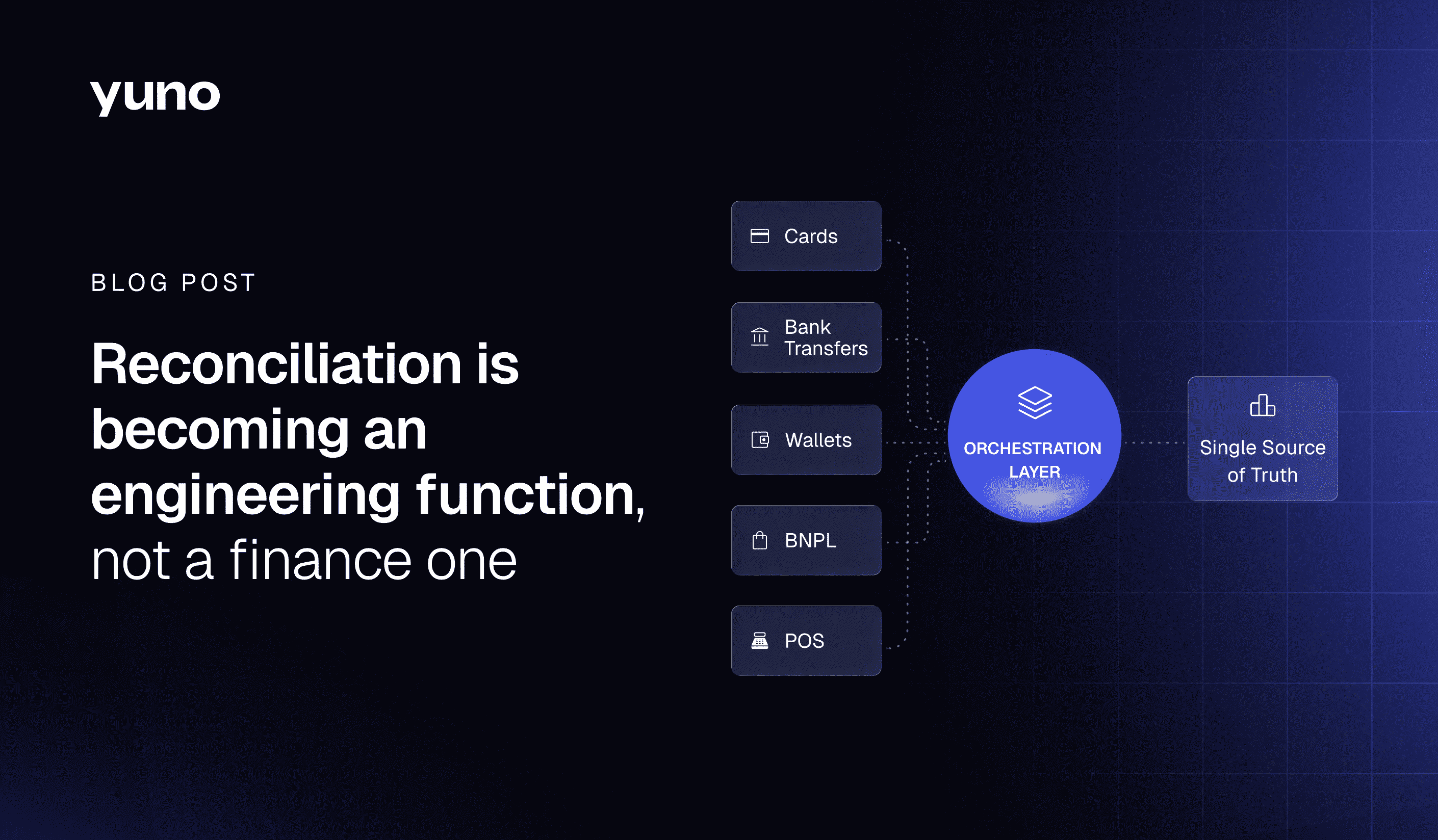
A neutral orchestration layer separates the decision of how money moves from the infrastructure that moves it, letting merchants add countries by configuration rather than construction. This is the architectural shift that determines whether expansion compounds or stalls.
The core mechanism is a pre-built provider network. Yuno's platform connects to 1,000+ payment methods across 200+ countries, meaning the API relationships, credential handling, and response normalization for local providers already exist. When a merchant adds a country, they are selecting from an existing menu of vetted providers, not commissioning new integrations. The engineering team does not touch the expansion.
This matters most for payment method coverage. Activating iDEAL for a Netherlands launch, or Bancontact for Belgium, or UPI rails for India, is a configuration decision on a pre-built connector, not a development project. The same applies to digital wallets like GrabPay in Southeast Asia or M-Pesa integrations in East Africa. Each one ships as configuration.
The second architectural requirement is multi-PSP routing at the transaction level. A single acquirer relationship in a new market creates a single point of failure. If that provider experiences degraded authorization rates, there is no fallback, and revenue loss is invisible until the weekly reporting cycle surfaces it. Based on our infrastructure, merchants running a minimum of two providers per market see meaningfully lower approval rate volatility, because routing logic can shift volume in real time when one provider underperforms.
For merchants evaluating how to structure these provider relationships, the infrastructure decisions behind multi-country payment platforms covers the architectural tradeoffs in detail.
How to Sequence a Country Launch: The Four Stages
A structured launch sequence separates compliance work from technical work and runs them in parallel, cutting the critical path by four to eight weeks versus the typical sequential approach. The four stages are provider selection, compliance verification, routing configuration, and live monitoring.
Stage 1: Provider Selection by Market Coverage
Start with the providers that hold local acquiring licenses in the target country. A global provider operating cross-border in a new market will have lower authorization rates than a locally licensed acquirer. The local issuing banks trust the local acquirer's risk signals more. This is not a minor difference; in markets like Germany or the Netherlands, the gap between local and cross-border authorization rates regularly exceeds five percentage points.
Select a primary provider and at least one fallback. The fallback does not need to be fully optimized on day one. Its role is absorbing volume when the primary degrades, not maximizing approval rates from launch.
Stage 2: Compliance Verification in Parallel
Compliance work begins at the same time as provider selection, not after it. The three checks that cannot be skipped are licensing (does your chosen provider hold the required license or passport in this jurisdiction?), data residency (where is cardholder data stored, and does that comply with local law?), and authentication obligations. In Europe, the European Banking Authority's PSD2 technical standards require Strong Customer Authentication for most card transactions, and the 3DS implementation must meet those standards before go-live (European Banking Authority, PSD2).
Running compliance in parallel with provider selection is the single highest-leverage change most payment teams can make to their expansion timeline. The common mistake is treating compliance as a gate after provider selection, which adds weeks to the critical path for no structural reason.
Stage 3: Routing Configuration and Testing
With providers selected and compliance confirmed, routing logic is configured before any live volume flows. This means defining primary and fallback routing rules, setting retry logic for soft declines, and establishing currency handling for the new market.
Smart routing on Yuno's platform uses transaction-level signals including card BIN, issuer country, payment method, and real-time provider performance to select the optimal route. In a new market with no historical data, the routing engine runs broader allocation across providers, accumulating signal before tightening optimization. Based on our platform data, routing logic typically stabilizes within the first two to four weeks of live volume, after which the average authorization rate uplift reaches 8% (Yuno platform data, 2026).
Testing covers three scenarios before go-live: successful authorization across all configured providers, fallback behavior when a provider returns a soft decline, and currency handling for the target market's local currency.
Stage 4: Live Monitoring and Automated Response
New markets carry higher provider uncertainty than established markets. An acquirer that performs well in sandbox testing can degrade in production due to issuer rules, fraud pattern differences, or technical instability. Real-time monitors with automated rerouting handle this without requiring a 24/7 operations team.
The monitor configuration we recommend for new-market launches includes custom thresholds by country and provider, multi-channel alerts (Slack and email), and automatic traffic rerouting when approval rates fall below the defined threshold. When the provider recovers, the system returns to normal routing without manual intervention. Response time drops from minutes to milliseconds, eliminating the revenue exposure that previously accumulated during manual investigation.
The Routing Logic That Protects Authorization Rates Across Markets
Multi-PSP routing with real-time performance feedback is what separates a payment infrastructure that compounds across markets from one that degrades under geographic complexity. Each new country adds new providers, new issuers, and new decline codes; static routing rules cannot keep up.
We've seen consistent patterns across enterprise merchants expanding into Europe and APAC. The merchants who maintain strong authorization rates across markets share three routing behaviors: they run at least two providers per market, they use transaction-level routing signals rather than static country-level rules, and they monitor provider health in real time with automated fallback.
The neutral layer is critical here. Yuno owns no acquiring rail and sells no payment processing, so routing recommendations carry no conflict of interest. When Yuno's routing engine directs volume to a provider, it does so because that provider has the highest probability of authorization for that specific transaction. A provider-owned stack cannot make this comparison objectively across competitors. Only a neutral layer can.
For merchants already holding acquirer contracts who question whether an orchestration layer adds value, the analysis of what enterprise merchants with existing acquirer contracts gain from orchestration addresses the commercial and technical case directly.
Proof: What This Looks Like in Production
The results from enterprise merchants who have followed this architecture are consistent: more countries, faster, with higher approval rates than the direct integration model produces. The pattern holds across verticals.
A global ride-hailing platform operating across 50+ countries used Yuno's orchestration layer to expand into ten new markets. The platform reached approximately 90% payment approval rates across its markets (Yuno customer data). The key was pre-built provider connections and routing configuration rather than direct integration work. The engineering team did not build a single new PSP integration for those ten countries.
GoFundMe uses Yuno's infrastructure to process donations across multiple markets. The platform requires high authorization rates and broad payment method coverage to avoid donor abandonment at the moment of intent. The orchestration layer handles provider routing and fallback without engineering involvement for each market adjustment.
The common thread is the separation of provider relationships from integration work. When the API layer already holds relationships with local providers, adding a country becomes a configuration decision, not an engineering project. That is Promise One in practice: live in days, not months.
How to Prioritize Which Countries to Add Next
Prioritization should be driven by provider coverage and compliance complexity, not just revenue potential. A high-revenue market with complex licensing requirements and no locally licensed provider in your existing network will take longer and cost more than a mid-tier market where your current provider holds a local license.
The prioritization framework we use across enterprise expansion engagements has four inputs:
- Provider coverage: Does your orchestration layer already have pre-built connectors for the dominant local payment methods in this market?
- Licensing status: Does at least one provider in your network hold a local acquiring license or regulatory passport in this jurisdiction?
- Authentication complexity: Are there SCA or equivalent requirements (PSD2 in Europe, RBI mandates in India) that require specific 3DS configuration before launch?
- Currency and settlement: Can you settle in local currency, or are you relying on cross-border FX conversion that will suppress authorization rates?
Markets where all four inputs are favorable launch in days. Markets where one or two inputs require work launch in weeks. Markets where licensing is unresolved belong in the next quarter's plan, not the current sprint.
The Practical Takeaway for Payment Leaders
The question every Head of Payments faces when the commercial team announces a new country is: how long will this take? With a direct integration model, the honest answer is quarters. With a pre-connected orchestration layer, the honest answer is weeks for complex markets and days for markets your provider network already covers.
The audit that changes that timeline starts with three questions. First, does your current infrastructure hold pre-built connections to local providers in your target markets? Second, can you add a new country without a new engineering sprint? Third, do you have real-time routing and monitoring that protects authorization rates from day one in a new market, not after the first weekly report surfaces a problem?
- Does your current infrastructure hold pre-built connections to local providers in your target markets?
- Can you add a new country without a new engineering sprint?
- Do you have real-time routing and monitoring that protects authorization rates from day one in a new market, not after the first weekly report surfaces a problem?
If any of these answers is no, the infrastructure is the constraint, not the market opportunity. The fix is architecture, and it is a configuration decision, not a rebuild. Yuno's platform connects to 1,000+ payment methods across 200+ countries on a single API (Yuno platform data, 2026). New markets switch on. The stack stays the same.