
Multi-PSP Failover and Smart Routing: How Global Merchants Reduce Declines and Downtime

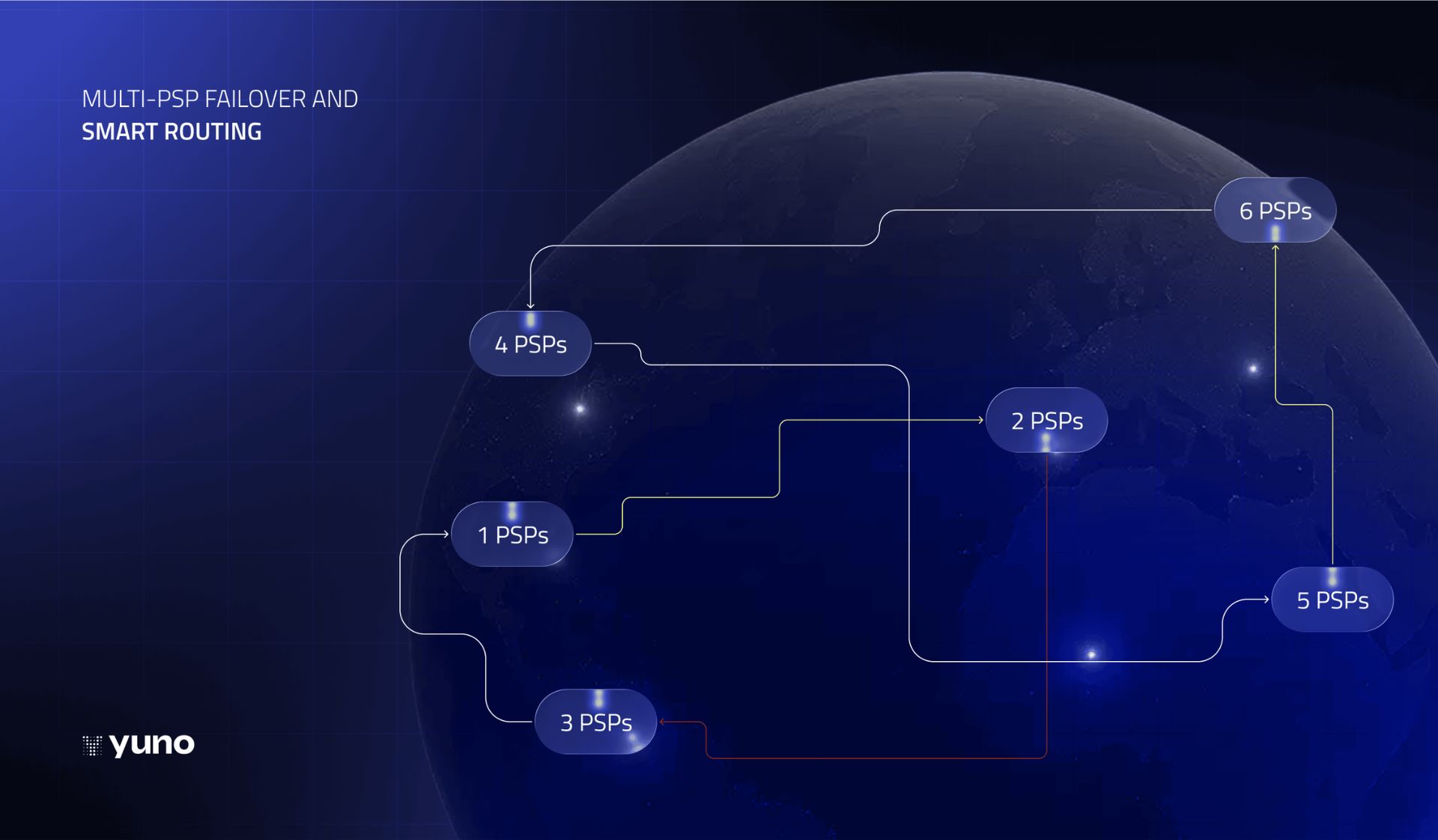
Global payment performance depends on more than having multiple payment providers. Without intelligent routing and automated failover, merchants still face avoidable declines, outages, and lost revenue. This guide explains how multi-PSP failover and smart routing work together to create resilient, high-performing payment operations for global businesses.
What is multi-PSP failover in payments?
Multi-PSP failover is a payment resilience strategy where transactions are automatically rerouted to an alternative payment service provider (PSP) if the primary provider experiences downtime, latency, or elevated decline rates. Instead of relying on a single processor, merchants distribute risk across multiple providers.
This approach ensures that a technical issue, regional outage, or temporary degradation at one PSP does not stop payments from being processed. Failover happens in real time, without customer intervention or manual action from internal teams.
Why is relying on a single PSP risky for global merchants?
Relying on a single PSP creates a single point of failure. Even short disruptions can lead to significant revenue loss during peak traffic, product launches, or regional campaigns.
For global merchants, the risk increases because payment performance varies by geography, issuer behavior, card network, and local regulations. A PSP that performs well in one country may experience higher declines or compliance-related friction in another. Without redundancy, merchants absorb these failures directly.
How does smart payment routing differ from basic failover?
Basic failover reacts after a problem occurs, while smart routing prevents failures before they impact revenue. Smart routing uses performance data, historical outcomes, and real-time signals to decide where each transaction should be sent from the start.
Instead of sending all payments through a default provider, smart routing dynamically selects the optimal route based on criteria such as location, payment method, issuer response patterns, cost, or fraud risk. Failover then acts as a safety net if conditions change mid-transaction.
How do multi-PSP failover and smart routing work together?
Multi-PSP failover and smart routing are complementary layers. Smart routing optimizes each transaction proactively, while failover guarantees continuity when unexpected issues arise.
Together, they create a resilient payment flow where transactions are continuously evaluated and redirected when needed. This combination minimizes both soft declines caused by suboptimal routing and hard failures caused by outages or technical disruptions.
What types of payment issues can smart routing help reduce?
Smart routing can reduce authorization declines caused by issuer preferences, network behavior, or regional processing differences. It also helps mitigate latency-related drop-offs and false declines triggered by rigid routing rules.
By adapting in real time, smart routing improves success rates for card payments, digital wallets, and local payment methods, especially in cross-border and high-volume environments.
How does payment downtime impact business performance?
Payment downtime directly affects revenue, customer trust, and operational efficiency. Even brief interruptions can result in abandoned checkouts, failed subscription renewals, and support escalations.
Beyond immediate revenue loss, repeated payment issues damage brand perception and increase internal workload. Teams are forced into reactive troubleshooting instead of focusing on optimization and growth.
Why is manual failover not sufficient at scale?
Manual failover relies on human detection and intervention, which introduces delays and inconsistency. By the time teams identify an issue and reroute traffic, thousands of transactions may already have failed.
At scale, payments require automated decision-making that operates continuously and instantly. Automated failover removes human latency and ensures consistent execution across all markets and time zones.
How do global payment environments increase routing complexity?
Global payment environments involve multiple currencies, local regulations, issuer behaviors, and preferred payment methods. Each market has unique characteristics that affect authorization rates and processing reliability.
Routing decisions that work in one region may perform poorly in another. Without adaptive logic, merchants either over-route traffic to a single provider or rely on static rules that cannot respond to changing conditions.
What role does real-time monitoring play in failover strategies?
Real-time monitoring detects anomalies such as sudden drops in approval rates, increased latency, or error spikes. These signals trigger automated failover before issues escalate into full outages.
Monitoring ensures that routing decisions remain aligned with current conditions, not outdated assumptions. This feedback loop is essential for maintaining consistent performance across providers and regions.
How does payment orchestration enable multi-PSP failover and smart routing?
Payment orchestration provides a unified layer that connects multiple PSPs, payment methods, and routing logic through a single integration. This abstraction allows merchants to define routing strategies and failover rules without rebuilding their checkout or backend systems.
By centralizing control, orchestration enables dynamic routing, automated retries, and provider switching without increasing engineering complexity or operational risk.
When should merchants consider implementing multi-PSP failover?
Merchants should consider multi-PSP failover when operating across multiple regions, processing high transaction volumes, or experiencing inconsistent authorization rates. It is especially critical for businesses with peak traffic periods, subscription models, or time-sensitive transactions.
As payment operations scale, resilience becomes a requirement rather than an optimization. Multi-PSP failover is a foundational capability for protecting revenue at scale.
More from the Blog
More from the Blog


.png)

Talk with one of our payment experts
Explore how Yuno's innovative payment orchestration solutions can help you increase approval rates, reduce costs, seamlessly integrate over 1,000 global and local payment methods, and simplify payment management.
Yuno is proudly certified to the highest industry standards, ensuring that data is handled with the utmost security and compliance. Its certifications include ISO 27001 and ISO 27701 for information security and privacy management, GDPR compliance for data protection, PCI DSS for secure payment processing, SOC 2 Type 2 for service organization controls, and recognition as a Visa Service provider. These certifications demonstrate Yuno's commitment to delivering trusted and secure services for businesses worldwide.


%20(1)%20(1).png)